
On September the 15th, 24 Year Old Nina Davaluri became the first winner from an Indian background to win the Miss America pageant.
Amidst the cheers of adulation and the small but obnoxious stream of racist remarks directed at the new Miss America, there have been whispers of another kind circulating the internet. Would this ‘dark-skinned’ woman of Indian origin have been able to win, or even enter a beauty pageant in India? As a recent emigrant to Asia, I am glaringly struck by the unfortunate answer.
A week ago, entertaining light-hearted conversation with one of Amman’s thousands of taxi drivers, I responded to the familiar questions about my background. Telling people I’m from Britain always draws the slightly vexing ‘but where are you really from?’ interrogations. After I’ve enlightened the challenger to the fact that I’m half Pakistani, I usually receive some amicable comments to the tune of me being their Muslim sister. This time is different. Said taxi driver quite exactingly and ruthlessly tells me ‘being brown is fine in England, but here we think white girls are more beautiful.’
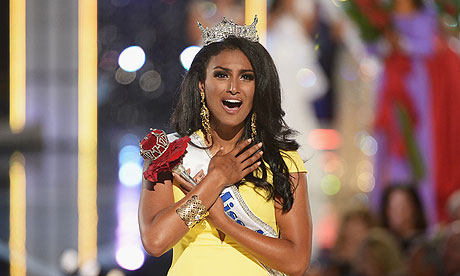
Image credit: Michael Loccisano/Getty Images
Of course, I was not ignorant to the admiration of light skin in the Middle East. Walk into any supermarket or pharmacy and you’ll encounter rows awash with ‘Fair and Lovely’ and other various skin bleaching products. Stepping into a local Carrefour I even noticed that Clean&Clear have brought out their own version called ‘Fairness Cream’. The abhorrence of linking whiter skin to greater beauty may seem blatant to those in the West but years and years of social conditioning along with residual associations of wealth to whiteness have normalised the idea of pale skin’s superiority across much of the World
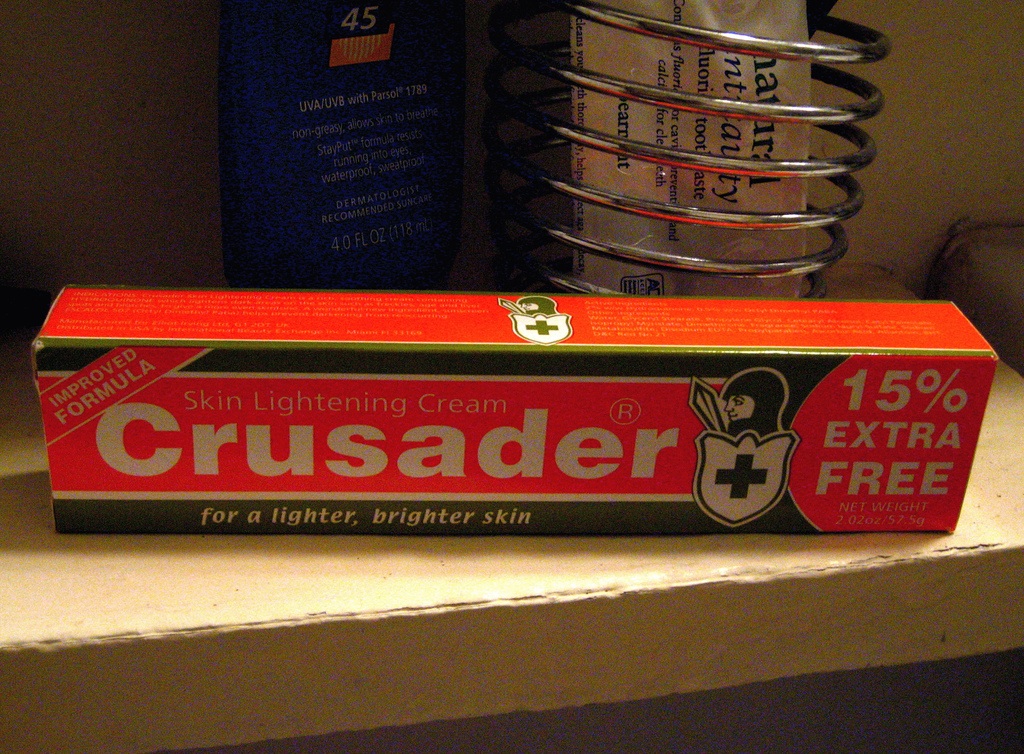
Crusader Skin Lightening Cream. Image credit: cobra libre
In fact, there is even a name for such a phenomenon; colourism. This term describes the discrimination which people face due to their pigmentation – not their race – and it occurs in much of Asia, Africa and Latin America. Some believe it is connected to the subjugation and consequent feelings of inferiority many endured at the hands of their white colonisers. In truth, however, the obsession with fair skin dates back much further; to a time when the well-heeled tended to stay indoors whilst the poorer farm workers developed darker skin tones toiling away outdoors.
In India, the tradition of admiring white skin is engrained even deeper. The millenia-olde caste system places the generally lighter-skinned Brahmins on a pedestal whilst the commonly darker skinned Dalits or ‘untouchables’ exist on the margins of society. Although discrimination on the grounds of caste was outlawed in 1949 it is hardly surprising the remnants of such a society are still prevalent today. Last year a skin lightening wash for genitalia was even launched. It follows that the skin lightening market in India amounts to a hugely lucrative industry, estimated at $432 million dollars in 2010.

An advert for an ‘intimate’ skin bleaching wash in India.
Africa also plays into this light-skinned-beauty obsession, where many have suffered serious consequences as a result of their quest to become whiter. In Nigeria, for example, 77% of women are reported to use skin lightening products and the lack of market regulation has lead many formulations to contain high doses of hydroquinone and mercury. Such concoctions can lead to serious scarring, discolouration and even kidney damage.
Yasmine, half Nigerian and half French, tells me that when she visits her mother’s home country, relatives unsettlingly compliment her on her ‘happy medium’ shade of brown. She puts the fascination with skin lightening in Nigeria down to the rarity of lighter skin tones in the West African state, along with the history of European and Arab colonisation.
Whilst many in Africa and on the Indian sub-continent would go to great lengths to possess an ‘Arab’ shade of brown, the Middle East is far from being untouched by this tragic preoccupation with skin lightening. Flicking between Arab TV channels, it is all too obvious that the stars of screen and stage here are often fair-skinned and green eyed. Naturally olive-skinned Arab women are thus habituated from an early age to the idea that ‘fair is beautiful’ and many will go to great lengths to attain light-skinned complexions.

Nancy Ajram – one of the most popular Arab singers and a beauty icon in the Middle East. Image credit: Chris Jackson/Getty Images Europe
Along with the popularity of skin lightening creams in the Middle East, niqabs, primarily used to protect a woman’s modesty, often serve the second purpose of preventing tanning. In Saudi Arabia, it is common for women to wear gloves, not only to avert gazes, but to ensure that their hands remain pale.
While the West would be quick to denounce these aspirations of acquiring whiter skin, we are not short of our own hypocrisy. In the US, there is the more acceptable face of black; the mixed-race models used on adverts, the beige-toned President and the tendency for ‘black’ female pop artists to come in coffee tones rather than ebony. Hip Hop singer, J.Cole stated last month ‘I might not be as successful if I was dark skinned’ and Jamaican dancehall artist Vybz Kartel controversially released his own line of skin bleaching products for men 2 years ago.
Though some would liken the admiration of lighter skin to Caucasian people’s passion for tanning, it would be misguided to correlate the two. Whilst baking oneself brown in the sun also carries major health risks, it does not often stem from a deep-seated hatred for one’s own natural skin colour. Paler-skinned Caucasians are not faced with ads which tell them they will land a better job, a more handsome husband, or a happier life if they use a particular brand of fake-tan. The tanning phenomenon is only really skin-deep. The roots of the world’s skin lightening obsession extend woefully deeper.
About the Author






amazing article 🙂 Various relatives back in India used to say “so fair, so beautiful” when describing those of paler complexion, and I remember a popular cream in every household we visited that had “will make you fair and beautiful” on its label. I’d always rationalised it by comparing it to the desire to tan in the West, so I found the last paragraphs really powerful and poignant
Interesting article, however I was hoping there would be more discussion on the origins of this East- pale, West-tan dynamic. I was hoping you would mention is the relationship between the poorer classes and sun exposure.
In most societies, including the West in the past, paleness was associated with the upper classes as they were not doing farmwork or outdoor labor like the tanned lower classes. Hence our Victorian imagery of fine ladies in full dress, hat, and parasol on a hot summers day. You can still find old ads for arsenic that women would rub on their skin to lighten it (and slowly poison themselves).
The Western image of tanning only changed with modernization when the lower classes also moved indoors into the factories. Coco Chanel is often associated with the modern correlation between tan and attractiveness in the West. Coming back fresh from a beach vacation on the French Riviera with a tan meant you had the means to take off time from work to bathe in the sun. Today, returning from a cruise in the Mediterranean has the same effect. The Western fad of tanning and its association with status drives women to apply bronzers and self-tanners, or spending hours in a tanning bed while risking sun cancer…
In the East, the association with pale is still connected to the upper classes while darker skin tones are associated with laborers. These associations may change overtime, especially in countries that are developing out of rural agrarian societies and into modern, or post-modern states. However, even in Japan which is post-modern, women will still carry a parasol on a sunny day as if it was Victorian England in 1886. Who knows if even the West will go back to its old fascination with paleness.
Thanks Vedantha. And vwinslow25, I do touch on that in paragraph 5 – ‘In truth, however, the obsession with fair skin dates back much further; to a time when the well-heeled tended to stay indoors whilst the poorer farm workers developed darker skin tones toiling away outdoors.’ This concept obviously still exists in much of the developing world. I feel I could have gone in to much more detail about the issue, as it’s a problem with many facets however I was obviously condensing the main aspects into a relatively short article. I also focused on India, Africa, the US and the Middle East. I could have written more about Latin America and China/ Japan and not only skin lightening creams but plastic surgery. I also didn’t mention the comparison with tanning too much as when I was researching my article I found it was more often than not used as an excuse to justify skin lightening and my aim was to do the opposite.Thank you for your feedback though, you made some very interesting points.
Great article. i am baffled by the fact that things seem to be getting worse, not better, with the relatively greater economic empowerment of women. So glad for the Dark is Beautiful movement — a highly overdue consciousness-raising campaign.
Nadia, I wish you highlighted the extent of ‘fair and lovely’ obsession in India by talking about the presence of creams that promise whiter and brighter private parts…it is sad but true. Also, the dark skin is not just limited to the dalits and the fair skin is not limited to the brahmins…there is a general obsession about being fairer…