
As the Labour party’s annual conference in Brighton draws to a close, here are five things that have been discussed that are worth keeping in mind.
1) A Question Mark over HS2
The Shadow Chancellor Ed Ball’s Speech to the assembled delegates at the Labour conference was quite a crowd pleaser. And while there was no shortage of policy positions put forward (Ball’s used the phrase ‘We Will’ some 31 times in a 40 minute speech) his unexpected announcement that a Labour government would not write a ‘Blank Cheque’ for the development of the High Speed 2 railway line has came as a great surprise to most observers; not least because HS2 was originally a Labour idea.
The shadow chancellor framed this policy shift by explaining that under the Conservative/Liberal-democrat coalition the estimated costs for the project has already risen to £50 billion and that further rises in cost to the taxpayer are likely. A Labour government would therefore hold a review upon the viability of the project as:
But is this announcement really a radical shift?
For some time now within Labour circles, there has already been support for a rethink on the subject of High Speed 2. One former Labour Transport Minister (and Deputy Prime Minister to boot) Lord Prescott has been particularly vocal in expressing his cynicism towards the project, particularly with regards to the promises of economic benefits for the northern regions of the country.
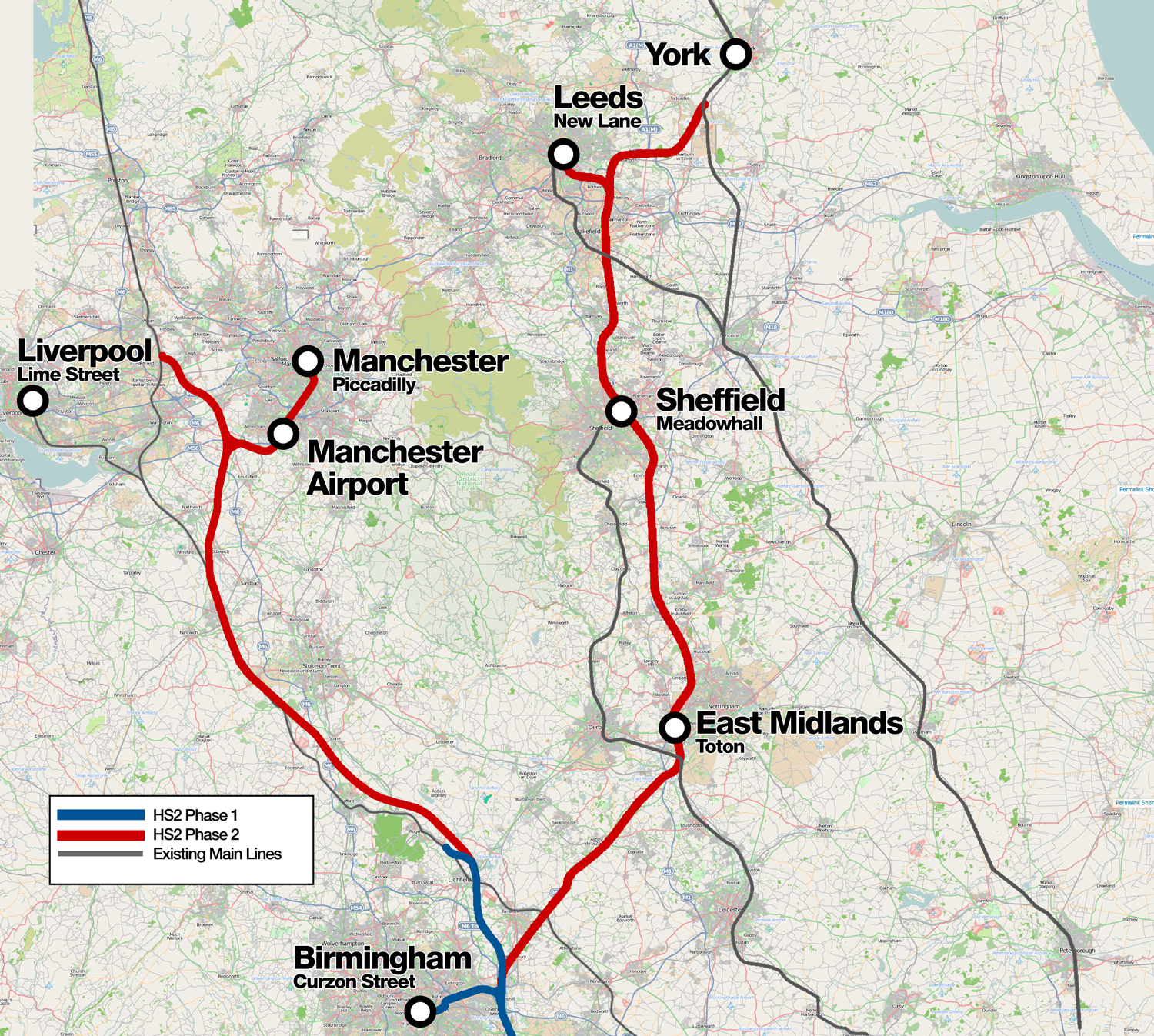
Phase 2 of HS2 High Speed 2 railway in the UK. Image credit: Cnbrb
Mr Ball’s comments should therefore not come as too much of a surprise to those in touch with drivers of party opinion.
Furthermore this commitment to a spending review on a infrastructure project of this scale would go a long way to help sooth public perception about the Labour party as a political entity committed to reckless expenditure; a perception that Mr Ball’s had hinted at in his speech when he announced that he wished to subject all of Labours plans for spending to the Office for Budget Responsibility (OBR) in order that a independent audit may be conducted before the next general election.
Outside of the party however this will read as a different story. There change of tune with regards to the High Speed Rail will differentiate Labour from the Conservatives and Liberal Democrats who will push ahead with the infrastructure spending regardless. If a HS2 review is carefully packaged, then voters in key constituencies on the HS2 Route like Meriden, Warwick & Leamington, Birmingham Yardley, Ealing Central and Acton, all constituencies which swung from Labour in the 2010 General election, may be won back.
We already know from pressure groups like STOP HS2 that some 108,000 are against this project. And if Conservative and Lib-Dem policy on the subject remains ‘yes’ to HS2, then Labour will be able to appeal as the only main stream political party offering voters an alternative route (even if that alternative is a bureaucratic exercise).
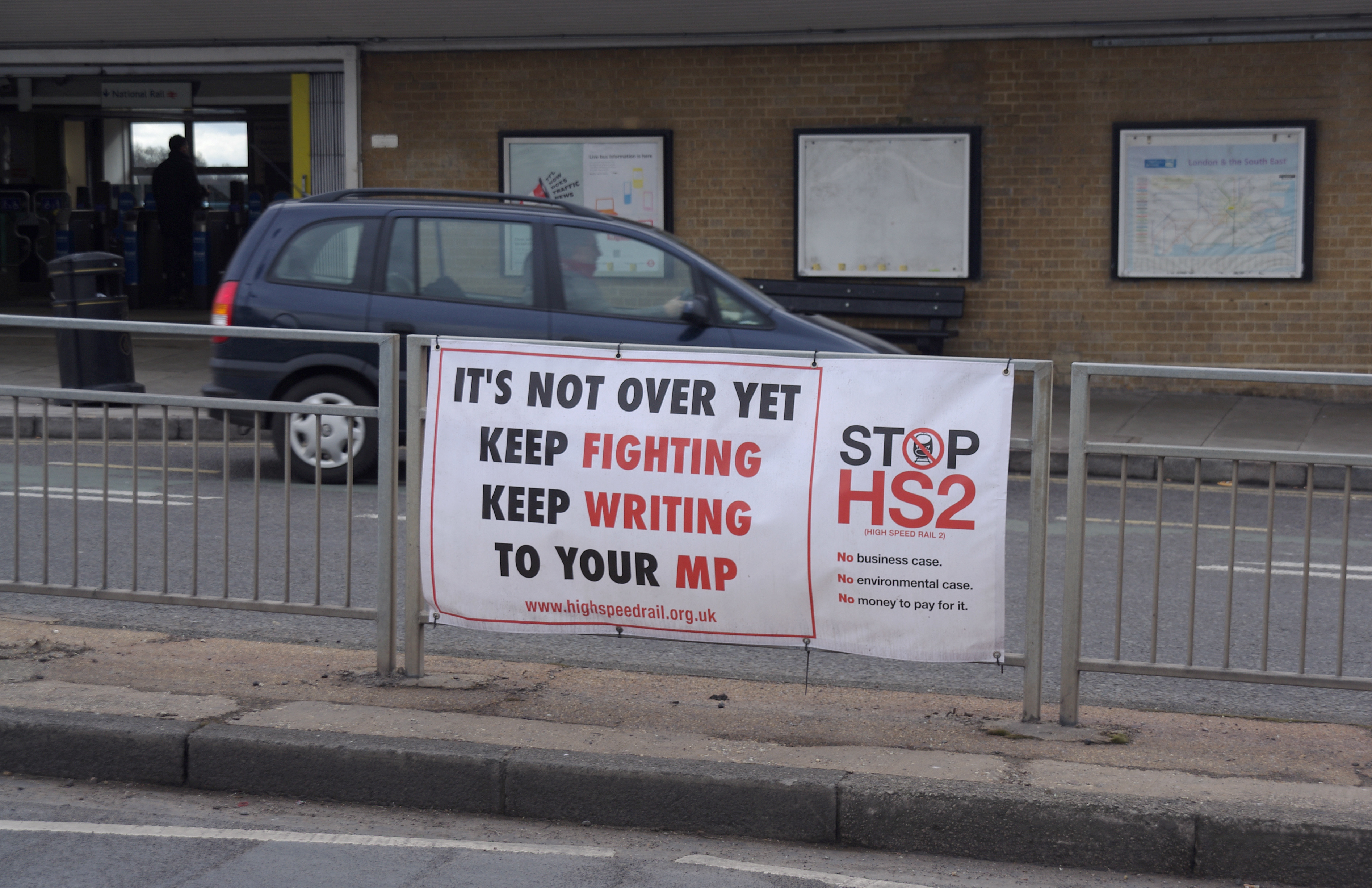
A “Stop HS2” banner outside West Ruislip railway station in London. Image credit: mattbuck
Needless to say, we have not heard the last of the HS2 issue and the debate on the subject will only intensify in the run up to the next general election. So I think it best to leave my thoughts on this subject with a brief word of caution:
A spending review isn’t quite the same as a rethink, or a U-Turn. So as ever the devil will be in the detail.
2) Energy Prices & Better Regulation of the Energy Market
Broadly speaking, when a Party Leader rises to deliver a conference speech you expect something special. You expect to hear something big and something news worthy. There will then follow a polite round of applause before the inevitable wander down to the pub so that hacks like myself can claim that they’d seen it coming.
Ed Milliband’s address to the party conference certainly had its fair share of fireworks, but nothing could have prepared delegates for the lighting blot that was the Labour leaders announcement that a Labour government would pursue the most radical changes to the UK energy industry since the mass privatisation’s undertaken by the Tory government some thirty years ago.
Citing the failure of the conservative party’s ‘Green Deal’, to insulate homes and lower consumer energy bills:
Milliband promised that a Labour government in 2015 would force energy companies to open their books so that for the first time in thirty years consumers would have transparency about the nature of their domestic energy rates.
The Labour leader then went on to propose a new framework under which energy companies would operate and trade together in a pool, eliminating secret price setting. He went on to accuse those in operation now of lacking the moral substance required to operate a public service:
let me spell it out:
“If they own the power station and sell the electricity to themselves, what’s the incentive to keep their prices down, if all it does is reduce their profits?”
And then emboldened by applause the labour leader went further:
“I pledge, we will break up the Big Six. The power stations will be separated from the companies that send you your bill.”
Just as the banks will have to separate their investment and trading arms from the high street branches, so we will make the energy companies separate their production from the companies that supply your home.
To say that this is a bold move by One Nation Labour is an understatement. For thirty years political consensus in Great Britain has been against regulation, against nationalisation, and against state intervention. Since Thatcher became an ‘Ism’ the centre of UK politics has undoubtedly been right, and to challenge this status quo is brave.
However as a young person who will not be putting the heating on for a second winter, and who for the last three years has seen 67.8% of his annual earnings go on rent I am in little doubt that it is not only brave, but the right thing to do.
3) Helping young People into work
We should be in little doubt that the demography most adversely affected by the global financial crisis has been young people. Whether you are British, Greek, or Spanish if you are aged between 16-24 you are more likely to be Unemployed than those older than you.
Because 16-18 year olds cannot vote, and because few 18-24 year olds follow politics, they are somewhat blasé about kicking young people where it hurts, even if they were elected on a promise that they would not do so; Nick Clegg’s infamous U-Turn on Tuition Fee’s is a clear testament to this callous attitude of most politicians towards young people.
Which is why I was happy to hear throughout the Labour conference that speaker after speaker from Rachel Reeves, to Liam Byrne, to the Shadow Chancellor and party Leader all giving a clear message that Labour would not overlook the issue of youth unemployment.
A major highlight of the conference therefore has to be Chuka Umunna, Labour’s Shadow Secretary of Business, Innovation and Skills speech in which he promised that Labour would increase apprenticeship numbers so as to ensure that young people are leaving education with skills that truly prepare them to enter the workforce.
Mr Umunna told the conference that he feared the current Government has increased its usage of apprentice schemes at the expense of quality, inferring that the Coalition’s usage of vocational training had been more about spinning unemployment figures than boosting the UK’s economic potential.
Which is why Umunna explained that a Labour government would change the system so that all apprenticeships are Level three qualifications, which will last a minimum of two years and deliver training that is mutually beneficial for both young persons and British Business.
“Quality apprenticeships for quality jobs…We want people to value their work and we want companies to value their people”.
Umunna then turned his attention to working conditions and reaffirmed that Labour were committed to outlawing the practice of ‘zero hours’ contracts where they exploit people. He stated that Labour continued to believe in a fair day’s pay for a fair day’s work and that labour would seek to empower local authorities and HMRC to prosecute companies who had broken minimum wage laws.
“Bad business practices have no business in a One Nation economy”.
Finally the minister ended with a word about the party’s campaign for a living wage:
“Three principles: good skills; good business, and good jobs. The Labour Party’s values in action”.
http://www.youtube.com/watch?v=pkKczmO5jzc
4) Europe
Labour has been very quiet on the subject of Europe for quite some time. The rise of UKIP into the forefront of the British political imagination has caused problems for all party leaders. David Cameron has experienced some major problems and Nick Clegg has found himself in the bizarre position where as a democrat he is not against the principle of a vote on leaving the EU, whilst also as a democrat he really likes the EU because its Elections are as close to Proportional Representation as his party will ever get.
Labour meanwhile has kept schtum, fearing that this Euromania is actually racism sanitised by an economic crisis. Of course no one in Labour has actually said as much… I mean not since Gordon Brown called some bigot ‘a bigot’ and then lost an election because of it.
Silliness aside EU membership remains a big issue for the party and clear signals were sent out during the conference that Labour would not succumb to this reactionary fad of committing the nation to a European Union membership referendum at great expense to the taxpayer’s wallet and to the nation’s political capital.
In his speech to the conference, Douglas Alexander, Labour’s Shadow Foreign Secretary, reminded the assembly of the Labour Party’s founding principles; seeking social justice within a context of progressive internationalism, arguing that the UK’s role within the European Union was consistent with the pursuit of these values.
Mr Alexander challenged what he characterised as a tendency of the British right to steer towards isolationism, believing that Britain could somehow become a ‘North Atlantic Singapore’. Arguing that in an age of global challenges including financial contagion, climate change and nuclear proliferation, unilateral solutions were no longer a viable option.
The Shadow Foreign Secretary then made the economic case for Europe:
In short Alexander told the assembled delegates that Labour will go into the next General election arguing for reform from within Europe, not exit from Europe.
http://www.youtube.com/watch?v=Akf53QKG364
5) Saving the NHS.
“Let’s give back what these Tories have taken away. Hope….”
If I had to pick a favourite speech from the conference, then I would have to settle for that of the Shadow Health Secretary Andy Burnham. In a masterful performance of oratory Burnham delivered an ardent defence of the National Health Service and passionately argued for change in societal attitudes to social care.
Using a heavily personalised rhetoric, speaking not of patients but of ‘mum and dad’ Andy Burnham’s speech is notable because of the irrefutable cogency with which it was delivered. It spoke to everyone.
The speech was filled with wonderful and saddening phrases like:
“Looking after someone else’s mum or dad is the highest calling a person can answer. But society says it’s the lowest”.
Yet Burnham matched his delivery of these emotionally difficult sections with equally compelling instances of Labour values and policy that brought his speech hope.
“For integration over fragmentation, compassion over competition, people before profits”.
In terms of the political red meat in Burham’s speech his main proposals were to combine both the health and social care budgets into one united fund, to end zero hours contracts for social care workers, to restore safe staffing levels in NHS hospitals, to repeal the 2012 Health & Social Care Act which paves the way for NHS privatisation and to extend to more people the right to end their lives at home.
It was a brave speech, one of courage and conviction which not only resonated because of its message but because it was the quintessence of the conference in its passion, its sense of challenge and its hope.
About the Author





