
On Monday I flew from London Heathrow to Jeddah, Saudi Arabia, a journey I have made countless times. This time around, however, the atmosphere was different. I had chosen to fly during the busiest time of the year in Saudi Arabia, as the country is in the midst of preparations for the hajj season. Before I could be checked in, special calls had to be made to ensure I had the authorisation to enter the Kingdom during this period, despite my protestations that as a resident of Jeddah, I had every right to be on the flight. “I know,” the airline staff member explained to me before handing me my boarding pass, “but it’s hajj season. We have to take extra precautions.”
As our plane pulled onto the tarmac at King Abdulaziz International Airport in Jeddah, the peaks of the special Hajj Terminal rose up in the distance, resembling a sea of bedouin tents. Built separately from the main airport building, the Hajj Terminal was designed to accommodate up to 80,000 pilgrims at any one time, making it one of the world’s largest air terminals. Indeed, organising the hajj is a momentous undertaking. As the fifth pillar of Islam, the hajj is mandatory on all Muslims of able body and means. Drawing upwards of two million pilgrims to the holy cities of Mecca and Medina every year, it is the largest human gathering on earth. The responsibility of overseeing the pilgrimage earns the King of Saudi Arabia the official title of “Custodian of the Two Holy Mosques.”
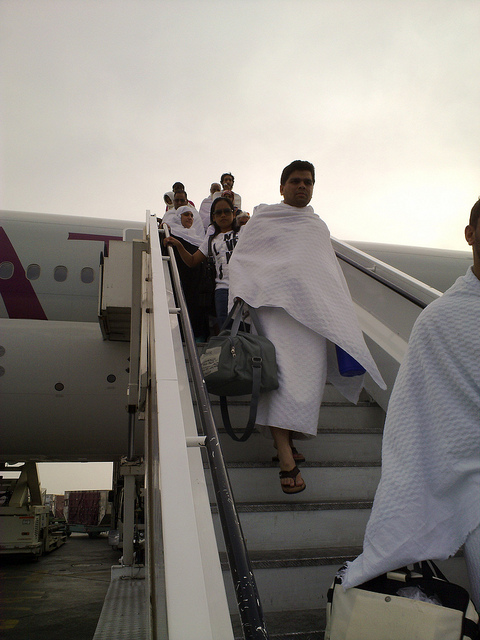
Pilgrims disembark from a plane in Jeddah. A bus will then transport them from here to the special Hajj Terminal, where they are checked for early signs of flu or other illnesses. Image credit: Omar Chatriwala
The hajj has been celebrated as an equalising force, a powerful ritual where Muslims from every corner of the world come together in worship of one God. Pilgrims must all wear the same two pieces of unstitched white cloth, known as ihram, obliterating divisions based on race and class. They are forbidden from quarrelling and cannot harm a living creature, not even a mosquito, while in the state of worship. Malcom X’s famous visit to Mecca in 1964 to perform the hajj was a turning point in his views on race relations.
But developments in the last few decades have caused many to question whether the spirit of equality, so central to the historic and symbolic meaning of the hajj, has been lost. When I performed hajj in 2011, I was profoundly unsettled by the glaring inequalities that were present at all stages of the pilgrimage. Our hajj group, composed of expatriates living in Jeddah, benefited from the luxury of air-conditioned mega-tents, buffet meals, and modern bathroom and shower facilities. Meanwhile, outside the doorstep of our tents, the plains of Mina had transformed into a virtual slum city. Pilgrims slept on salvaged pieces of cardboard and loitered outside of tents in the hopes of securing leftover scraps of food from the dinners being served inside. A foul stench rose up from the communal bathrooms, where pilgrims lined up by the hundreds for their turn. While our group enjoyed the use of the brand-new metro system to shuttle us between the ritual sites, others had to the make hours-long trek on foot beneath the scorching sun.
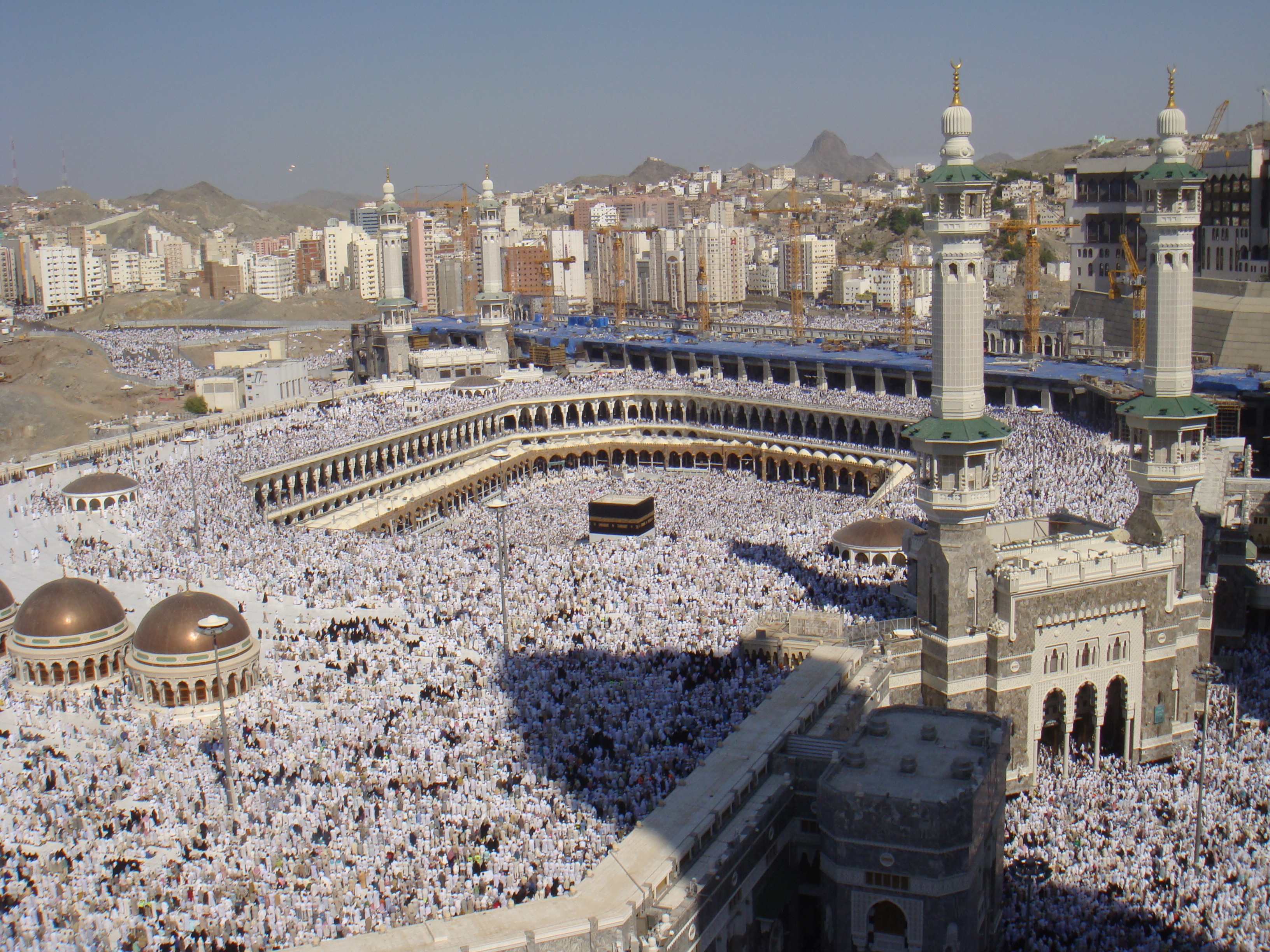
The Kaaba at al-Haram Mosque during the start of Hajj. Image credit: Al Jazeera English
These startling realities point to a deeper truth: the modern-day hajj has become a multi-billion dollar industry. The perimeter of the Grand Mosque in Mecca is now dominated by the Abraj Al-Bait skyscrapers, boasting 5-star hotels, luxury shopping malls and buffet restaurants. A hotel room in one of the towers overlooking the Ka’abah can go for upwards of $700 a night during hajj season, and hajj tour operators run a lucrative business, selling luxury packages offering the ultimate levels of comfort, access to amenities and proximity to all the pilgrimage sites. The cost of going on hajj for international pilgrims has risen exponentially in recent years, making the pilgrimage unaffordable for the vast majority of the world’s Muslims. This has led many to conclude that the holy city has become, as a 2011 article from the Independent put it, a “Mecca for the rich.” Pilgrims who cannot afford the luxury packages are forced to accept sub-standard accommodation miles away from the pilgrimage sites, or attempt the risky undertaking of going on the pilgrimage illegally.
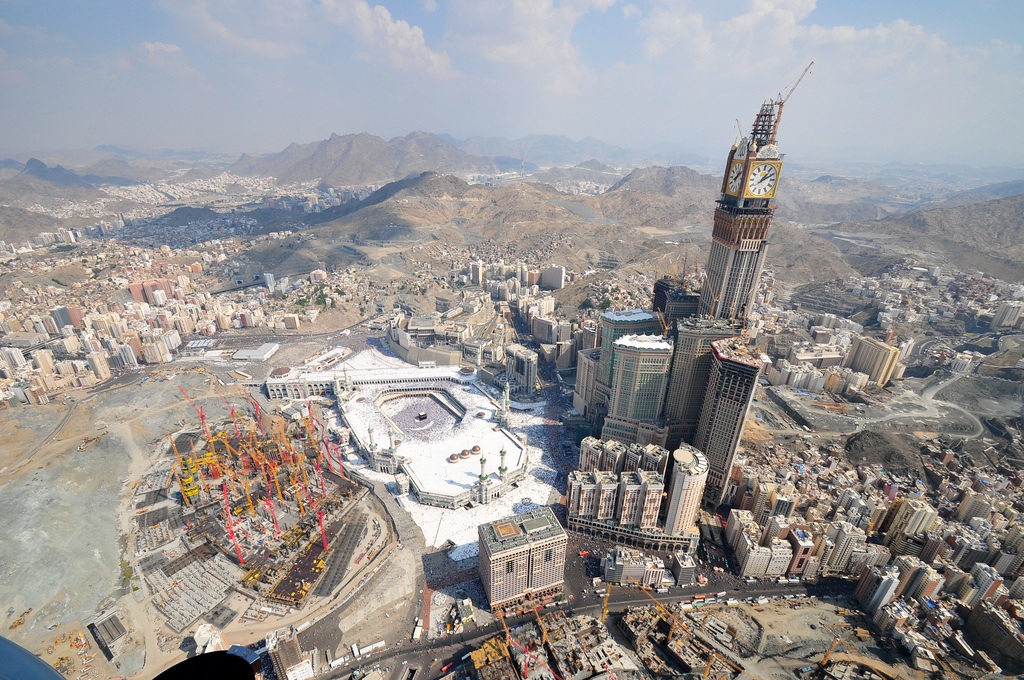
The Abraj Al-Bait skyscrapers. Image credit: Al Jazeera English
If today’s hajj reveals profound class divisions, so too does it accentuate the lines of race and nationality. While the Muslim ummah is often constructed as a transnational community, and Saudi officials routinely call on pilgrims in the run-up to the hajj season to relinquish political divisions amongst themselves, this rhetoric is at odds with the government’s management of the pilgrimage, which continues to reify national divisions. Hajj visas are allocated according to a quota system which varies by country, with the lion’s share of visas going to Gulf nationals. The Saudi government has long used the allocation of visas as a political weapon in its relations with other Muslim countries, with the effect that the hajj has served as a platform where geopolitical rivalries are played out. For example, the Saudi government imposed strict restrictions on the number of pilgrims coming from Iran in the wake of the 1979 Revolution, fearing the spread of political Shi’ism, and again in the 1990s in retaliation for Iran’s suggestion that the administration of the hajj should be placed under the shared control of all Muslim countries. Within pilgrim-sending countries, the distribution of limited spaces within the national quota is subject to the exigencies of internal politics. A greater share of the slots available is awarded to key constituencies as a way of buying political support while politicians and their families are permitted to bypass the lottery system altogether. A country’s hajj delegation therefore becomes a microcosm of existing societal stratifications and power dynamics. This year, quotas will be even more restrictive due to ongoing construction which has reduced the capacity of the Grand Mosque in Mecca, which will only raise the stakes in the game.
There have been other incidents, too, which raise suspicions of ethnic and racial discrimination on the part of the Saudi government. In 2010, the government imposed a blanket ban on Moroccan women from performing the lesser pilgrimage (known as ’umrah) based on weakly substantiated allegations that Moroccan women were using ’umrah visas as a conduit for entering the Kingdom to work as prostitutes. Last year, in a selective application of the law requiring female pilgrims to travel with a male companion, hundreds of Nigerian women en route to the hajj were detained in humiliating conditions at the airport in Jeddah before being deported en masse. These incidents reflect deep-seated fears and stereotypes of African women as potential criminals, in a country struggling with a major illegal immigration problem. Illegal immigrants, who number in the millions in the Kingdom, are blamed for exacerbating the already grave unemployment problem among citizens and legal residents of the country. These tensions come to a head during the hajj, a time of mass migration when many enter the country illegally; an estimated 10 percent of pilgrims overstay their hajj visas.
Incidents like these reflect the problems of an authoritarian state struggling to police its borders and manage mass migration in an increasingly multinational society. But the Saudi government has been entrusted with the responsibility of making the hajj accessible to Muslims around the world, regardless of race, class, ethnicity, gender or sect. As millions of pilgrims converge on Mecca once again this year, let us hope that the hajj can serve as a time for reflection and that its deeper meaning is not forgotten.
About the Author






I live in USA. During summer vacation My family plan to going Umrah. I read rules and regulation and prepare myself. Complete preparation my father told me travelling by Dawn Travel over all tour memorable for me feeling relax I saw KHANAY KHABA and pray a lot.
http://www.dawntravels.com