
The rhetoric has been scaled-back. Potentially embarrassing Congressional votes have been avoided. Multinational conflict has (for now) become an unlikely possibility. In fact, since the chemical arms agreement with Syria was struck, in which they will hand over the chemical weapons they possess, the Western media has fallen silent. Syrian deaths are no longer interesting news – that conflict has run its course as headline-creator. The war isn’t over for the people suffering attacks on a daily basis, nor for the millions of displaced refugees now without homes. One of the greatest humanitarian crises in recent history rumbles on. But as the West turns the page on the Syrian problem, one must ask: who are the winners and losers?
Winners
Vladimir Putin
Putin can stop trying to come across as some kind of reasonable human being – anyone fooled by his New York Times piece should remember this is the man who sent tanks into Georgia in 2009, regularly curbs media freedoms and crushes any form of uprising in his own country. Is it really a surprise he bemoans any apparent attack on state sovereignty? He has called the shots. Further, he has increased his influence on the world stage, from a stubborn, anti-West leader with a veto used to quell any US-led policy, to the champion of small-state sovereignty, the savior of those threatened by Western imperialism under the guise of ‘humanitarian intervention’. Remember, though, that somewhere hidden in all of Putin’s altruism is the fact that The Moscow Times valued Russian investment in Syria at $19.4 billion. Assad is an investment Putin will not let slip.
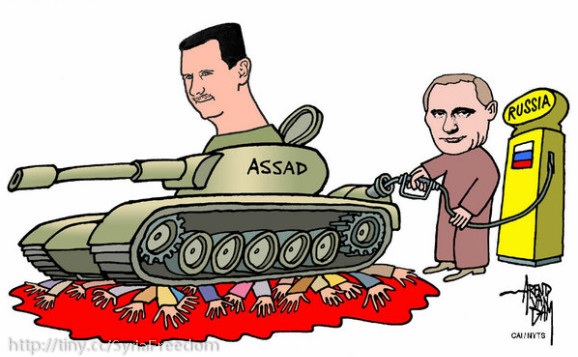
Russia’s Putin is Fulling Assad’s Tanks and Violence. Image credit: Freedom House
Bashar al-Assad
President Assad will have to give up his chemical weapons. However, what he and his friends in Moscow have managed to create is a situation in which he is a key member of the peacekeeping plan. Without Assad, the deal with Syria falls through, or at the very least requires reassessment. Nobody could have envisaged Assad staying in power, even one month ago. Diplomats around the world professed the need for Assad to step aside in order to move on from this brutal conflict. And yet he will stay, and his rule will be legitimised by his dealings with major states on the international scene as this peace process moves forward.
Barack Obama and David Cameron
Perhaps the two biggest proponents of intervention, it seems strange to have them on the ‘winners’ side. Perhaps more apt would be that they have avoided being losers in a situation in which they seemed destined to be so. Obama avoided the embarrassment of what surely would have been a colossal defeat in Congress, and can claim that his actions paved the way for the US-Russian talks that eventually led to an agreement. Cameron did not avoid the embarrassment of losing at his legislature, but since the US will not lead a unilateral invasion of Syria, the media has turned its head away from the conflict, thus Cameron is not constantly reminded of this loss. No American or British troops’ blood will be spilt. No accusations of Iraq-esque regime-change motives can be leveled at the leaders. There will be no worries of aiding terrorists in the rebel cause, something that would surely be a public relations disaster. This is an unlikely win for Obama and Cameron, who seemed to be faced with a lose-lose situation just a few weeks ago.
http://www.youtube.com/watch?v=hfpFNOS2WnY
Losers
Syrian Rebels
Of course there are losers amongst all this winning. The Syrian rebels, who for so long must have been sure they were about to receive help in their battle to overthrow Assad are those losers. They’ll no longer be attacked with chemical weapons, but the hundreds of thousands dead, the millions displaced and many more left to live in constant fear of attack in their communities will tell you chemical weapons are not the problem. War is the problem, and it will not stop when Assad relinquishes his weapons.
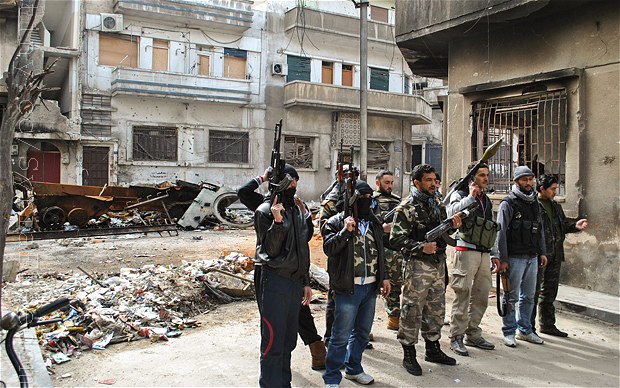
Syrian rebels gather in front of the remains of a burnt military vehicle belonging to Syrian government forces, Homs province. Image credit: + Add
Freedom House
The death toll continues to rise as the rest of the world move on with their lives. The Syrian people affected by this conflict are left to ponder how they have ended up being the only losers in this settlement.
About the Author






You forgot the other 3 losers. Saudi, Israel and erdogan
Hi Max, thanks for posting.
Each has their grievances with the decision not to attack Assad militarily, I agree. However, for two main reasons I declined to comment on these three states (Turkey, as well as Israel and Saudi Arabia).
The first, is that I don’t believe the frustration felt by these parties means that they are at a loss to the extent that the Syrian rebels, and more generally the Syrian people, are.
The second, was that this article was written in an international framework, rather than from a regional point of view. You will notice that the winners are all Security Council members, aside from Assad, who obviously is a major party in any discussion of Syria. Thus, to gain entry into either category, the ‘win’ or ‘loss’ had to be big enough to mean it was a win or a loss on the international stage. I don’t believe that those grievances felt by Turkey, Saudi Arabia or Israel, which generally were simply frustrated that their policy of intervention wasn’t upheld, were big enough to warrant publication in this section. Undoubtedly, an article on the regional implications of the chemical arms deal would have included the three losers you mentioned, though.
Thanks