
Believing in the USA means being an American.
Now I don’t mean that in some kind of romantic metaphor of national citizenship, but more of a belief in what the United States is supposed to represent—whatever that may be for you. These days, any kind of belief in the US can be a scary thing— especially, after everything that has happened this year. Things have not been easy for the United States’ reputation, even if much of it is a result of its own actions. Living in the United Kingdom for the past year, I feel I have some obligation to examine my own patriotism
When I say patriotism (or being a patriot), I mean, to believe in what pushes a nation in a morally superior direction. Like wanting the best four your country, even if it is in direct conflict with its current policies. Patriotism is also a way of forming an identity based on geography of birth. This creates a facet of one’s identity that all people have internalised in their sense of self—not necessarily a bad thing. It is your nationality and consequently part of who you are (in a commonly accepted social-ideology). What somebody choses to accept, is the driving force of belief. What I imagine when I think of the US, might not be what others think about or believe. But in a sense, this is the beauty of patriotism—we all believe in the same thing for different reasons. The acceptance of a national identity instills a sense of pride in its members. You can never escape or change where you are from, even if you change your physical location. To believe in doing what is right, and wanting that from your country of origin, therefore can’t be a truly bad thing—unless it impinges on other’s sense of self.
To think about where I came from is to remember where the city skylines gave way to sprawling suburbs, ranch houses, chain linked and white picket fences. Exits off interstate highways that lead to towns of 15,000 people where everybody almost knows everybody. The kinds of places where you’re likely to bump into at least one person you know, on your morning run or in checkout lines in the grocery store. Having to make conversation, by exchanging platitudes, isn’t required but it’s pretty much expected. For example, “How are your kids, are they still good?” “You know, they’re at that age…” In more recent years, these kinds of conversations have made their way into the local Starbucks on Main Street which now serves the community its daily macchiato and Frappuccino-fix.
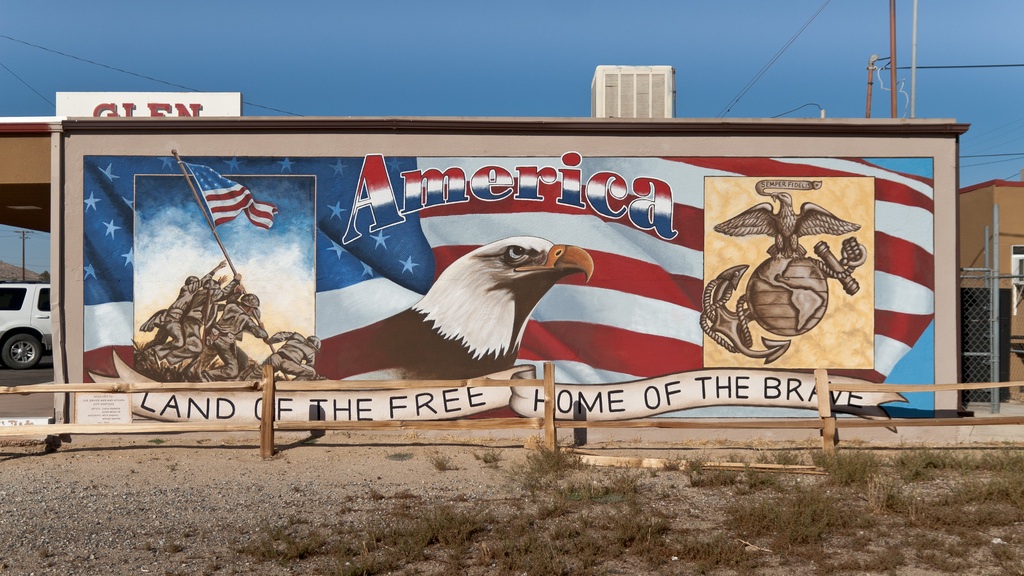
America in a Mural. Image credit: Orin Zebest
In my America, I remember Christmas being a luminous display of decoration and energy consumption. My neighbor, who owned a local flower shop—and whose own garden epitomised floral & fauna beauty— would take an immense amount of pride in his own Christmas display. Stringing lights from every architectural angle and window frame, causing his house (what I assume) from an aerial view, to appear to cast a stationary tower of light in the sky, like one sole spotlight at a movie premier. Neighbors would never think to complain about the amount of light pollution, but rather would speak enviously over dinner tables about where he obtained that nine-foot inflatable, waving Santa Clause. The pièce de résistance of his Noel effluence was a full sized wooden sled atop his roof. This sled had it’s own spotlights and was being drawn by reindeer, who also emitted their own light. His house was just across from the one I grew up in, and I remember being in awe of how he maneuvered a full sled on to his roof every year. Never fully disclosing the semantics behind this annual practice and nobody—what I mean is, “nobody”—seeing him do it. Never answering any question about the practicalities of the sled’s transportation, and always with a defiance of logistics.
“You really out do yourself every year Mr. J— How did you manage to get the slay up there, this year?”
“I told you, Santa left it for me one year.”
(The obvious pitfalls, of Santa’s inability to deliver presents around the world without a sled was never brought into question. Never argue with someone who is referential to Santa without any sense of playful irony.)
The get together they never show you in movies or on TV are easy to imagine, but non-US folks probably don’t. Block parties in the summer time with Dads wearing polo T-shirts and checkered shorts in boating shoes, standing around barbeques, drinking beer from bottles and talking about families, wives, jobs, and/or the latest success/failure of [insert local sports team here]. Moms sipping wine coolers in circles, discussing Sex in the City, school politics, or things about their kids and wearing conservative sun dresses or jean shorts and carrying bowls of coleslaw or potato salad they slaved over. The streets are not cluttered but there always is a group effort to move white plastic tables and police sanctioned-road blockades, if someone needs to move a car in or out of a driveway. There’s some group expectation: nobody ever directly asks if you can help or says, “Could you please move that table, over that way?” but it’s implied that it’s just something that you do.
When a part of America is broadcasted to the rest of the world, it typically reflects some kind of extremism, anything from broadcasts to artistic exports. But certain fanatical imaginations of plots in films, don’t even reflect a belief system, I think my America believes in. I know, I don’t believe that every LAPD detective becomes entangled with drug smuggling diplomats—in the style of Lethal Weapon 2. Or that almost every NYPD cop goes rogue, multiple times in a career for social justice—kind of like the entire Die Hard series. And I would never think of making expedient instructive declaratives like, “Follow that car! And step on it!” to a New York cab driver. (In fact, I find it is much more difficult to hail a cab in New York than depicted in the movies and on TV.) People other than Americans typically imagine these scenes are legitimate. It doesn’t often occur to anyone who uses these snippets as justification that it’s possible there’s more than just what you see through a screen. This is much in the same way some American’s cultural snorkel to the world is through TV, much like the way some parties in both groups will never visit a continent other than their own.
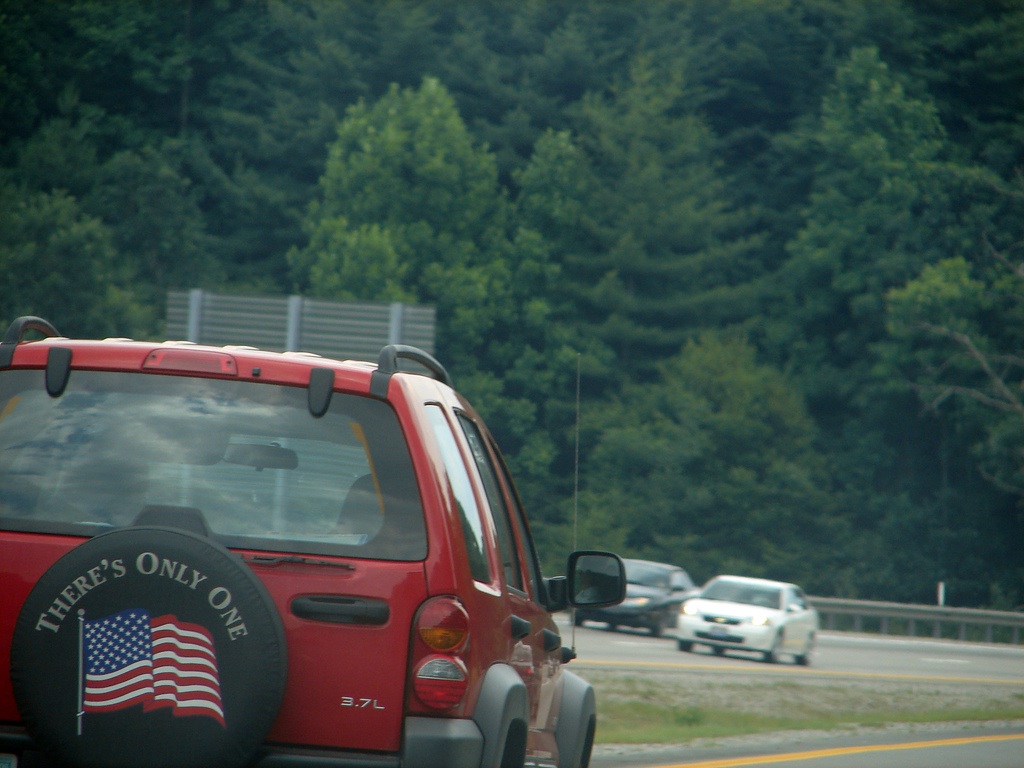
Freeway patriotism. Image credit: Quinn Dombrowski
The cynicism that provides both parties is mutual contempt. The assumptions of both parties are equal part generalisations and marginalisation of entire groups of people. It thereupon emerges that neither of these groups of people really know the other. And thus arises a sense of innocence in not fully understanding. Make no mistake: the innocence isn’t necessarily a bad thing- it is just innocence. A type of ignorance perhaps, that comes without experience.
But it is a progressive sense of alienation I feel from both groups of people, when I feel I have to explain why I still feel an affinity for my home country and am living abroad. My America has a lot of flaws that need explaining as well as fixing, but that belief doesn’t cheapen itself because I am not there. Or that I want the best for a nation of people I feel I am a part of. That is where I believe the true nature of my patriotism arises. The defense of my patriotism, under most circumstances should be justified with, “Hey. It’s where I’m from.” And to be an American and believe in the United States, in today’s world means wanting the best for: Mr. J—, the Moms, Dads in the Polo T-Shirts, New York cab drivers and really, everybody else in the world. Whatever representation the America people hate, wherever they are, it isn’t the one I know and believe in.
About the Author





