
Imagine being beaten, blindfolded, kicked, electrocuted, wrapped in plastic and sexually harassed. For Claudia Medina Tamariz, mother of three, this wasn’t just a nightmare you wake from in the middle of the night. She was a victim of these atrocities when tortured by Mexican marines on 7th of August 2012. She was accused of being part of a criminal gang, possessing arms, grenades, ammunition and smuggling drugs. Claudia denied the accusations and in court all the charges were dropped except one. Up until now, the Mexican government had not investigated Claudia’s torture, and the marines had not been held accountable for what happened.
Thirty years ago this year, the United Nations adopted the Convention against Torture and Other Cruel, Inhuman or Degrading Treatment or Punishment. The Convention is ratified by 155 state parties, including Mexico where Claudia was tortured, and all parties agreed to take effective measures to stop torture within their borders.
This Convention against Torture is being ignored, and torture cases are increasingly common in countries such as Mexico. According to Amnesty International, torture still happens in 141 countries, and in every region of the world. Most torture cases are not properly investigated by authorities and anti-torture laws are not being fully implemented.
Mexico is one of the countries Amnesty will be focusing on for the next two years as part of the Stop Torture campaign. Morocco, Nigeria, Philippines and Uzbekistan will also be under the spotlight. Amnesty campaigned for the creation of the Convention Against Torture 30 years ago and is still fighting for the abolishment of torture today.
Last weekend, Amnesty members and supporters went on an Embassy Crawl around London to deliver a letter about a particular torture case to seven different embassies: Nigeria, Philippines, Mexico, Indonesia, Bahrain, Ethiopia and Iraq. Torture is routine in these seven countries.
Three of these countries (Philippines, Mexico and Iraq) voted in favour of the Universal Declaration of Human Rights in 1948. According to Article 5, they agreed that “no one shall be subjected to torture or to cruel, inhuman or degrading treatment or punishment.” Sadly, governments and authorities didn’t stick to their promises.
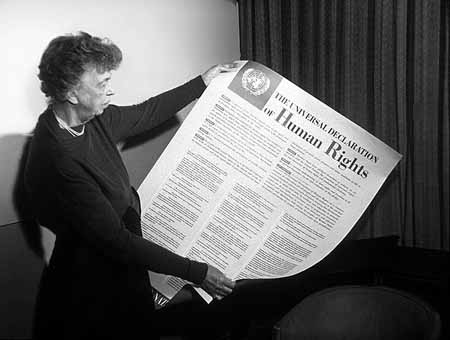
Eleanor Roosevelt and the Universal Declaration. Image Source: Humanium http://www.humanium.org/en/childrens-rights-history/references-on-child-rights/universal-declaration/
When the Amnesty group approached the Philippine embassy, two staff members were seated outside having a cigarette. They didn’t seem bothered that Alfreda Disabarro, a victim of torture, was the reason why a group of activists stopped by the embassy to deliver a letter.
Alfreda was accused of drug dealing on the 3rd of October 2013 in the Philippines. The 32-year-old mother of two said police officers “punched her face and stomach, hit her with a club, poked their fingers into her eyes, slapped her, forced a mop into her mouth and banged her head against a wall.” She was then photographed with 300 Philippine pesos and a sachet of drugs. Alfreda was also told to sign blank sheet of paper.
“He put a bottle on top of my head and aimed his gun at it. I was so afraid I would get shot. I just closed my eyes in fear.” Alfreda Disabarro, Philippines.
Authorities used torture to force Alfreda to confess to a crime she potentially didn’t commit. Even though the Philippines have signed various anti-torture laws, police officers and state security forces have keep using torture to get answers from suspects and prisoners. The same occurs in Nigeria, whose embassy the group also visited to deliver a letter about Moses Akatugba.
Moses was only 16 years-old when he was beaten and tortured by the Nigerian army for stealing three mobile phones and some other items. He was beaten with machetes and batons, hanged, tied up and his nails were pulled out until he signed two confessions. Moses has been in prison for eight long years and is now on death row. On death row, for stealing three mobile phones.
“The pain of torture is unbearable. I never thought I would be alive till this day.” Moses Akatugba, Nigeria.
Moses is not the only one on death row for crimes such as stealing. In Iraq, where the Embassy Crawl ended, 169 civilians have been executed in 2013 alone. Ahmad ‘Amr ‘Abd al-Qadir Muhammad, a Palestinian born in Iraq, was arrested in July 2006 because the authorities believed he was part of an armed group. In May 2011, he was sentenced to death after being tortured and forced to “confess.”
As mentioned before, Iraq signed the UN Conventions against Torture and voted in favour of the Universal Declaration of Human Rights. This document was created to protect civilians but governments and authorities are choosing to ignore it for their own benefit. It is presumably more convenient for these groups to blame innocent people than to attempt to find the ones who are guilty; perhaps believing that torturing, punishing and killing civilians is an effective way to control society.
As you read this, Moses is waiting for his death in Nigeria, while Claudia waits for justice in Mexico. They are the reasons we must make sure the most powerful fear the consequences of their own actions. They are the reasons why torture is a modern-day issue still waiting to be solved. They are the reason why we need to stand up and fight against it.
About the Author





