Whether reading watching or listening to the news, it is likely that there will be a story about a war or conflict somewhere in the world. These reports only begin to scratch the surface of the vast number of conflicts occurring at any one time: right now, it is estimated that there are hundreds of conflicts occurring involving members of more than 450 militia-guerrillas or separatist groups in 60 different countries.
Unfortunately, as repeatedly alluded to in both popular literature as well as philosophical texts, throughout the ages, wars and conflicts seem inevitable and a world without them is unlikely (although, according to some, not impossible). As a result of this, there is need to try to prevent or at the very least restrain the degree of harm caused during these conflicts.
One way of trying to control wars and conflicts is determining which side is ‘just’ in declaring war. This is important as it can influence the extent to which outside observers viewing the conflict will allow harm to be committed by the warring party. The problem with this view is that there is no such thing as an independent, objective arbiter. As can be seen in the ongoing struggle for power in Syria, different members of the international community are providing evidence to promote the idea that the side they are supporting (regime or rebels) has just motivation and therefore has greater justification in committing acts which during peace would be totally unthinkable. The rebels, or certainly the National Coalition for Syrian Revolutionary and Opposition Forces are fighting for a civil, democratic Syria while the regime are supported with arguments for the respect of sovereign states and a defence against western imperialism. It is therefore very difficult, if not impossible to have an obvious ‘good’ and ‘bad’ side and thus laws of war are needed to govern how wars are fought. In the philosophical just war theory, this is called jus in bello.
These jus in bello ‘laws of war’ determine how a war is fought. The problem is that these modern laws of war were devised by a small group of powerful states, mostly European, with the memories of wars involving powerful standing armies (as most wars during the 1800s were) still fresh. The jus in bello they devised which we continue to use today are, unsurprisingly, centred around the idea of sovereign states: this can be seen if in the use of uniform to distinguish between those individuals who are regulated and protected by the laws of war, and those who are not.
Existing laws fail to address the changing face of war. Almost all conflicts today centre around asymmetrical warfare such as guerrilla or covert operations. In Syria, the rebels if forced to face the government forces in an open battle field would suffer large casualties due to inferior weaponry and training. However, by using different techniques the same troops are able to cause significant damages to the Syrians army. Factors such as these mean that “modern combatants look increasingly unlike the army regulars around whem the Geneva conventions were drafted” meaning that it is much harder to separate those individuals liable to be harmed from non-liable individuals. The traditional distinction of combatants and civilians no longer seems so clear cut.
In Syria, both the rebels and the government forces have been accused of killing civilians. The ‘rebels’ recently killed at least 190 non-liable individuals while the Syrian army have been criticised throughout the conflict for targeting civilian populations. These acts have both been greeted with outrage by the international community and, even at a more abstract level; the idea of killing civilians, or non-liable individuals, is frequently dismissed outright. However, as battlegrounds increasingly involve playgrounds and residential streets, it seems difficult to avoid such collateral damage even if attempts have been made by, for example, the Ottawa Convention which banned anti-personnel landmines.
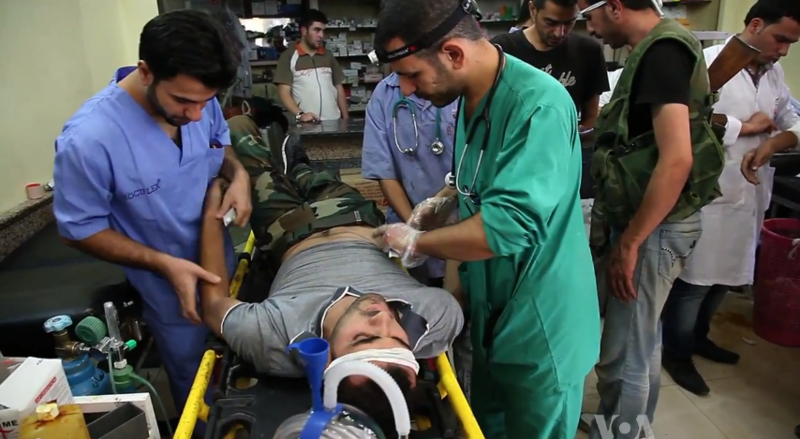
Doctors and medical staff treating injured rebel fighters and civilians in Aleppo. Image credit: Scott Bobb
Even with all of the rhetoric surrounding new and improved weapons which only target combatants, the civilian percentage of those killed in war has risen from between 10 and 15% at the beginning of the 20th Century to 75% at the turn of the 21st. Yet, the laws of war continue to focus on combatants and their actions and largely disregard laws of war governing civilians. The increase in the proportion of non-liable individuals dying in conflicts shows that this attempt to simply reaffirm to combatants that civilians are ‘out of bounds’ is not, and has not worked.
The case of Syria shows that the current international laws of war have failed to keep up with the reality of war. No longer are conflicts fought predominantly by two sovereign nations (if they ever were), nor are the two opposing sides using ‘conventional’ methods of warfare. Finally, the attempt by international law, as seen in documents such as the Geneva Convention, to largely exclude questions of civilian populations (outside of declaring that they are out of bounds as targets) has, potentially, led to greater death and harm of these people. The international community must act to ensure that the laws governing conflicts are no longer outdated and outmoded and in fact guide and restrain modern warring parties to ensure that the harm caused is limited in the highest degree possible.
About the Author