
Urban heat islands (UHI) result from urbanization, seen around the world. As space becomes limited and the needs of people change, further urbanization (urban growth) will occur.
Urbanization removes and replaces natural vegetation (i.e. deforestation) with impervious surfaces and materials with less reflective capabilities. This replacement leads to less evaporative cooling coupled with less reflective surfaces and traps heat in the city. The natural reflective capacity, albedo, is often referenced with regards to the poles reflecting sunlight, helping to keep Earth at a more stable and desirable temperature. Hidalgo et al. (2010) shows that a UHI reaches a maximum heat at night. Furthermore, unless cities are built strictly for public transportation and biking, which is not the case for most large urban areas, cars are needed and these high levels of carbon dioxide assist in trapping heat (EPA, 2008). Urban breezes from nearby forests and agricultural areas are the “natural” way to combat this heat island effect. Noted is that the mechanics of UHI actually provides the source of urban breeze circulation.
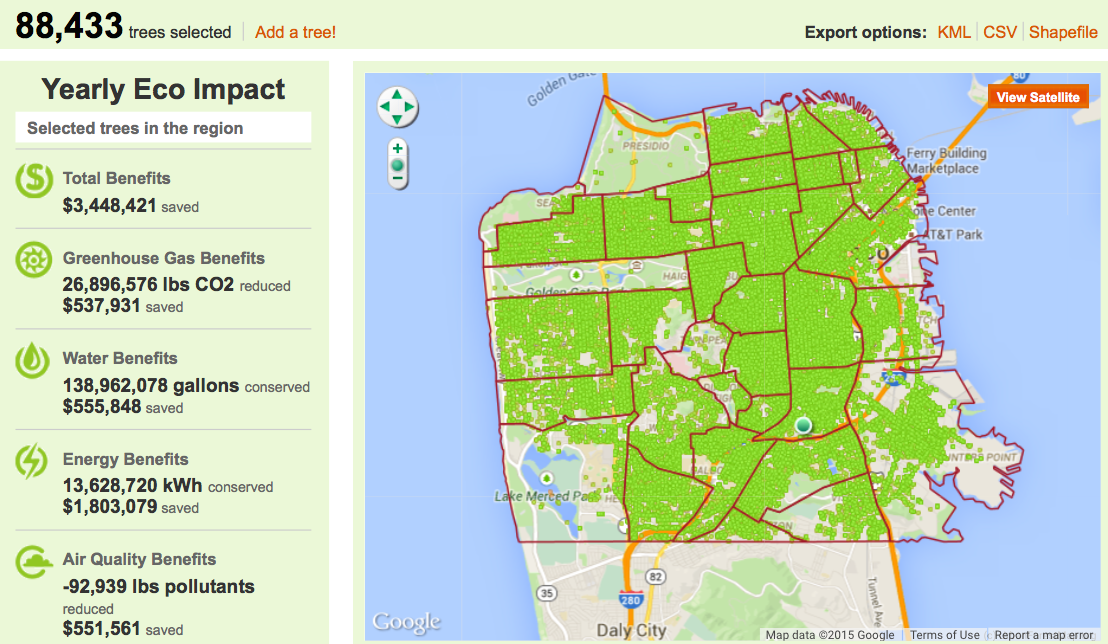
Figure 1: San Francisco, CA; Urban Forest Map. Image Source: http://urbanforestmap.org/map/
The Controversy
UHIs without cyclic urban breezes appear detrimental because of the intense heat however, it has been observed that this heat bubble can actually be beneficial for trees. A study was conducted by Searle et al. (2012) in four different locations in New York that assessed the growth rate of red oaks relative to urban proximity. Keeping variables constant, the red oaks in the city – the Central Park plot – accumulated twice as much aboveground biomass after one year compared to the red oaks of the three non-city sites and by the end of the study were shown to have grown up to eight times faster. An increased growth speed and biomass accumulation has great implications for recently planted and planned trees. With an increase in city growth, the benefits of trees that may normally take fifteen or more years to see, may be realized earlier. However, one inconspicuous paradox is that there would be fewer trees. If we are to increase the number of trees in the urban areas, we would expect the urban breeze cycle to become more regular and effective and thus lose some of the positive effects of intense UHI on tree growth.
Another study on heat islands and tree health was conducted after witnessing an unprecedented increase in insect numbers in a surrounding urban area. The city of Raleigh, North Carolina is getting hotter and the trees are suffering at the proboscises of the Melanaspis tenebricosa also known as the gloomy scale insect. Gloomy scale insects, which have grown 200 times in numbers, are covering and eating more of trees because of the warmer weather (Metcalfe, 2014); an increase in insects with increased temperature is a common ecological occurrence. This heat increase that may help trees grow, is killing the trees by offering better living conditions for predatory insects. I would propose finding trees that have a natural resistance to the gloomy scale insect and planting them to increase canopy cover in the urban areas to facilitate urban breeze consequently lowering the ambient temperatures. The lower temperatures and increased tree-species diversity could potentially combat the new insect problem and UHI.
Increased Non-government Initiatives and Citizen Forestry
The problems have been explained and are becoming more apparent to those most affected – the urban citizens. Two approaches that may help with the UHI issue are to increase vegetation of nearby forests and agricultural areas while simultaneously increasing canopy cover in the urban centers themselves. Increasing forest area and, preferably, non conventional agricultural land are beyond the scope of this discussion, so we move to option two which may be more quickly attained: increasing canopy cover within the city. This would reduce the amount of heat trapped in the city during a 24-hour cycle and depending on species and maintenance, according to recent findings, these city trees would have the potential to grow at tremendous rates because of the current, favorable heat conditions. Unfortunately, the number of trees needed is probably enormous and would scare the faint of heart and yet, urban tree planting is catching fire.
Historically in the United States, government agencies would give money in the form of grants to interest groups and city agencies to plant trees. Unfortunately, funding for urban tree planting has seen a major decline and many cities have cut back on tree planting projects and general maintenance (Levin, 2015). Without the money from the government, how would urban re-forestry survive? Through searches, it is becoming more common for non-government and nonprofit organizations to take the reigns and begin tree planting initiatives that many times, solicit the help of citizens hence the growing citizen forestry sector. The nonprofit Urban Releaf, of the City of Oakland, has planted 20,000 trees since 1998 and is currently in competition to receive part of a $15 million dollar fund offered by Cal-Fire that has been allocated specifically to assist urban forestry in underserved communities (Levin, 2015). This fund is in-line with historic United States however allocating to these specific communities is nuanced. Urban Releaf was founded on the basis that underserved urban communities were being neglected and suffered the most when trees were removed (for a lack of upkeep, accidental removal, etc.). Though this new avenue of funding creates a great opportunity for change, little attention has been given to the tree inventory of Oakland making it difficult for Urban Releaf to gauge where to start and therefore, where to go with their project.
Many domestic cities (and international) have begun to ask citizens to help with this inventory process by offering online mapping tools. Seen in Figure 1 and Figure 2 respectively, San Francisco and Grand Rapids have successful map programs that were started with nonprofit money and initiative but continued with public determination. These programs have progressed, I believe, because the citizens in these urban areas have become more attached to their communities and want to see improvements. Large organizations such as Citizen Forester in Washington D.C. are peaking public interest but smaller organization and projects exist such as the Urban Forest Project in Grand Rapids, headed by Lee Mueller (Aistars, 2014). This smaller, community-based organization approaches the urban forestry movement from the education perspective. When the community is involved and relied on themselves as opposed to outside entities, the connection and sense of responsibility grows.
As urban areas grow, UHI becomes a perpetual man-made phenomenon that fortunately can be sufficiently opposed from simply growing trees.
About the Author





