
‘Syrian citizens were bent over, crumbled to the floor in rubble and crying for the loss they felt from seeing their buildings and monuments destroyed. These brave people had risked their own lives to try to save these sites. But there was nothing they could do. They were being shot at from all angles. This was not Da’esh shooting them, but Assad’s own men’.
A tall academic speaks out and tell this story of the Assad regime to an audience attending the talk from the Director General of UNESCO, Irina Bokova, held at Sciences Po, Paris. His anecdote is a sharp reminder that it is not only groups like ISIS that are set on destroying or looting history’s legacy, but political groups, such as Bashar al-Assad’s army.
Irina Bokova’s appearance at Sciences Po coincides with the launch of UNESCO’s latest programme #Unite4Heritage.
When a video was shared of IS militants destroying priceless artefacts in the Mosul Museum in March 2015 the world began to face up to the reality and scale of damage to antiquities. Since then, we’ve learnt of even more obliteration throughout the Middle Eastern region, including Hatra, Dura Europos, Mari and Nimrud.
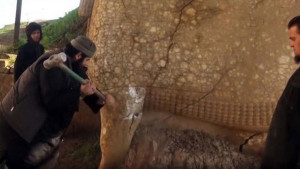
Image Source: http://bit.ly/1OCtevh
If I’m honest, I must admit that I had not heard of the majority of these historical sites. However, a few minutes online researching these structures reveals the extent to which they are foundational buildings within our shared human history. Mesopotamia, which marks modern day Iraq, Kuwait and northern Syria, was where human history really began.
The destruction of monuments and art for religious or political reasons is nothing new. The Byzantine era from the 700AD represents a clear moment in history where iconoclasm was a widely practiced reactionary behaviour against Christianity. What appears as distinctly new is the fact that these acts are occurring within an enormously changed humanitarian context; states are collapsing, art trafficking can occur through diverse international black markets and religious fundamentalism is compelling new actors to participate in the destruction of humanity’s greatest treasures.
Whilst I’m not convinced that a social media campaign like #Unite4Heritage can bring about much change, Bokova explains that #Unite4Heritage is about changing a narrative and explaining why heritage matters for everyone, equally, regardless of where you live and which God you believe in. ‘We are so angry and sad, but we are also mobilised’, she insists. Bokova explains how destroying heritage is the equivalent of destroying an identity, especially in such a fragmented world.
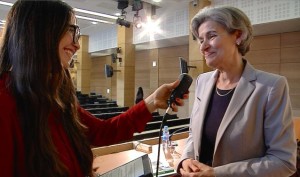
Image Source: http://bit.ly/1Gg0Sb3
For me, the words chosen by Bokova, such as narrative, fragmentation and identity strike me as the kinds used in an university paper, which won’t necessarily mobilise people sufficiently into understanding the urgency in action. Bokova describes the broader cultural efforts being made by UNESCO which mark a show of solidarity with Islam; for example, it is currently publishing conferences and documents celebrating the long and fascinating history of Islam. Moving discourses away from their obsession with fundamentalism is critical, of course. Islam should not be automatically associated with extremism. But I’m not sure how these publications, especially if we admit their narrow reach, or the armchair activism linked to Unite4Heritage, can really bring an international change.
However, I support the coordinated and underlying efforts of UNESCO bringing this discussion to the UN Security Council. It makes sense, especially since it is widely understood that the selling of these artefacts is funding extremism. Framing the destruction of these artefacts in a security paradigm is both a clever and necessary shift instigated by UNESCO, a UN agency which has received its fair share of critique and which is not typically considered to be fast acting or agile humanitarian actor.
UNESCO’s approach reminds us that the fight against fanatics needs more than military action. In order to overcome this kind of extremism and destruction we must look at the growing conflicts of ideas and see how the battle for the minds of people can be won for humanity. Heritage can offer an opportunity for solidarity and unity, however it is clearly difficult to reveal the urgency of UNESCO’s action. In a context of humanitarian emergency, where countless individuals are dying each day in the Middle East, how can the public be made to realise the importance of protecting ancient ruins and statues?
The tall academic who spoke out at towards the end of conference raised a further point. He reminds the audience of the controversial fact that UNESCO admitted Palestine as a Member in 2011. This led to the U.S., in a form of protest, withdrawing its funding of the UN agency. A total sum which represented of 22% of UNESCO’s entire budget. Accordingly, the U.S. promptly lost its voting rights. The academic asks Bokova, ‘Why can’t UNESCO remove Syria’s voting rights or membership as a reaction against the Assad regime’s annihilation of the nation’s cultural heritage?’. The Director General of UNESCO is unable to answer, and swiftly moves the event along.
About the Author





