
The ‘right to privacy’ is, according to the liberal tradition of political philosophers such as John Stuart Mill one of the most important rights for man to be treated as a ‘free, autonomous, and valued individual’ and its necessity is reflected continuously throughout international documentation starting with article 18 of the UN declaration of Human rights and being repeated and reinforced in multiple different binding documents. The growth and spread of this liberally minded belief has spread to a point where now almost every country in the world recognises the right to privacy explicitly in their constitution.
The growth of social media is a phenomenon which has been examined, explored and reflected upon. It is by its very nature threatening the differentiation between public and private spheres which the ‘right to privacy’ relies upon. While widely recognised as a vital area of exploration to protect human rights, not enough is being done at a policy level to address this blurring of boundaries. Instead, policy makers have simply applied the traditional rules governing the right to privacy when it comes to security and privacy of mail, telephones, email and other forms of communication.
This attempt has not been as easy. Much was made of Paul Chambers; who jokingly tweeted about blowing up an airport. The tweet subsequently went viral and he was charged (and found guilty) by the police of sending an ‘electronic communication of a menacing character’. However, he later managed to have this conviction overturned suggesting that the authorities were not sure if he should be allowed to retain his ‘right to privacy’ or whether it was in the states interest to intervene to ensure the prevention of disorder or crime, for the protection of health of morals, or for the protection of the rights and freedoms of others.

Al Murray, Paul Chambers and Stephen Fry outside the High Court at the ‘Twitter Joke Trial’ appeal hearing on on 27 June 2012. Image credit: Paul Clarke.
This example, and many others like it, shows that the traditional and simplistic understanding of privacy no longer fits in a world where the home is no longer solely private and social media allows thoughts and conversation between two people to be broadcast around the world. The idea of a physical public and private sphere to match their respective theoretical spaces no longer exists.
It is also interesting to see that there appears to be a sharp generational divide with regard to opinions concerning privacy and the internet. Younger people are far more willing and relaxed about presenting their private lives to the world while the older generation are much more apprehensive when it comes to social media. A prime example of the loss of concerns from the younger generations are footballers who are frequently pushed into trouble by a throw away comment they posted on twitter which, due to their ‘celebrity’ status goes viral.
The question thus stands as to whether social media is an insurmountable challenge to the traditional understanding of a right to privacy or whether it is possible to continue with the traditional liberal distinction of public and private realms.
The state, and policy makers are being left behind even as they create and attempt to utilise, with various degrees of success, new forms of media to access the electorate. What is integral for future work is some form of regulation and thus a regulatory body to remove social media from a frontier free for all.
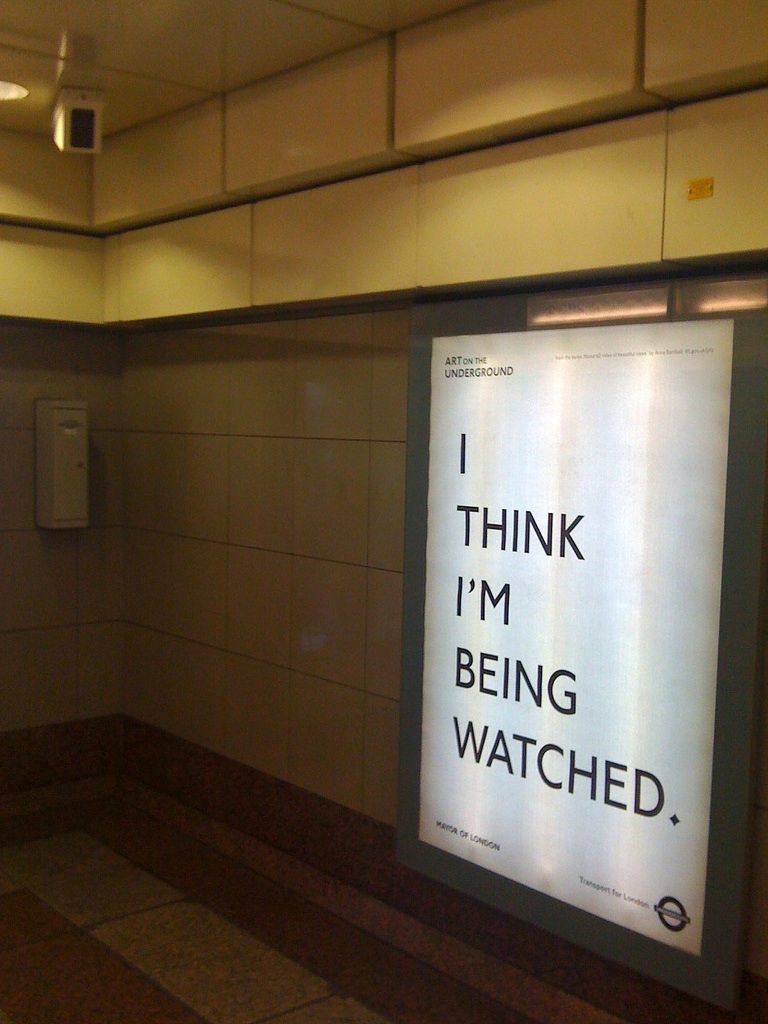
I think I’m being watched. Image credit: Chris Applegate
The difficulty of determining a balance is exacerbated by the generational gap regarding ‘acceptable’ degrees of publicisation. This fear of the grey vote may be one of the reasons that governments have been keen to continue with the traditional understanding of the right to privacy. However, it is time to be bold and to provide clear boundaries even if getting this ‘right’ is impossible. Therefore, even if the guidelines are held by some as placing the boundaries of public and private in the wrong place or restricting freedom of expression to much (or not enough) it is still better to have them than not.
National level regulation will always be problematic with things like the internet where regulation can be avoided by re-locating elsewhere. However, as can be seen in extreme cases of internet control, and in other areas such as taxation, there is the possibility that governments can successfully regulate within national boundaries.
There will always be controversy due to a general disagreement concerning the point (if there is one) and power of the internet but the key is to create a set of guidelines which can be followed. While undoubtedly railed against by some members of the public it is only through this, and further debate, that change and adaptation to a more rounded coherent regulation of social media can occur.
In order to maintain the current emphasis and importance of the ‘right to privacy’, action must be taken with regard to social media. Social media is a new frontier, if governments do not want to be left behind then they must be innovative and ensure that the individual is protected, the public educated, and privacy permitted.
About the Author