
Early in November, the European Association of Lawyers for Democracy and World Human Rights (ELDH) and the European Democratic Lawyers (EDL), published their “Motion regarding the situation of Lawyers and Human Rights defenders in the Basque Country”, in the context of the Basque Country’s on-going struggle for independence. It’s a call for attention to the continuing mistreatment of human rights workers, lawyers, and political activists in the Northern Spanish region.
The motion follows a new peak of commotion in the Basque Country. On 30 September, 18 people were arrested when authorities were looking into Herrira, a human rights organisation concerned with the rights of political prisoners and exiles.
It’s been just over two years since ETA announced that it would stop its violent activities during a peace conference on 17 October 2011. Unfortunately, the Spanish government has not become more lenient in its treatment of Basque political activism, and ETA, despite no longer using violence, has not actually disarmed.
The last years have seen breakthroughs though; most notably the Basque government has approved a decree for the support of torture and police violence victims between 1960 and 1978, and they are currently considering launching investigations into torture allegations by Spanish security forces since 1978 (post-Franco). If this were to happen, it’s a major step forward, since Spanish national authorities considers the only victims in the Basque-Spanish conflict to be the ones that suffered from ETA attacks, yet many Basques claim to have been tortured by Spanish police.
In late 2009, I was living in the Basque Country (Bergara, Gipuzkoa) and working as an intern for EiTB, the Basque public broadcasting cooperation. While EiTB has to deal with the controlling eye of Spanish authorities – I was censored when I submitted an article that factually illustrated dynamics between Basque media and politics – for my own interest and writings I was able to speak to a number of people closely involved with the issues mentioned above. Whereas in my immediate environment, citizens were reluctant to speak their mind to an outsider, I eventually got in touch with a few pro-independence political activists, the former editor-in-chief of Basque newspaper Egunkaria (which got shut down), and most importantly, a spokesperson for a human rights organisation. During my stay, 34 young activists were arrested, resulting in much commotion and restlessness. After marching along in a 20,000 people protest against these arrests, I interviewed some of my contacts. My conversation with Iratxe Urizar from Behatokia resulted in the information below.
December 2009
The 34 youths who were arrested were suspected of belonging to Segi, a politically engaged, separatist youth movement. The Spanish government considers Segi a terrorist organisation, linked to ETA, despite lacking evidence to back up this suspicion.
The arrests provided a good illustration of the dubious approach of Spanish authorities towards terrorism suspects. For the first five days of their arrests, the activists were held incommunicado, a particular measure during which a suspect is not allowed contact with his family of lawyer and during which no one is informed about the suspect’s whereabouts.
In the week following the incommunicado period, human rights organisation Behatokia (Basque Observatory of Human Rights) received numerous complaints from the youths about being tortured during that time.
Iratxe Urizar, spokesperson and lawyer for Behatokia, said;
According to Urizar, the latter was never proven, but the authorities need a legal reason to stop Segi from organising its activities. By labelling them as terrorists, every member of the group can be judged as such.
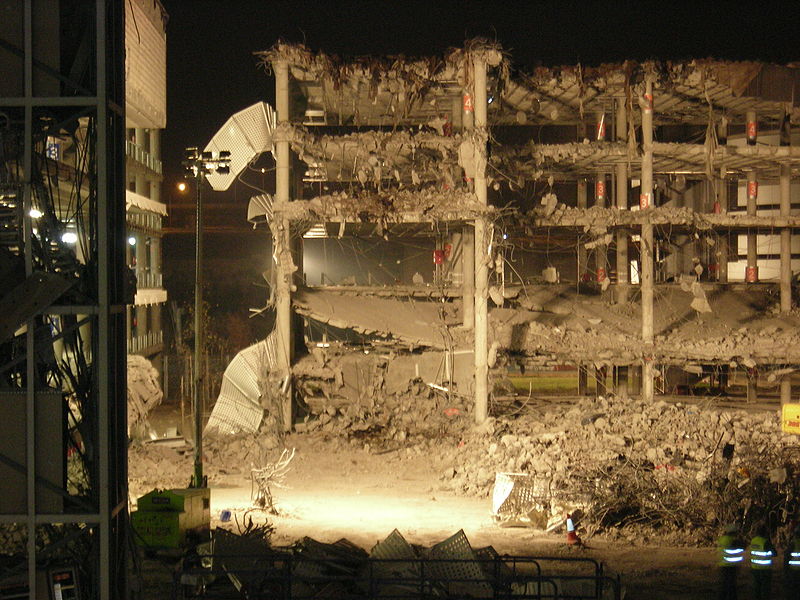
T4 (Madrid-Barajas) days after the ETA attack December 30, 2006. Image credit: Sebastián García
Urizar clarified why the Guardia Civil and the national police can make these somewhat unmotivated arrests.
The incommunicado detainment has been investigated and acknowledged by the United Nations, Amnesty International, and other human rights organisations. It’s a procedure used solely for terrorism suspects. For minimum three, maximum five days, the suspect seems to have disappeared off the planet. Most torture complaints stem from this period. “After five days you are being taken to court to make a statement. If you tell the judge that you were being tortured during your imprisonment, he is obliged by law to launch an investigation and temporarily stop the prosecution. In cases dealing with terrorism however, this never happens.”
Despite the situation having been acknowledged through UN and Amnesty International reports, urging the Spanish authorities to abolish the incommunicado arrests, nothing had changed at the time. “Not the UN nor any human rights organisation has the power to actually change something.”
http://www.youtube.com/watch?v=q-uNBMuTxdY
According to the European Committee for the Prevention of Torture (CPT) and the Danish International Rehabilitation Council for Torture Victims (IRCT), the poor quality of the forensic reports on terrorism suspects in Spanish prisons is reason for concern. During the incommunicado days, a daily visit from a forensic doctor of the Spanish national criminal court is required and he needs to deliver a report on the medical examination. The CPT and IRCT say the reports are too vague and incomplete to determine whether the prisoner has been tortured. Torture practices have become more sophisticated. Urizar noted,
The authorities do not take these complaints seriously and assumes ETA commands the suspects to invent stories. In the past fifteen years no trial to denounce these practices was started, although over forty complaints were registered in 2009 alone.
About the Author





