
Rape and pregnancy are typically not the concerns of children, or so we would hope. Yet, these are precisely issues faced by young girls across the globe, including a 10-year-old Senegalese girl who has been denied an abortion despite being pregnant with twins after being raped by her neighbour. Abortion is a highly contested issue in societies all over the world, but such cases highlight the complexities and moral ambiguities of policy making, especially in conservative settings now infused with the influence of more progressive values.
A law dating back to the colonial era continues to have profound effects on Senegal’s pregnant women. Abortion is illegal except in cases of immediate danger of death of the woman involved, and if undertaken illegally can mean imprisonment for up to 10 years for both the patient and the performer of the procedure. In addition, an abortion must be signed off by three independent doctors in order to be legal, which immediately excludes those in poverty. Even in cases where there are considerable health risks to an abortion, a woman is legally obliged to proceed unless death is an immediate possibility. While anti-abortion laws are often justified through moral arguments of the effort to protect the unborn child, Senegal’s antiquated law is just one example where the protection of the unborn comes before the protection of the living and the breathing, and even children.
The bodily integrity of a women and her right to control over her body is violated in rape, and is again violated by the imposition of 9 months of pregnancy and childbirth. If a woman has not chosen this path, then who can demand she forfeit her body and potentially her security of person guaranteed in Article 3 of The Universal Declaration of Human Rights? Religious belief often underlies the urge to condemn abortion, but the decision to undergo a medical procedure with considerable health risks is not taken lightly. For many women, an abortion is the only option; they feel they simply cannot support a child. It is not a get out of jail free card, neither is it a lack of love or compassion for the foetus. It is a heartbreaking decision that the state has no authority to make. Only the woman involved can make this decision, or have made on her behalf by a medical professional if necessary for a woman’s health and wellbeing. For the state to proscribe ethical and medical decisions, on an issue that only a woman can face, is at once overbearing and chauvinistic. For the state to deny children a medical procedure that seeks to preserve their childhood, and psychological and physical health underscores serious shortcomings of state protection for its people.
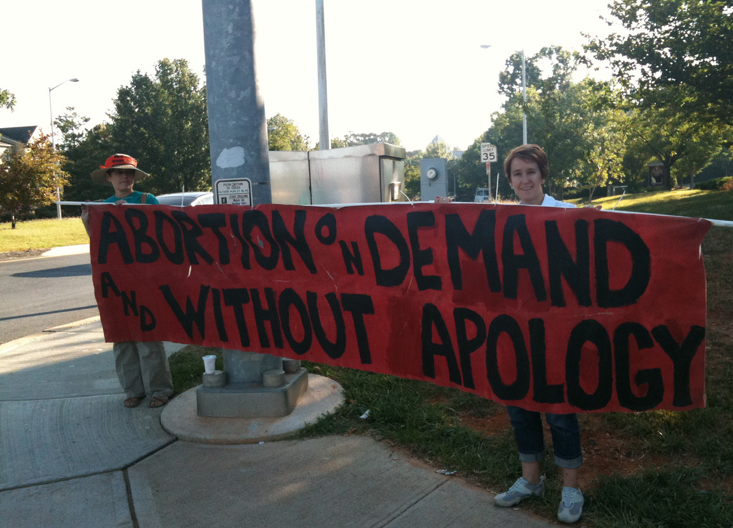
Image courtesy of Debra Sweet, © 2011, some rights reserved.
On the issue of religion and abortion, it is an understandable belief that an abortion could constitute the loss of an innocent life. Rarely do proponents of safe and legal abortion options deny this. Rather, it is about choice and about the right to be free from the imposition of ideological, religious and ethical opinions by the state. Moreover, when based on religious observance, state judgements on abortion raise serious questions about the separation of church and state. The existence of outdated colonial laws denies even the option of a choice being made legally. This means women will, and certainly do, resort to unsafe and illegal methods of abortion, at great risk to their health and personal security.
Of course, each country has the right to decide on policies for sovereign territory, and not necessarily to blindly accept liberal notions of rights from the West or from feminism. However, even in ‘secular’ states, religion and conservativism seems still to hold such power over policy in the area of reproduction. As with any policy decision, the key is public engagement, and political contestation and compromise of differing positions to arrive at an agreeable pluralistic solution. Yet, in many countries women are so marginalised that channels of democracy cannot hear the voices of women crying out for change. Even more ‘progressive’ countries continue to demonise women who have been victims of rape, or even those who dare to subvert the mould of submissive child-bearer. Spain has recently regressed on its abortion legislation, where now abortions are illegal except in cases of rape or considerable physical and mental health risks to the mother. This policy amendment was so unpopular with the Spanish public that it had to be passed by a secret ballot to avoid public accountability. In Ireland, a woman had to die for changes to be brought into place in 2013, which for the first time allowed abortions in cases of health risks to the mother.
The issue of abortion ultimately comes down to who is afforded a voice in society. Many would argue that because the unborn child cannot speak, it must be protected with stringent abortion legislation. However, it is possible to maintain such legal protections while also providing space for the marginalised voices of women to be heard. Extremely conservative abortion laws consign the poor and marginalised to either unsafe procedures, risking a lifetime of harm to mother and child, further impoverishment thought legal channels, or a life of hardship in struggling to provide for a family too large to support. These issues are thrown into even sharper relief in cases of child sexual violence and pregnancy.
Political power in a variety of societies is still affected by the legacy of colonialism, the consolidation of ethnic or patriarchal power, and the arrogance of class elites. Rape and abortion legislation is only a small area that this affects. Globalisation does not mean the inevitable imposition of Western values, feminist or otherwise, but it does mean that the discriminatory policies of states are much more likely to be exposed and resisted.
This article was originally published on St Andrews Foreign Affairs Review.
About the Author





