
Beyond a shadow of a doubt, the Euro-zone crisis has been used in many parts of the Old Continent as a fuel for the treacherous machine called “separatism”.
We have not had enough time to cool down after the unsuccessful Scottish referendum, and now, the integrity of another European country is threatened. Catalan separatists decided to jump on the bandwagon and, on November 9, will organise something which is no less than a quasi-referendum on Catalan independence.
The Euro-zone crisis – which has tipped many into disillusionment, contributed to the thrive of extremist parties and made the Madrid-Barcelona relationship more complicated than ever before – is highly likely to influence the outcome of the voting. This year, the Day of Catalonia, or, as it is called in that region, La Diada, was used to express eager willingness to break ties with Spain. The Catalans formed a “V” shaped figure which was told to be standing for “vote” and for “victory”. But leaving sentimentalities aside; it is time to analyse the Catalan situation from an economic perspective, debunk the myths and present the proofs that if Catalonia became independent, the word which the V-shape would be standing for would not be victory but vagrant.
https://twitter.com/RUARlDH/status/531786656861663232
The Catalans have created a myth that their region is wealthier than the rest of the country, but frankly, there is nothing more misleading than this statement. Catalonia is currently in very real trouble and the question of their independence has been very wisely used by the Mas administration to distract the public opinion from their real problems; in 2012, for example, their debt was the highest among all of Spain’s autonomous regions and amounted to 45 billion euros. This year the debt per inhabitant adds up to 7,104.50 euros. The spectre of the necessity of the EU bail-out is looming large on the horizon, but if the separatists were to fulfil their goals, Catalonia would end up outside of the EU, rendered unable to receive not only the bail-out but also any EU funds.
Each year, Spain receives around 12 billion euros from the European Union and as a result; this year, for example; each Catalan has received 4,340.89 euros from the Spanish Government. This amount is almost twice as high as the amount of money which is collected in taxes. Although Catalans may feel exploited as they pay 9,76% more in taxes than other Spanish regions, which in practice means that every single citizen of Catalonia pays around 2 500 euro per year (22 billion euros in total) to Madrid, they also receive more money than any other Spanish autonomy. Speaking bluntly, the fiscal balance calculations are made in such a way that they strengthen the political message whose main aim is to influence laymen, who are not particularly interested in economics, to vote in favour of the estrangement.
Furthermore, Artur Mas proudly claims that France is Catalonia’s main trading partner (10% of its export goes to the northern neighbour), but according to the research made by Pankaj Ghemawat, a business thinker at IESE Business School in Barcelona, if Catalonia did become an independent country, the main trading partner would be (unsurprisingly) not France but Spain, as these days, 30% of Catalonia’s “exports” goes to other Spanish regions. The problem is that as a result of the estrangement, EU protectionist tariffs would apply to Catalan products, rendering them not competitive enough to make them viable for purchase either by the Spanish or by French consumers. Would any country be willing to trade with them?
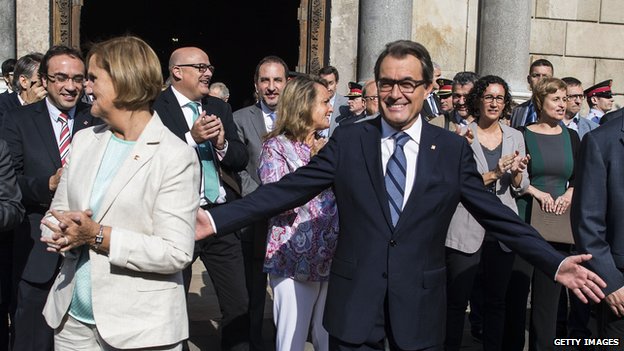
Catalan leader Artur Mas campaigning. Image Source: BBC News http://www.bbc.co.uk/news/world-europe-29410493
Some people might argue that Norway or Switzerland, for example, are also outside the EU yet their products are still competitive on the market. So why would the Catalan experience be different? The answer is very simple: as previously mentioned, Catalan GDP (€26,412 per capita) is higher than the rest of Spain but is nothing in comparison to the vibrant Norwegian and Swiss economies with their GDP per capita amounting to €64,363 and €53,977 respectively. On top of that, the main pillar of the Swiss export is their relationship with the US (30% of Swiss export); none of Catalonia’s main trading partners are outside the Old Continent. Norway, on the other hand, has got vast deposits of oil which is very desirable in Europe, especially at present, when relations with Moscow are strained. 67.3% of Norwegian export is oil, and Catalonia has no comparable commodity which could possibly compete (unless Mr Mas has discovered something at the bottom of the Mediterranean Sea, and that is the surprise which is going to be revealed on the 9th of November).
In addition to this, there are many other obstacles which the Catalans would face if they became a separate country, such as the fact that most likely the international businesses located there would be moved to Madrid. The region would become impoverished, isolated on the international arena (today, around 40% of the Spanish representatives to the European Parliament are from Catalonia; there is no other Spanish region which would have that many representatives in Brussels as Catalonia does), but most importantly – Catalonia would not be able to pay back their debts.
Forgetting what the voices of Catalan hearts say, one should look scrupulously at the slogan of Bill Clinton’s 1992 presidential campaign which perfectly describes the current situation in Spain: “It’s the Economy, stupid!”
About the Author





