
Last week’s exchange of political prisoners between the US and Cuba, followed by a handful of far-reaching declarations tabled by the White House were widely acclaimed as a new opening between Havana and Washington. For all that, this wind of change is no news to Cuba.
A wave of buoyant and auspicious comments compassed the world media, spawning numerous parallels, metaphoric comparisons and historically revisited analyses of last five or so decades in US-Cuban relations.
Not even once in last fifty years did the leaders of the two countries speak for as long as Obama did, holding on to Raul Castro on the phone on Tuesday for over 45 mins. And albeit in Cuba, throughout all these years the leadership hardly evolved, in the US, the atavistic approach to Castro’s regime was sustained by 9 consecutive heads of state. Drawing from this somehow deliberately skin-deep overview, every now and again followed by slump images of the 1962 missile crisis, one can be easily led to believe that the release of Alan P. Gross from a Cuban prison sets a case for a precedence, gives room for a change to come. Inasmuch as this statement might be true, an auxiliary question must be asked — a change for whom?
Recap
A recap in brief: last Tuesday, following 18 months of classified bilateral negotiations, most of which took place in Canada and the City of Vatican, the Cuban government agreed to release Alan P. Gross, an USAID sub-contractor, accused of espionage and subversive activities and subsequently arrested back in 2009. In exchange, Washington freed two Cuban citizens, held imprisoned in the US since 1998.
Be that as it may, the mere exchange of prisoners – a phenomenon occurring relatively frequently even in perennially strained US-Cuban realm – was not the essence of the deal. Following the agreement, Barack Obama declared the United States are set to re-establish permanent diplomatic relations with Cuba – an occurrence that even a decade ago would be shelved as close to unthinkable. In specific terms, the American embassy in La Havana is meant to be re-opened, welcoming a nearly appointed, first in decades US ambassador to the country.
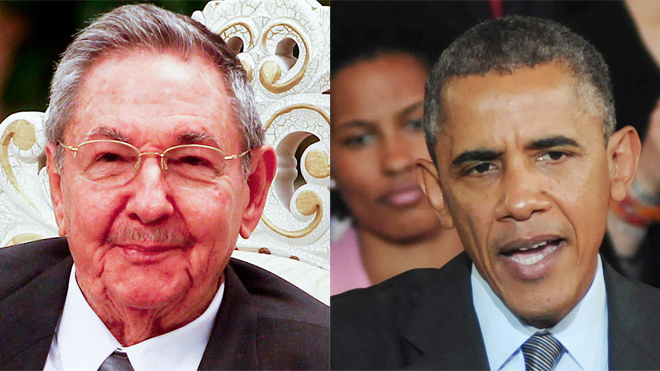
Castro (left) and Obama. Image Source: http://bit.ly/1wyAkqC
By the same token, Barack Obama instructed John Kerry to usher in the proceedings necessary to erase Cuba from the list of countries supporting terrorism (the Castro’s regime was listed as a state sponsoring anti-US insurgencies since 1982, with further restrictions imposed during the first years of George W. Bush’s presidency). As soon as early next year, a special mission coordinated by Trade and Commerce Secretary Penny Pritzker, alongside a number of migration and legal specialists designated by the White House is set to leave for Cuba for further negotiations on relaxing mutual visa restrictions and to explore potential fields of economic partnership. And inasmuch as the aforesaid are mostly half-baked proposals and are likely to remain so for the next weeks or months, as for some of them coming into force will require battling the Republican hardliners in Congress, they might indeed herald a significant turn towards rapprochement on behalf of Washington.
Rapprochement takes two
But as history, especially in the Latin American realm, teaches us, rapprochement – just like the tango – takes two. Or more specifically, a change that comes for both the parties. Whereas last week’s statements gave, howbeit, room for a paradigmatic shift for the US much more than they did for Cuba. In La Havana, this wind of change – not yet coming directly from Washington, but a similar, market-oriented, and encompassing a considerable degree of economic and travel liberalisations, has been blowing already for years. Strictly speaking, last week did not mark the death of Cuba as we used to know it – the proud, revolutionary, cheguevarista, anti-yankee and independent at any cost. The Cuba of today has not been fit for such a description. The heavy arms of the revolution have loosened their holt much earlier and no move in this process has been pushed through inconsiderate.
Obama’s new Cuban policy hopes for an organically homegrown capitalist upsurge, e.g. through facilitating transfers of remittances to the island from families residing in the US. Albeit the diagnosis – Cuba needs a constant inflow of foreign currency – is right, the action might turn out to be inadequate. According to the estimates by IADB, Cubans already send back home a total of 2,5 billion dollars annually. Most of which, however, at a certain point pass through the hands of the state, which still does not allow for a free circulation of foreign currencies. What is more, following last year’s abolition of the dual currency system and the so-called peso convertible (known as CUC), the possession of US dollars is no longer synonymous with unprecedented economic well-being (the CUC was equal to 1 dollar, whilst its conversion rate stood at 24 normal pesos, a twentieth of an average monthly salary; now the government sets the rate with normal pesos only). The transfer facilitations on behalf of the US are likely to deepen the phenomenon, but are not necessarily going to anyhow foster a total opening of Cuban economy.
Private investment in Cuba
The next step of this imbalanced rapprochement is meant to encompass American private investment in Cuba, designed to spawn a private sector on the island. Again, a rudimentary form of foreign direct investment has already been present for years – ranging from Fidel’s beloved film industry, undertaking numerous co-productions with France, Canada and Spain already in the 1990s (see, for example, the staggering Viva Cuba), to the obvious tourism industry. As for today, already some 430,000 Cubans are believed to be self-employed or working in private enterprises, mostly as hairdressers, taxi drivers or owning small restaurants or B&Bs. Larger sectors of the economy – such as heavy industry or construction – remain solidly under the command of the state. What is more, their handover into private ownership would require a simultaneous privatisation of neighbouring sectors (deliveries, logistics, provisions of materials) inasmuch as a radical change in the very principles of the revolution (collective construction brigades, central planning of housing). In short, gradual privatisation is already there, but is confined by a bubble of short and middle-range professions. An expansion of free capital on a larger scale is an all-or-nothing game, and limited American presence might not be enough to win it vis-a-vis the persisting and untouched Helms Burton Act and the infamous trade embargo.
Eventually, a relaxed visa policy towards Cuba is again a belated remedy with a limited scope of impact. The Castro’s regime has introduced significant travel concessions for its citizens already in 2012, allowing Cubans to obtain a passport without the troublesome prerogative of possessing a personal invitation to go abroad. For all that, following the supposedly generous decision of the regime, all the existing passports have lost their validity, what in practical terms means that whoever was set to travel abroad, had to inquire for a new passport. And even without the invitation principle in place, this task is hard enough. The authorities maintained the right of rejecting any passport application whose owner might „pose a threat to the security of the country and the Revolution” – thus being practically able to hold back anyone from leaving the country. And even if such application finds its way through the never-ending chain of offices, it is never a cheap travel.
As portrayed by Yoani Sanchez, a worldwide recognised Cuban dissident journalist, the whole process of obtaining a passport might amount to a total cost of over 100 US dollars (with both formal and informal costs included). Given that an average salary accounts for somewhere between 12 and 22 dollars, a foreign travel still becomes a luxurious dream. Even if it eventually comes true, though, a period of 11 months is the maximum that Cubans can remain outside the country – if they fail to return before the deadline expires, all of their possessions become taken over by the state. Obama’s most recent facilitations – aimed at providing easier access to bilateral travels for purposes of educational projects, scientific research and religious exchanges – appear to be missing the necessary target. Academics and, generally, the best educated Cubans – not only the massively exported physicians, but also filmmakers and agricultural experts – are widely traveled and have been for long holding the privileged positions in the passport struggle independent of the regime’s current condition. If this policymaking aspect was to produce a substantial change in the Cuban regime, it would have to enfold a much greater chunk of the population. And for the time being, such course of events is highly unlikely, considering that full-scale US tourism to Cuba is to remain forbidden by the law.
Insubstantial changes
In summary, the new opening in US-Cuban relations brings only a partial spirit of novelty and it does so mostly for the American side of this compromise. Assessing them through the lenses of Havana, the onerous declarations of Obama fall short of a change-making capacity and will certainly fail to shaken up the foundations of La Revolución. If the deal was designed to ignite a spark of free market economy – too late, it is already there. Moreover, much to one’s surprise, it did not take a major foreign presence to get the capital flowing (the National Bank of Cuba has already provided commercial loans for a total of USD 122 million to Cuban citizens). If it was, in turn, aimed at triggering substantial changes in the Cuban regime – it simply does not possess such capacity. Especially when taken into account how determined and simultaneously powerful is the opposition in Congress, already voicing its discontent over the Cuban rapprochement. The usual protagonist of the republican team – Marco Rubio, now backed by the republican frontrunner for a presidential nomination Jeb Bush, won’t throw in the towel on the Cuban question. It is the democrats that are in a dire need of a victory, given Hilary Clinton’s early promises of a relaxation on Cuba already during her times as State Secretary. By and by, the American public asks for it in the first place. According to a survey commissioned by the New York Times, nearly 60% of those polled supported a rapprochement with Havana. Unexpectedly, a much needed electoral boost might therefore come from a once inviolable enemy.
What is left for Castro in this affair? A “wait-and-see” approach is most likely, because, ironically, the US no longer pose the biggest threat to stability of the communist regime. Raul looks fearfully towards the EU and its new regulations on granting citizenship – some 400,000 are possible to inquire for a foreign (mostly Spanish) passport, courts in Madrid estimate. A trans-oceanic exodus might, therefore, destabilise the Revolution more than any Washington-led attempt to shorten the 88 miles of distance between Cuba and Key West. In other words, Castro needs to run – maybe as fast as never before – to keep the island in its supposedly perennial place. Cuba needs to run to a standstill.
About the Author





