
In 2014 the geopolitics of oil production changed dramatically.
Due to the recent U.S. shale boom, Saudi Arabia – the world’s largest oil exporter – lost its position as a ‘swing producer’ in the oil industry which had allowed the Kingdom to guide world oil prices at minimal extra cost through calculated production adjustments.
In the new era, Saudi recognises it must build consensus instead of exercising pure dominance to maintain a stronghold in the industry. However, dealing with an intransigent Russia – the world’s second largest oil exporter – has brought to life a classic prisoner’s dilemma.
The Rise of U.S. Shale
In 2014 the U.S. surpassed Saudi Arabia’s spare capacity – the amount of crude a country can produce in 30 days in case of an emergency – by 4.5 million barrels per day.
The Wall Street Journal reported, “Shale-oil production in places like Texas and North Dakota has boosted U.S. output, displacing exports to the U.S. from OPEC members and adding to global oversupply.”
Subsequently, increased supply from the U.S. and stagnant global demand resulted in dramatic price drops, and erosion of Saudi Arabia’s market share. As of 23 December 2014, gasoline prices declined 88 days in a row, the longest streak in history.
Saudi Arabia’s decades-long ability to unilaterally calibrate the oil market to fit its needs ended in 2014 and forced the Kingdom to work with other members of the OPEC cartel, as well as non-members, to solve the problem of falling prices and diminishing market share.
Easier said than done.
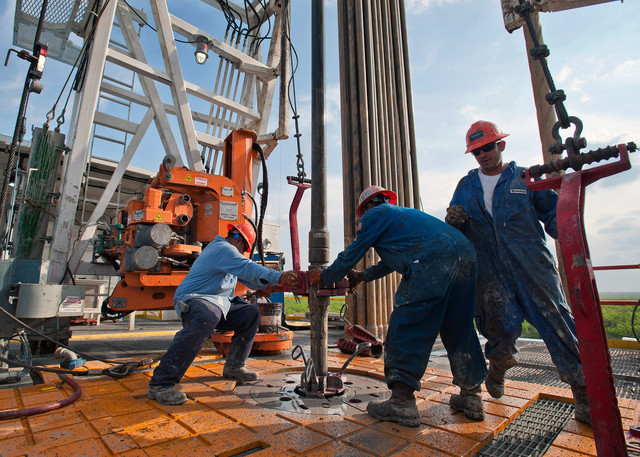
US Oil Drillers. Image Source: http://bloom.bg/1rYdWf8
From Russia With Love
Saudi oil minister Ali al-Naimi met with oil representatives from Venezuela, Russia and Mexico ahead of OPEC’s November 2014 meeting in Vienna with the aim of coordinating a mutually beneficial output cut to boost prices. According to the Wall Street Journal, Naimi proposed removing two million barrels a day from the market. “OPEC would shoulder the bulk of the cut, but Russia and Mexico were expected to trim a combined 500,000 daily barrels.” Russian delegates quickly declined, quashing any possibility of further cooperation between OPEC and non-members.
Saudi officials knew unilateral production cuts would threaten their market share and had the potential to incur long-term revenue loss – a risk they were unwilling to take.
Results
Russia’s decision not to cooperate with OPEC caused oil prices to fall below $60 a barrel in December 2014 from over $100 in June 2014. Russia is on track to lose $80 billion in oil export revenue in 2015 in addition to losing $40 billion a year from sanctions.
The results have been catastrophic for Russia, halving the rouble’s value against the U.S. dollar in 2014.
With the manifold problems facing Russia it would seem unthinkable not to cooperate with the OPEC cartel. However, a quick look at game theory can provide insight into why Moscow sidestepped a seemingly logical negotiation.
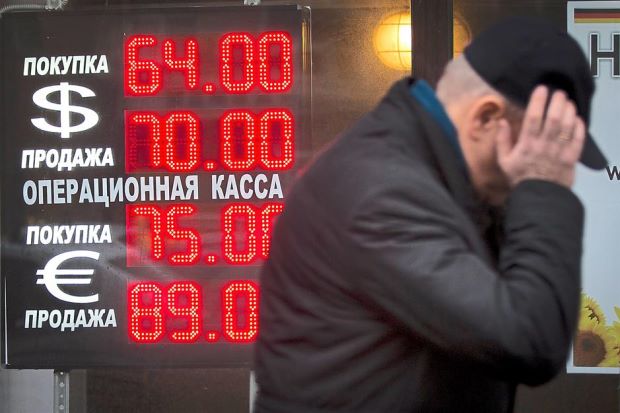
Dramatically low Russian Currency Exchange rates. Image Source: http://bit.ly/17dHc8m
The Prisoner’s Dilemma
Game theory is a way of examining participants in a particular situation with theoretical models that predict their optimal decisions.
The particular model presented in Saudi Arabia’s interactions with Russia is the so-called prisoner’s dilemma: “A paradox in decision analysis in which two individuals acting in their own best interest pursue a course of action that does not result in the ideal outcome.” The prisoner’s dilemma presents a scenario in which both individuals are worse off than if they cooperated with each other during the decision-making process.
The theory argues cooperation is more difficult among impatient players who discount future payoffs – for example Russia who is desperate to find a short-term solution to its financial woes.
The prisoner’s dilemma also contends cooperation can often arise in a scenario featuring a hegemonic leader to guide the process – a position now vacant due to Saudi Arabia’s loss of comparative advantage in the oil industry.
Had Russia chosen to cooperate, it would have experienced short-term revenue loss and a cut back in market share. However, Moscow would have experienced the long-term benefit of higher prices for its oil exports which comprise 68% of its total gross exports.
What Happens Now?
The next OPEC meeting will take place in June 2015. However, Russia cannot sustainably continue at its current production levels of 10 million barrels per day unless prices reach $100 per barrel. Unless Russia cooperates with OPEC in the near future, its economy will continue in a downward spiral and global oil prices will continue to remain low.
About the Author





