
Politics, power, and oil are tightly intertwined in Libya. To control oil is to hold power, thereby making Libya’s oil infrastructure a hotbed of conflict and violence. Libya’s complicated political landscape is dynamic and fluctuating, leaving onlookers mystified as to who is really vying for power. Its main cities – Benghazi, Tripoli, Misrata, Tobruk – among others have shifted in importance over the past four years. Different terrorist organisations including but not limited to Libya Dawn, Islamic State, Ansar al-Sharia, and Dignity have each left a mark on the political scene in recent months.
So where are we now?
Immediately after the fall of Libyan dictator Muammar Gaddafi in February 2011, the National Transitional Council committed to creating a democratic state that would provide representation to all interest groups across Libya. The first elected General National Congress took power in August 2012, headed by prime minister Abderaheem el-Keeb.
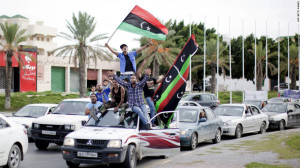
Libya’s Rebels celebrate in Tripoli after the death of Muammar Gaddafi. Image Source: http://cnn.it/1FPmlqy
However, according to The Guardian, over the next two years powerful local militias “failed to disband and state institutions did not develop”.
In the June 2014 election, Islamist parties performed poorly, triggering a violent reaction. It is interesting to note that before the overthrow of Muammar Gaddafi, Libya’s nearly 2,000 militias were united in their hatred for the Colonel. However, competing ideologies and the resultant power vacuum divided the country and plunged it into violent chaos in 2014; Islamist fighters under the name “Libya Dawn” took control of the country’s west with its base in Tripoli, the “Dignity” party shored up power in Libya’s east with its base in Tobruk, Ansar al-Sharia took over Benghazi, and an Islamic State affiliated militia group emerged in Derna, also in Libya’s east. Each group thereafter began to splinter and hundreds of rival militias across the sparsely populated country cropped up, further adding to the already fragile security situation.
How has this impacted the oil industry?
Militants across Libya view oil as a secure source of revenue and the key to controlling the country. As a result, attacks on oil facilities have increased in recent weeks. On 14 February, a pipeline explosion by a militant group halted oil delivery from Libya’s largest producing oil field, El Sarir (200,000 barrels per day), to the Hariga shipping terminal. This led to a reduction in Libya’s oil output by approximately 180,000 barrels per day. As a result, Libya’s total production fell to fewer than 200,000 barrels per day, down from the 1.6 million bpd produced before 2011. The recent beheading of 21 Egyptian Christians by Islamic State militants prompted Egypt to carry out air strikes in retaliation. This along with the pipeline bombing, impacted world oil prices, which increased to $62 per barrel on 16 February.
Disappointingly, Western governments have so far pledged not to intervene in the conflict. Recently, a representative at the U.S. State Department refused to comment on the matter. Consequently, the price of oil will continue to fluctuate until and unless external actors agree on a plan for stabilizing the strife torn country.
About the Author





