
The Leveson Inquiry, set up as a result of the indiscretions of News International, has led to an increase in public doubt in journalistic integrity. According to a poll published by YouGov for the Media Standards Trust in 2012, 79% of the public were in favour of creating an independent press regulatory body grounded in statute. But is anyone really surprised?
Over the last few years, we’ve heard countless stories on how the News of the World hacked the phones of celebrities, politicians and even ordinary citizens. In 2011, The Guardian reported that the NoW hired a private investigator to hack the voice-mails of murder victim, Milly Dowler, deleting messages that had already been heard in order to make room for more calls. Whilst the family of Milly Dowler were financially recompensed and Rupert Murdoch donated £1 million to charities that Milly would have approved of, no amount of money could account for the cruelty of raising the family’s hope for finding their lost child.

Rupert Murdoch, the owner of (now closed) News of the World, donated £1 million to charities as part of a settlement agreement with the Dowler family. (image: david_shankbone / Flickr)
There have been calls for a stronger level of press regulation since the self-governed regulatory body, the Press Complaint Commission (PCC), clearly didn’t work for the NoW. It was agreed en masse by the media that the actions of News International were thoroughly deplorable, and that the Press Complaints Commission is an ineffective regulatory system.
The majority of guidelines outlined by the PCC Editor’s Code are already protected by law, but the consequences for breaching PCC guidelines are not particularly stringent. The press pays for their own regulation, which only further identifies some problems with the system. But is the need for a better regulatory body best answered by Government-backed legislation?
David Cameron doesn’t think so. One could argue that having an external regulatory body would be a more effective method of reining in the press, because an independent body could hold all newspapers accountable and set standards that protect both the public and the media. By backing the body with legislation, however, one begins to undermine the role of the media.
For many years, the press has acted in a role akin to a public ‘watchdog’, opening the eyes of the masses to the indiscretions of the political world. Investigative journalists have uncovered a series of political failings – the MP expenses scandal is a great example of this. By holding politicians accountable for their actions in the media, the press acts as a guardian for the voting public when it comes to choosing which party they want in power.
But if the Government starts getting involved in the regulation of the press, is the democratic relationship between the press and the government being undermined? If the Prime Minister is required to set up a independent regulatory body backed with legislation, what’s to stop future political parties from taking away bits and pieces of press freedom?
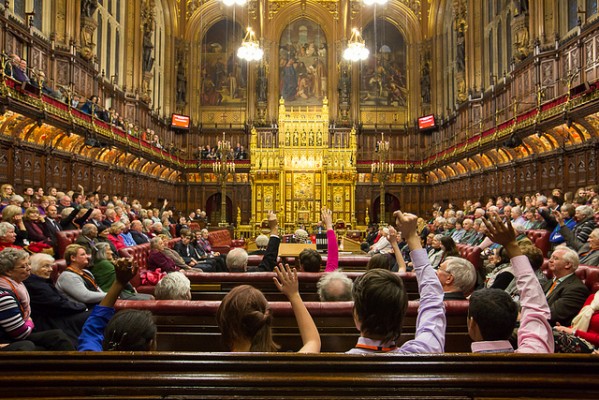
Proper debates need to be undertaken at the House of Commons to protect press freedom. (image: UK Parliament / Flickr)
There are some are in favour of the move to create a legislatively-supported regulatory body, including Barry White, the National Organiser of the Campaign for Press and Broadcasting Freedom, who said:
The Press Complaints Commission has been a failure. It was not a regulator, simply a body, funded by the press themselves, that considered a limited range of complaints about newspapers from the public. It has been a dismal substitute for regulation. Leveson recognised this, and with his proposals for continued press self-regulation, he also proposed a minor statutory measure to verify the standards of the new regulatory body to be set up.
It’s a modest improvement, but too much for David Cameron who broke off inter parliamentary party talks this week, and hopes to force his watered-down ‘Royal Charter’ version through the House of Commons on Monday night. Leveson’s proposals are not an attack on press freedom, they would go some way to restore public confidence in the press following the ‘phone tapping and other revelations which led to the Leveson Inquiry being set up.
There needs to be a balance between the freedom of the press and the role of the Government; it’s going to take some time for the Houses of Parliament to:
- Set up an independent body. We’ve seen the effects of self-governance with the NoW; it seems sensible to recommend an externally-regulated body.
- Create an incentive for papers to join. Be it more protection in defamation cases or lower fines in lawsuits for those who break penalties compared with those who do not join the group – there needs to be a reason for the press to join the organisation.
- Have a balanced governing board to analyse issues. It cannot be solely editors and journalists who make decisions on whether the press has acted wrongly, nor can it be made up of politicians and lawyers. We need a mix of the public, the press and the politicians for a varied, well-balanced opinion for complaints cases.
- Debate. A law made swiftly is usually a law made badly. Parliament needs to seriously discuss and debate the benefits and consequences of both the Royal Charter and of regulatory legislation before coming to an agreement. Journalists need to have a voice in these discussions, in order to ensure the right to freedom of speech is protected.
Above all, the Government need to remember throughout this debate that, as Arthur Sulzberger said, “the benefit of freedom of the press, belongs to everyone – to the citizen as well as the publisher… The crux is not the publisher’s ‘freedom to print’; it is, rather, the citizen’s ‘right to know”.
This article was written by Becki Tse and originally appeared on the Urban Times.
About the Author





)