
The Brazil, Russia, India, China and South Africa (BRICS) Summit held in Durban draws to a conclusion today. The one issue that has not been discussed at this forum is the need to reduce emissions, something which the BRICS countries are severely liable for. The buzzwords have been “economic growth” and “BRICS bank” and yet there has been very little recognition that the BRICS economic growth (projected to grow 5% annually in the future) will cause appreciable stress on the environment. The time to act is now with impacts of climate change becoming more prevalent and a permanent regime shift present if no concrete decisions are taken. It is quite ironic that (Conference of Parties) COP17 was held in Durban not two years ago where the focus was the mobilization of the “green fund” and “green economy”. South Africa has set a poor example to the rest of Africa with approximately 1% of the 2% of global carbon emissions emanating from South Africa.
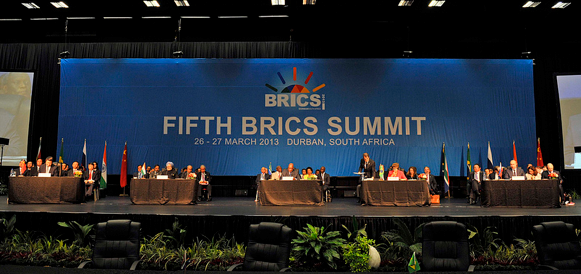
Negotiations at the 5th BRICS Summit held at the Inkosi Luthuli International Conference Centre in Durban, South Africa (Adapted from the official BRICS5 website).
Climate awareness and activism campaigns have seldom had any effect on the polluting industries within the BRICS which is a concern for climate negotiations in the future. The truth is that in the search of economic growth and competition with developed countries and their respective economies, the BRICS are eating away at natural resources and producing greenhouse gas emissions at a rapid rate. It is sad to see that the BRICS, who proclaim to try and forge a new path of leadership, have not stepped up in terms of climate governance with constant blocks and formal withdrawals (Russia) from Kyoto protocol talks hosted by the UNFCCC (United Nations Framework Convention on Climate Change). The underlying issues of world emitters and their constant underhanded agreements to withdraw from climate negotiations and their acknowledgement that economic growth is more important than sustainable development by their actions leads to the question: In terms of climate governance are the BRICS really different from the other major emitters? The Durban Summit concludes today in Durban and sadly no issues of climate change have even been mentioned. This may be an economic forum, but climate change is currently the most important social issue that foreign policy needs to consider. If the BRICS are truly to be influential on the world stage then this surely needs to stop being a “talk show” as South African President Jacob Zuma claimed the BRICS wasn’t and it needs to acknowledge that economic growth is now intertwined with climate change as an issue and that the two issues need to be addressed simultaneously if we are not to cause long term damage to the climate of the planet.
More coverage of the BRICS Summit here.
About the Author





