
1.6 billion people around the world live without reliable access to electricity. 600 million of those live in Africa. I’m sure this isn’t the first time you’ve heard an astonishing statistic like this. Everyday we’re thrown new figures concerning poverty, disease and the state of the global climate. Although incredibly scary, they can also leave us feeling terribly guilty, and perhaps rather useless.
There’s no doubt that charities and NGOs achieve amazing things, but we’re not all multimillionaires, politicians or international aid workers. Only so many people can be philanthropists and there’s only so much that philanthropy can do. Yes, gifts can be innocent, but are they sustainable?
As the world becomes increasingly connected, we’re seeing business ideas that have the ability to transform lives in other parts of the globe. While the number of ‘profit-for-purpose’ businesses and social enterprise organisations are growing rapidly, we’re also seeing multinationals taking Corporate Social Responsibility (CSR) projects a little more seriously. In many cases, CSR is embedded in overall corporate philosophy – rather than just being a tick of a box.
I travelled across to Kenya last week to check out a partnership project between the UN and Philips. Although at first I had no real idea of what to expect, by the end of the trip I was simply blown away. In a time of corporate disillusionment, and cynicism with capitalism itself, I saw a project that was delivering incredible results for local communities and not just big business. More importantly however, I saw a strong partnership that is also creating new partnerships; the possibility to generate and deliver new ideas seems endless.
Africa is both one of the brightest and darkest places on the planet. Stretched across the equator it experiences some of the sunniest weather in the world. As the sun drops below the horizon however, many cities, slums and towns fall into almost complete darkness. Kerosene lamps and torches are often the only light by which children can study, businesses can trade and commuters can travel. In many places, it’s simply not safe to be outside after dark.
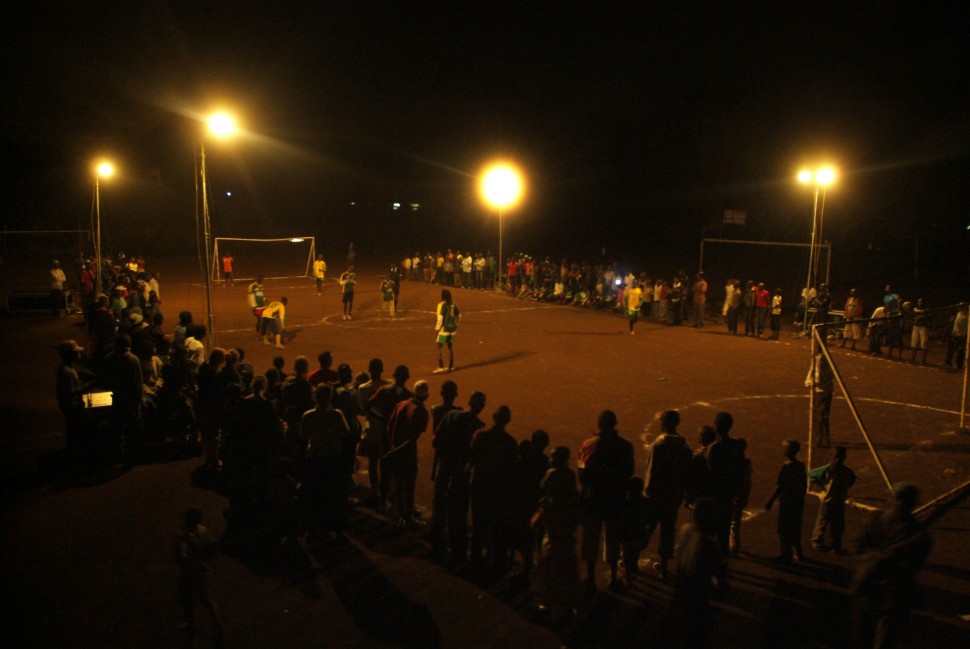
Kenya’s first solar-lit football match in a Community Light Centre. Image Credit: Philips Lighting
This situation is a little different in the West. Cities like London and New York have had widespread access to electricity since the turn of the 20th Century. The Northeast blackout of 2003 was a stark reminder of our vulnerable reliance on Swan and Edison’s clever invention. While we have tended to take light for granted, we’ve also disregarded the fact that its use is costly and environmentally damaging.
This is now changing. While I’m sure you’ve heard of LED lighting, you might not be aware of how much it’s actually revolutionizing the way we source and utilize light. Across the world, traditional bulbs are being replaced with LED. You may have seen local authorities replacing your downtown traffic lights, or heard about New York City’s famous NewYears Eve ball recently making the switch. Incandescent, halogen and sodium vapour lamps will soon be a thing of the past. Not only is LED technology great for design and functionality, but a typical LED bulb can be used for 25,000 hours compared with the 1000 hours of an incandescent bulb. The benefits to the environment are astounding.
For Africa, LED technology means even more than that. With so much of the population situated off the electricity grid, there is now the opportunity to install high quality and efficient solar-powered lighting across hundreds of cities and towns. Governments no longer have to play catch-up, laying out expensive transmission lines as populations soar. Instead, a combination of on and off-grid lighting will be far more economically effective and environmentally sound.
At the forefront of the LED revolution, Philips Lighting has the most advanced systems in the world. Having now teamed up with the United Nations Industrial Development Organization, it’s doing some really spectacular things across the continent. For starters, it’s delivering 100 Community Light Centres across Africa. These 1000m2 solar-lit communal areas can be used for education, healthcare facilities, social events and
commercial activities.
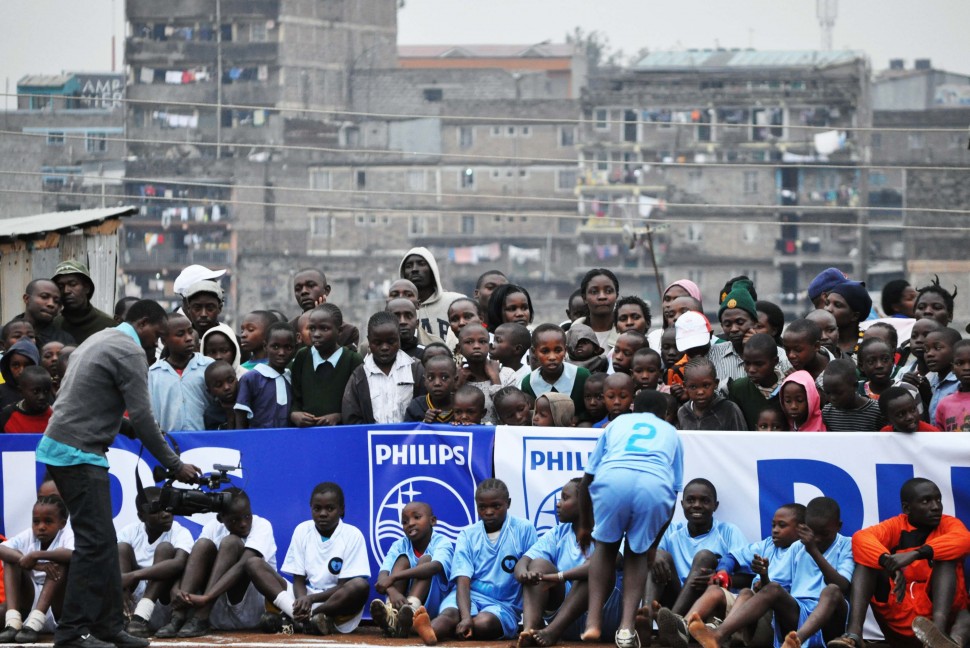
School children eagerly anticipate the inauguration of the Mathare Community Light Centre (Image: Tom Payne)
Speaking with Philips’ Senior Comunications Manager Nick Kelso, he explained to me that these projects are about far more than just the lights. “Lighting is an art as well as a science” he said, “It’s about making cities more iconic, attracting tourists and investment. This is how cities grow”. Witnessing the inauguration of the Community Light Centre in a Mathare slum, I was able to see what Nick was talking about first hand. Driving into the slum, hundreds of children were crowded around a football pitch to see the lights turn on. It was a pretty eye-opening experience. These children, parents and teachers were witnessing their local community transform. As we stood in the solar-lit football field looking out across the vast and dark slum surrounding us, it was easy to imagine the dangers of living without light.
Seeing the transformation of this small Mathare community was outstanding. Across Africa, the Community Light Centres have sparked a chain of business activities. Not only are products and materials locally sourced but collaborations with the KNVB’s World Coaches, W.A.S.H program and UNIDO are creating a chain of new partnerships in education, sports and sanitation.
With an abundance of anti-capitalist rhetoric floating around these days, seeing the inaugration of the Mathare Light Centre first hand reminded me that big business is not always a bad thing. Philips has the power to transform the lives of millions while at the same time forming a new business model for future investments.
It’s also important to note that not all business is fair or transparent. ‘The African Lion’ is a hotspot for new investment and companies across the globe are looking to crack the market. There is a very real risk that local economies will be exploited to the benefit of ‘capitalist cowboys in the final frontier’. Therefore, it’s important to give credit where credit is due.
Philanthropy is great, but permanent change to some of the poorest places in the world is likely to come through new ideas, strong partnerships and intelligent business models. Innovative technology mixed with social enterprise can create a business models with endless possibilities. This is just the beginning; more bright ideas are yet to come.
This article was written by Tom Payne and originally appeared on The Urban Times.
About the Author





