
Grudges can last for a long time. The one held between China and Japan, the two traditional adversaries of the Far East, however, has been particularly lengthy. Since 1895, when China suffered a bitter defeat to Japan in the Sino-Japanese War, animosity has blighted relations between two of Asia’s most powerful nations. The perennial grudge is beginning to rear its ugly head again.
History is the key to understanding the fractious relationship that has been endured by the two powerhouses of the Far East. Traditionally, Japan has played the role of imperial aggressor. Opening itself up to international trade in 1854, Japan was quick to adopt western practices, values and weaponry and gained economic strength through a process of rapid industrialisation following the Meiji Restoration in 1868. With more economic power came greater military clout, and in 1895 and 1905 respectively Japan placed itself loudly on the world stage with the crushing defeats of China and Russia. China, by contrast, was until the late twentieth-century little more than an economic backwater and the whipping boy of Japan: the latter invaded China again during the 1930s through Manchuria and left in its wake a path of devastation. The massacre of hundreds of thousands during the “Raping of Nanking” in 1937 sears the memories of many in China still. Conflict, it seems, has never been far away between these two.
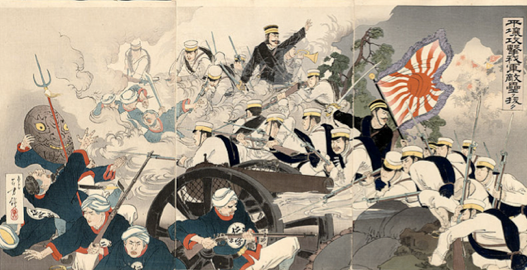
Image Credit: Wikimedia Commons
Similar tensions continue to play out today. Most recently, the source of friction has come over a group of islands which lie in the East China Sea known as the Senkakus (or Diaoyus, to the Chinese). According to China, the hotly disputed group of islands were taken from them by Japan in 1895 and should have been returned upon Japan’s defeat after WWII. The Japanese, however, regard the islands as part of the Okinawa chain and say that they were unclaimed until they were “discovered” by Japan in 1884. A stunt performed by Japan last September to try and nationalise three of the islands by buying them from their private owner was, unsurprisingly, not received well across the water. Then, back in April, ten Japanese boats carrying 80 right-wing activists set sail towards the islands in what appeared to be a deliberately provocative act to ignite nationalistic sentiment back home. Japanese politicians have done little better. A recent visit by the newly elected nationalist Prime Minister, Shinzo Abe, to the controversial Yasukuni shrine in Tokyo (in which 14 convicted war criminals are interred) fuelled unrelenting anger in Beijing. The insensitive remarks of the Mayor of Osaka, who recently claimed that wartime sex slaves were a “necessary evil” for Japanese soldiers during the Second World War, has also added fuel to Chinese fire.
Japan, though, may have reason to be anxious. The world’s third largest country, and Asia’s largest, it appears, has grand designs of its own. As well as the Diaoyu Islands, China has also been eyeing up territory claimed by the Philippines and has even been caught conducting tourist cruises around the Paracel archipelago, which is claimed by Vietnam. China’s growing maritime presence has also manifested itself in the so-called “string of pearls” – a series of strategic ports dotted across Southeast Asia, Sri Linka and Pakistan that are seen by Japan, and especially India, as evidence of China’s increasing hegemony in the region. Indeed, the proposal of the Chinese People’s Liberation Army (PLA) to conduct its first “digital” war game, as well as plans to develop an aircraft carrier and stealth fighters, will do little to quell the fears of China’s close neighbours. Others may argue, by contrast, that China’s real agenda is simply commercial rather than militaristic or expansionist. Only time will tell.
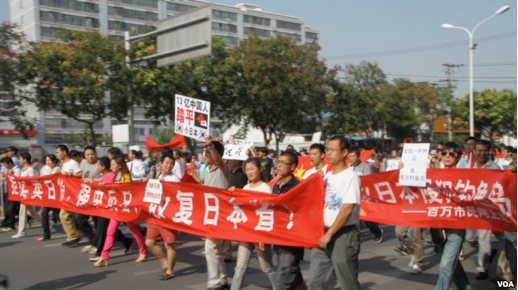
Rising tensions: Anti-Japanese demonstrations in Beijing, 2012.
Image Credit: Wikimedia Commons
Despite the real concern of Japan and others – and the apparent militarisation of China in recent years – it seems unlikely that China will willingly enter into a military conflict with a fellow Asian nation: there is no reason to, and besides, improving relations with America (who is also a strong ally of Japan) suggests that China is happy to maintain the status quo. Similarly, Japan has nothing to gain from a scrap with China and knows that it would pay dearly. People in that country are also immensely proud of their non-nuclear deterrent and pacifist policies.
One thing is sure though. The waves of blame hood and victimisation that have stifled both countries since the nineteenth-century look set to lap the shores of Shanghai and Nagasaki for some time to come.
About the Author






[…] http://archive.the-ipf.com/the-blame-game-political-chess-in-the-far-east/ […]