
Sighs of relief are being breathed across the world now Edward Snowden has been granted temporary asylum in Russia, ending his one-month confinement in Moscow’s Sheremetyevo Airport. Snowden, who told the world the truth about the total-surveillance systems secretly installed by the Americans and their allies, domestically and across the world, has been relentlessly pursued by the American government since he fled to Hong Kong in May.
It’s no wonder they’re after him, given what he’s revealed: that total surveillance of the global population, that old Orwellian nightmare, has become a reality. It is being conducted by private contractors across the world, under the jurisdiction of the US National Security Agency (NSA) and their secret courts, and in Britain with the complicity of our government, who have been tapping information from the covert PRISM programme since 2010. Google, Facebook, Microsoft, Apple, Yahoo, Skype and a host of telephone providers have all been implicated.
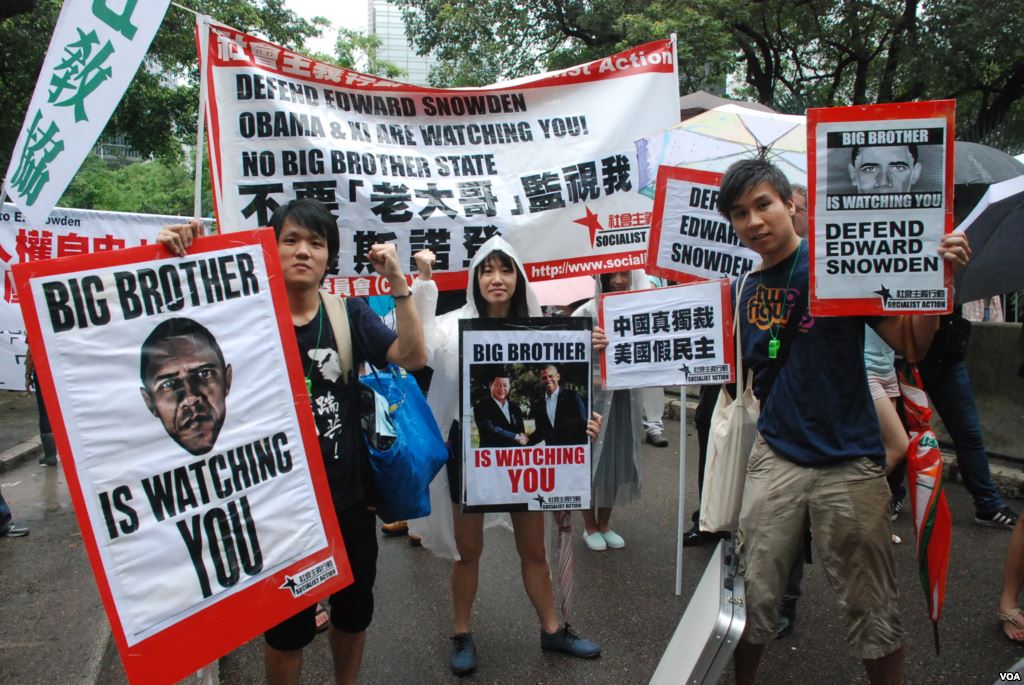
June 15, 2013: Protesters rally in Hong Kong to support Edward Snowden. Image credit: VOA
War against the Whistleblowers
In his one video interview, given from a secret location in Hong Kong, Snowden admitted he never expected to feel safe again:
The crusade launched by the US media against Snowden has been vicious. Now under scrutiny is his psychology, integrity, patriotism and girlfriend – everything, basically, but his bosses. Even so, according to Time Magazine, Snowden continues to enjoy a higher approval rating (54%) than either Congress or President Obama. Edward Snowden, a 29 year old analyst, was privately contracted for the NSA in Hawaii and is an ex-CIA senior adviser. For revealing the megalithic Prism surveillance system he has been fired, stripped of his citizenship, persecuted by the so-called ‘liberal media’ and charged by his government with espionage.
Related: Russians Wary Of Snowden Asylum
The issue has also divided the US government. While Dick Cheney has described him as a ‘traitor’ and probable Chinese Spy and several journalists and politicians calling for the death penalty, bipartisan opposition to the Prism programme is on the rise and even members of the Homeland Security Committee, previously unaware of the programme, have denied the leak compromises national security and expressed their gratitude for being informed.
As in their pursuit of Wikileaks founder Julian Assange, still trapped in London’s Ecuadorian embassy, and persecution of Private Bradley Manning, now standing trial after over two years of torture and unlawful imprisonment, the Americans have shown a remarkable willingness to lie, disrespect diplomatic relations and violate international law in order to ‘get Snowden’. The seizure of the Bolivian presidential plane leaving Moscow in early June, based on unfounded suspicions that Snowden was on board, created an international scandal.
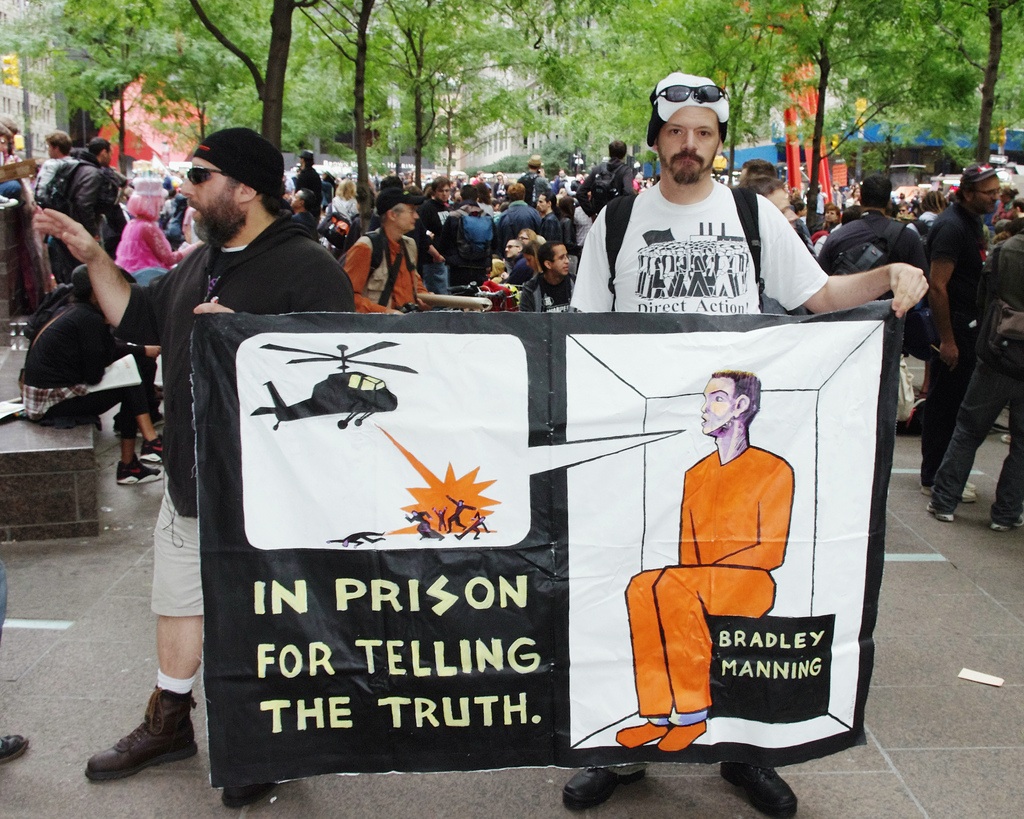
The first day of Occupy Wall Street, Bradley Manning Protest 2011. Image credit: David Shankbone
As tensions escalated, the international focus swung more and more in the direction of Russia, whose cooperation would be required to ensure Snowden’s safe delivery to any nation which had offered to grant him political asylum, his right under international law. In a not-too veiled challenge to the Russian government, Assange told Sky News: “It will be telling which countries genuinely protect human rights, the privacy of the public, and asylum rights. Which countries will actually do that and which are scared of the United States and which are in bed with the surveillance complex, like GCHQ is here in London.”
The Orwellian Nightmare: total surveillance and secret laws
Daniel Ellsberg, who leaked the explosive Pentagon Papers on the Vietnam War, has described the PRISM files as the most significant leak in US history. As David Cameron was quick to point out, the surveillance being conducted is entirely ‘within the law’ – but that should hardly be a comfort. This beyond Orwellian surveillance programme is facilitated by the US Foreign Intelligence Surveillance Act (FISA): a Jurassic piece of legislation which dates back to the early 1970s and whose operation is overseen by secret courts.
Related: Does the NSA Tap That? What We Still Don’t Know About the Agency’s Internet Surveillance
FISA’s mandate was expanded in section 2.5 of the US Patriot Act, passed in the aftermath of 9/11 without the privacy protection of innocent citizens which characterised traditional phone tapping practices and with no meaningful amendments to ensure privacy protection in an era where mobile communications means that a phone tap is also a perpetual tracking device. According to Susan Landau, a cyber-security expert interviewed by Democracy Now, the metadata (that’s phone numbers, duration and location of calls) being stored can be, if anything, more revealing than the actual content of conversations: “Metadata reveals a remarkable amount about a person, who they are, whom they associate with, who they spend their nights with, where they travel. All that kind of information is very private and deserves constitutional protection.”
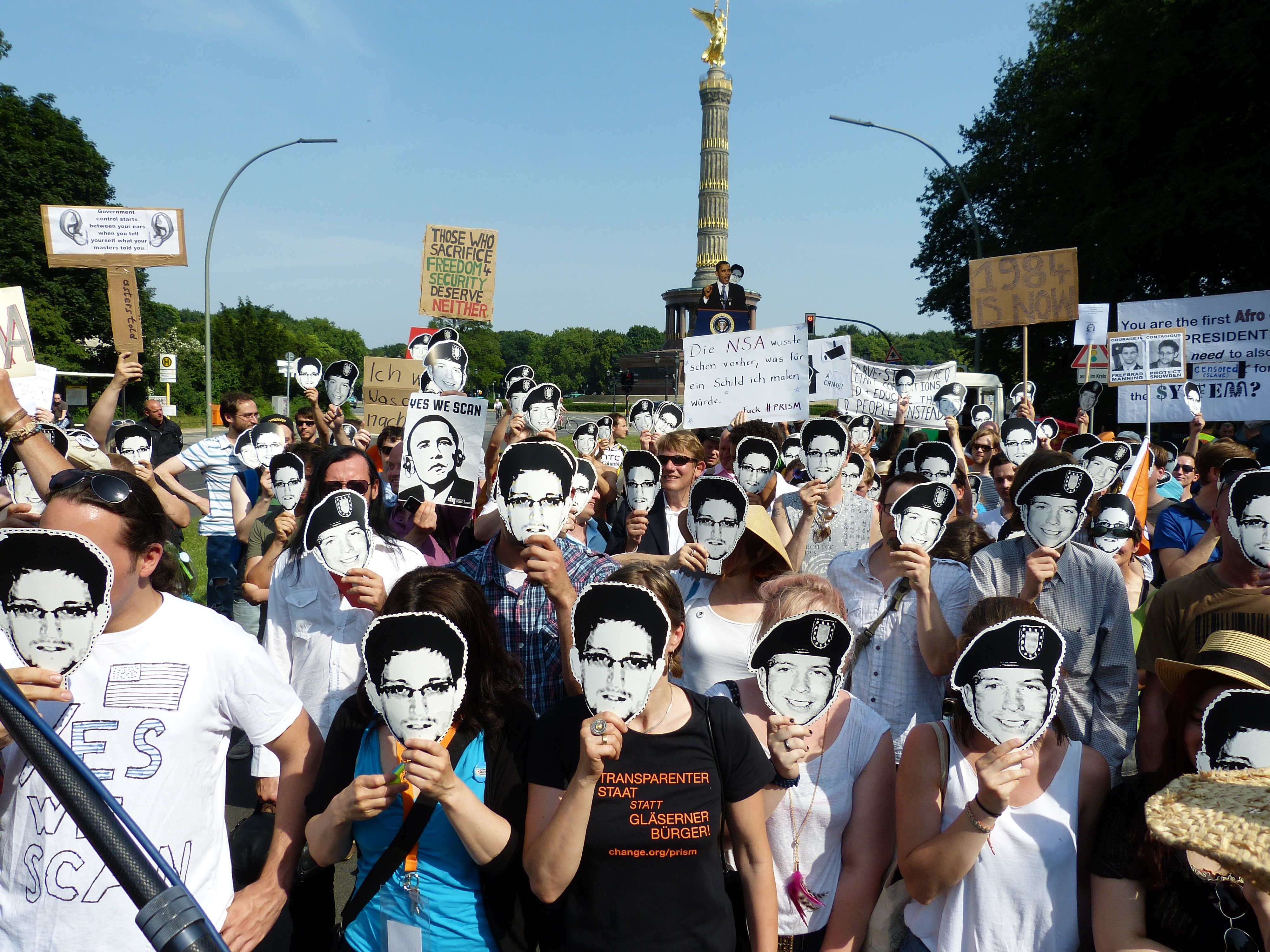
Demonstration against PRISM in Berlin, during United States president Barack Obama’s visit, organised by the Pirate Party. Image credit: Mike Herbst
The program’s defenders in Silicon Valley and the NSA argue that it simply provides a more efficient mechanism for the storing of data already being collected for security purposes. But it is hard to see why, if this were the case, even companies like Yahoo took the NSA to (secret) court on the grounds that participation in the PRISM programme would violate users’ Fourth Amendment rights against unreasonable search and seizure.
The strength of attacks on Edward Snowden, like those against Bradley Manning, have little to do with them as individuals. It is because the information they leak is so potent, because the gulf between what the US government does and what a properly informed public would allow is growing greater ever year. Manning’s leaks put the US military at the heart of a humiliating international scandal, and undermined their case for the oppressive and illegal occupation of Iraq. The total-surveillance systems revealed by Snowden, justified ostensibly on the grounds of this ‘war on terror’, created another global scandal. But short of Chinese-style measures to ‘shut down the internet’, the only thing they can do to try and stop the flow of revelations is to make an example of those that expose this information to the public and frighten the press, and future whistleblowers, into silence.
Related: Snowden, the NSA, and Latin America: Beyond the Headlines
Following the leak, Obama was forced to recognise the existence of the surveillance programme, but pointed out that ‘no one is listening to your phone calls’. Just as the NSA was caught out lying to Congress, now Obama has been caught out lying to the world. According to a subsequent leak by another former NSA analyst, Russell Tise, “the NSA today is collecting everything – including content – from every digital communication in this country, both computer and phone, and that information is being stored indefinitely.”
The Tip of the Iceberg
In 2011, Senator Ron Wyden warned Congress of the dangers posed by the Patriot Act, and the covert nature of the so-called oversight systems in place: “When the American people find out how their government has secretly interpreted the Patriot Act, they are going to be stunned, and they are going to be angry… The fact is, anyone can read the plain text of the Patriot Act. Yet the fact remains that Congress has no idea how the act is being secretly interpreted by the executive branch because that interpretation is classified.”
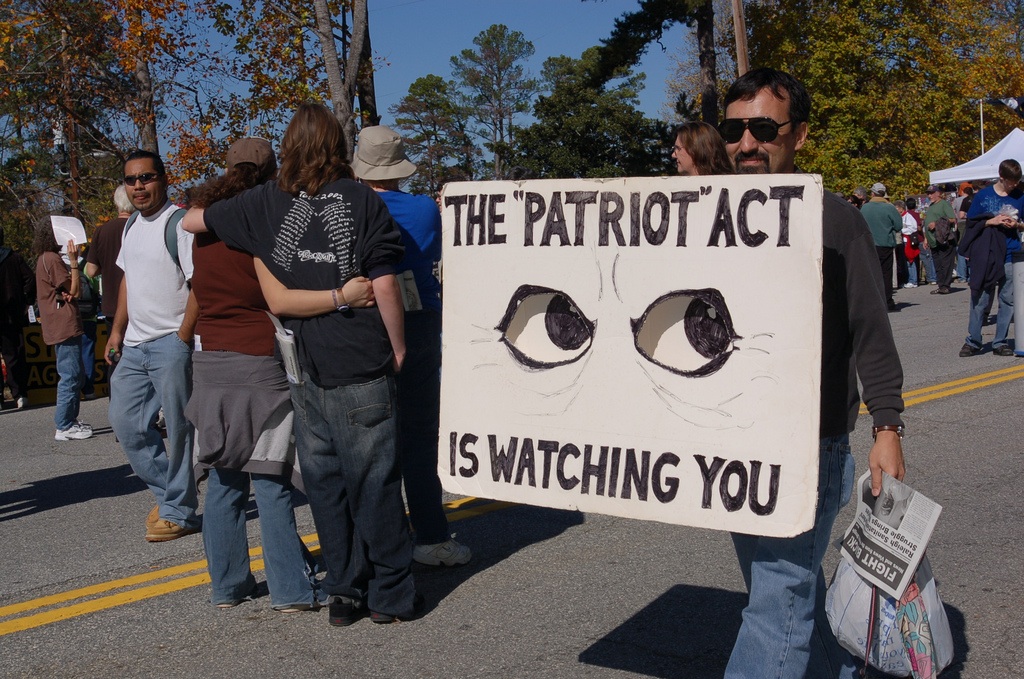
The patriot act is watching you. Image credit: Ashleigh Nushawg
What this amounts to is the exercise of repressive ‘secret laws’ which are completely antithetical to the ideals of liberal democracy. Here we have a massive, unconstitutional and global surveillance-industrial complex, installed by secret intelligence agencies and approved at the highest level of government without the knowledge of most British or American politicians – let alone the public.
This Cold War-style drama is fast blossoming into an international ‘incident’ and a serious embarrassment for the British and American administrations. The European Commission, whose Washington offices were found to be bugged, has described the leak as ‘disturbing’ and demanded full and transparent clarification of the NSA’s surveillance activities: a demand thus far met by deafening silence.
Furthermore, all indications point to there being much more under the surface. After a classified briefing by NSA officials last Wednesday, Democratic Rep. Loretta Sanchez said: “What we learned in there is significantly more than what is out in the media today… I believe it’s the tip of the iceberg.”
When it comes to spying on their own citizens, the US is using private contractors across the world, under the jurisdiction of the US National Security Agency (NSA) and their secret courts, and many allied countries have been tapping information from the covert Prism programme since 2010. Google, Facebook, Microsoft, Apple, Yahoo, Skype and a host of telephone providers have all been implicated. The true meaning of this, and the ‘secret laws’ which facilitate it, is perhaps best understood by those populations who remember what use totalitarian and fascist governments have made of far more incomplete data sets than what they now have access to.
In terms of inter-governmental surveillance, Obama’s renewed commitment to attend the G20 talks in St Petersburg has also been made a more empty gesture after the revelations about British and American spying during the 2009 G20 talks in London. During the talks, Snowden has revealed, British intelligence set up fake internet cafes to spy on allies and ‘enemies’ alike. According to an internal review, analysts were for the first time able to relay ‘a live picture of who was talking to who’ for the benefit of British representatives. Numerous allies have reacted with fury at the scandal, with the British ambassador to Turkey being summoned directly to Ankara to explain himself. Practices such as these display a shocking disregard for national sovereignty and democratic process, and their continuation has the potential to do serious damage to the stability of international relations on a global scale.
Shining a light in dark places
The US government has now charged Snowden under the 1917 Espionage Act, which was also used to bludgeon Bradley Manning. This is significant. Espionage is punishable by life imprisonment. Its use to persecute whistleblowers and the journalists that work with them implies that speaking to the press is tantamount to communicating with the enemy during wartime: a grave offence punishable by death under US law. Cases like Manning, Assange and Snowden are being used to launch a systematic ideological attack on the entire principle of press freedom. It is a bid, ultimately, to criminalise investigative journalism whenever it fulfils its purpose: which is to act as a check on tyranny, and keep the public informed on key decisions made in their name, especially, not except, when secrecy is involved.
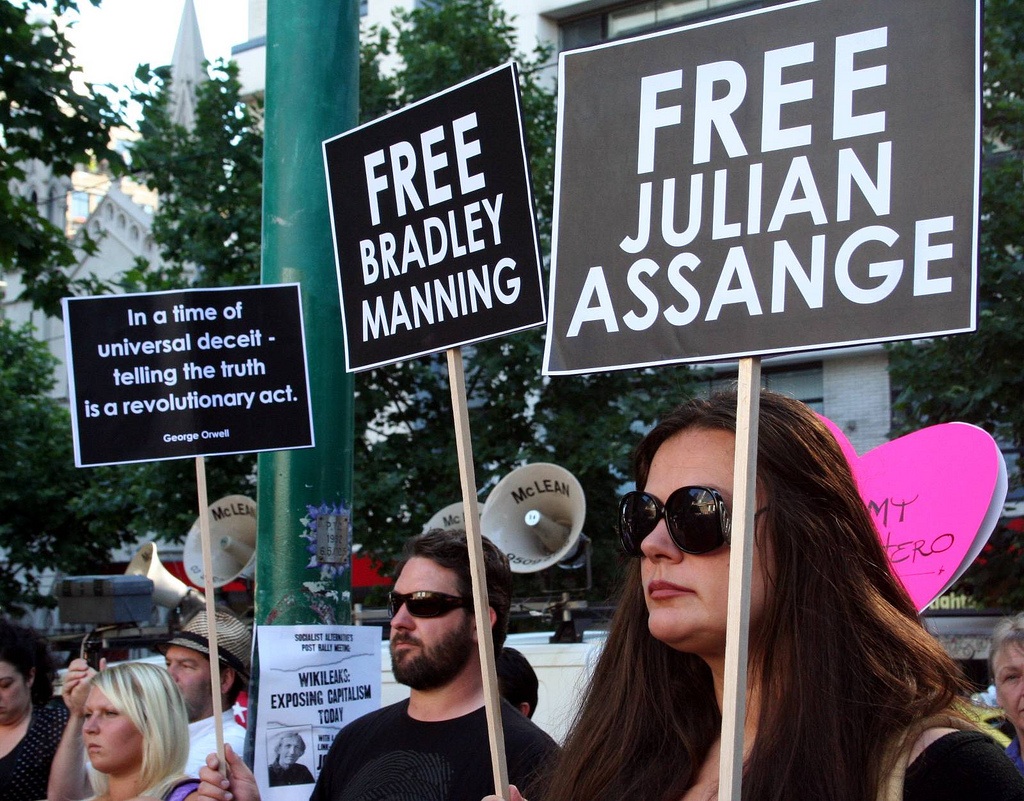
Free Julian Assange – Free Bradley Manning – Support Wikileaks. Image credit: Takver
Putin’s most recent decision to grant a temporary Russian visa to Edward Snowden and his farther is to be welcomed, and encouraged. If geopolitical rivalry provides an incentive, then in this respect it serves a valuable purpose: creating a space for the development of a counter-narrative to the perpetual propaganda of Anglo-American imperialism.
To preserve whatever is left of the media’s ability to provide a check on executive power and facilitate these leaks, so vital to the building of meaningful international democracy, it is essential that sanctuary be provided for whistleblowers who risk their freedom – and their lives – to shine a light in dark places and tell the public the truth. Now, the Putin administration must be held to their word, and the public must remain vigilant and ready to defend Snowden until he is safely on the ground wherever he ultimately seeks asylum.
Media Matters
Coverage of the whistleblowers’ story has become an effective litmus test for journalistic standards, which the bulk of the mainstream media is failing miserably. With honourable exception, notably the Guardian’s Glen Greenwald, it has been widely forgotten that for the media to do its job, it must be able – or at least willing – to protect those who volunteer information which not only sells papers, but is undoubtedly an issue of public interest. The bulk of news media today is governed exclusively by commercial interest, which is tempered only when the imperative to sell contradicts the most well-established political interests. Only then will the potential profit from covering an international scandal like this be given up to maintain their ‘special relationship’ with the state. With the political leaders of ‘the free world’ trying to relegate source protection to the history books, the political role of journalism in representative democracy has never been more contradictory.
There is nothing intrinsic to the fabric of the internet that secures its progressive potential. It is a contested battleground, and the willingness of Western governments to contest it – pushing for file-sharing restrictions, abolishing online privacy, persecuting whistleblowers and prosecuting Wikileaks with a secret Grand Jury – illustrates its importance. It is becoming clearer and clearer that the witch hunt for whistleblowers is motivated by political concerns rather than security concerns. While terrorist and organised crime networks have the money and motivation to encrypt their sensitive data, it is the conscience-driven whistleblower and everyday activist who is being watched. As privacy campaigner John Perry Barlow has pointed out:
One pertinent lesson from PRISM is that media ownership matters. Yes, it is shocking the intelligence agencies have been able to co-opt the courts to produce secret orders and embroil some of the largest telecomm corporations in their covert activity. But it is possible because enough of our online lives are monopolised by a handful of those corporations for government pressure upon them could yield a total surveillance system installed in secret right under our noses. Technology is a double-edged sword, and if this precedent goes forwards unopposed, our ability to communicate instantaneously and show global solidarity becomes a weakness because the state has a fly on every wall.
Of course, when governments want to use the media as an anonymous mouthpiece, they leak information themselves. It’s a tactic they have used for generations to break movements, swing elections and start wars. But no amount of respect for ‘freedom’ and ‘democracy’ will incentivise them to publicise their own abuses of power. Once upon a time, the free press was the most powerful and democratic check on this ability of the state to doctor the historical record. It was our means to speak truth to power and shine a light into the darker corners of Westminster and Washington. And it was what protected men like Bradley Manning from disappearing into cells without due justification, where he has been for over 1,100 days. That kind of investigative journalism is effectively being criminalised.
The case against the corporate media has never been clearer; nor the need to develop online and independently funded alternatives. But for their safety to be assured, the battle for internet freedom and online anonymity must be fought, and it must be won. It has never been more important because Big Brother has never before stared so hard – or been keeping so many secrets.
About the Author






[…] revelations by former NSA-contractor Edward Snowden of the worldwide mass surveillance organized by the American national …. For example, in Germany (53%) and Argentina (41%) the spying on Chancellor Merkel, and President […]
[…] Article Link: http://archive.the-ipf.com/snowden-censorship-the-surveillance-state/ […]