
On November 21, 2013, a chain of events began which have resulted in a crisis that many consider to be the most pressing threat to global stability today. When Ukraine’s ex-president Viktor Yanukovych suspended involvement with the EU in favor of pro-Kremlin policies, popular protests eventually forced him from office and set the stage for unrest in the country’s eastern and southern regions. In order to truly grasp the evolving situation in the embattled country as well as potential outcomes, one must understand the history of the Ukrainian-Russian relationship and the geopolitical framework of the region.
Russia has been an expansionist state for much of its history. Through a series of gains and losses beginning primarily with Ivan IV (Ivan the Terrible) in 1553, the country ballooned from relatively meager beginnings in Northern Eurasia to the apex of its reach during the Soviet Union. It is important to note that territorial expansion is not unique to Russia; many world powers including the United States have historically increased their lands through military means. What makes Russia different in the modern context is that it still holds revanchist policies despite the prevalent trend since the years of decolonisation and the dissolution of the Soviet Union to grant states sovereign independence.
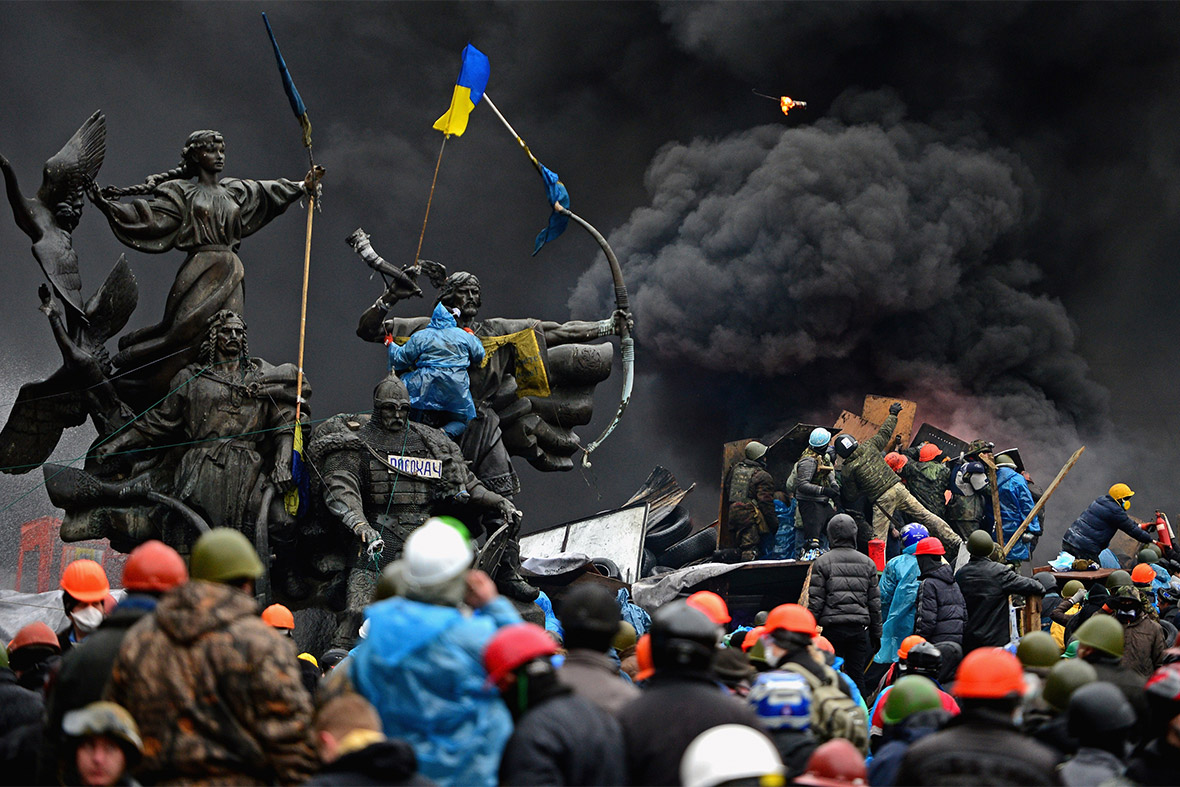
Battles on the streets in Kiev, behind monuments to the city’s founders. Image Credit: Getty
Two key understandings that will help properly frame Russia’s actions in Ukraine are Moscow’s relationship with the North Atlantic Treaty Organization and how it views its cultural position within the region.
Russia’s relationship with NATO
It cannot be argued that one of the original purposes of NATO was to serve as a military counter-balance against Soviet forces. In the words of Hastings Ismay, the British first Secretary General of NATO, the organization was created to “keep the Russians out, the Americans in, and the Germans down.” When added together with the enlargement of the alliance and the disputed agreement regarding its expansion after the Cold War, it is easy to understand Moscow’s discomfort towards what it views as a hostile force. This is by no means an excuse for unacceptably aggressive behaviour (unlike other international behaviour towards regions seeking independence, Moscow unilaterally sent troops to fight against a sovereign neighbour in a precedent-setting move that many see as a direct attempt to destabilise and/or absorb parts of Georgia), but it provides essential insight into Russian thinking.
Cultural interactions
The second consideration is the way Moscow views its interactions with its ethnic neighbors. Russia historically regards itself to be the head of a three-pronged grouping of Slavic peoples with Ukraine and Belarus being its “little brothers.” Indeed, Putin has referred to Ukrainians and Russians as being one people and called Kiev the “mother of all Russian cities.” Regardless of whether or not this is Putin’s genuine belief, it stirs nostalgia within the populations of both countries and lends to the president’s narrative of protecting his people against a hostile West.
During the current crisis in Ukraine, Moscow has shown Putin publicly speaking out for peace and stability in order to counter the West’s accusations of Russia fueling the war. This stance from the Kremlin, along with its broadening control of Russian media, has rather successfully positioned Putin as an international protector throughout Russophone Eurasia. Such success serves Moscow’s goals on two fronts: First, it engenders popular support for his efforts both domestically and within some of Russia’s “near abroad.” Second, it demonizes the political unrest that stemmed from the Euromaidan protest which ultimately went on to depose Yanukovych. The second point is particularly important because Putin views popular unrest as a clear and present danger to his own presidency. Following protests in 2011 and 2012 against his reelection, and in light of by Yanukovych’s ouster, Putin recently signed a law that restricts protests and extends jail time for offenders. What Western observers can learn from this is that he will be resolute in executing his vision of the future, and that he has a potentially exploitable weakness in terms of open political debate.
Shaky ceasefire
In recent days, the shaky ceasefire in Ukraine’s east has weathered several violations and potential deceptions from both sides. It is also providing much needed breathing room for policy makers to reassess the situation and develop plans for possible future scenarios. In addition, the lull allows humanitarian aid to be distributed to the thousands of people affected by the fighting, though the Ukrainian military claims this aid is intensifying the breaches of the ceasefire by secreting weapons across the Ukrainian-Russian border. In response to Russia’s continued involvement in the conflict, including the documented use by separatists of weapons not available outside of the Russian military, the West has increased its support of Kiev via aid packages and by providing military advisers. In addition to highly damaging sanctions, these types of non-lethal assistance appear to be the best tools the West can use to support Ukrainian forces outside of direct intervention.
Western policymakers are faced with tough decisions on how to best address a revanchist Russia. Recent Russian and planned American military exercises highlight the depth of the crisis not just for Ukraine but for the international community as a whole. While it is clear Moscow intends to solidify separatist gains, Western nations cannot simply allow Russia to continue its piecemeal reabsorbtion of its sovereign neighbors. However, with a clear knowledge of Russian history and its current world view, hopefully a more holistic understanding of the nuanced crisis will offer a perspective on how to deal with Russia as the rational actor that it is.
About the Author






First of all, there are two significant historical mistakes here.
Firstly, ‘Russia’ (actually Grand Principality of Moscow at the time) started expanding from the second half of the fifteenth century, almost a century before Ivan the Terrible. Whether a coherent policy or not, the expansion is called by historians ‘the gathering of Russian lands’. In fact, during Ivan the Terrible’s times Russia was unable to expand Westwards, massively loosing the Livonian War after some initial successes (although it did expand to the East, mopping up some of the successors of the Golden Horde).
Secondly, the characterisation of Kiev as ‘mother of the Russian cities’ is not Putin’s rhetorical invention as the author seems to suggest; the phrase is as classic as ‘Paris, the city of light’, and has been known and very widely used in Russia for decades, if not centuries.
Furthermore, the author has an obvious mistake at the star of the paragraph about Russia and NATO, as it definitely can ‘be argued that one of the original purposes of NATO was to serve as a military counter-balance against Soviet’.
Other elements are interesting as well. ‘Moscow unilaterally sent troops to fight against a sovereign [state]’. So has NATO, the US, the UK, France, Germany and a host of other states in Panama, Grenada, Iraq, Afghanistan, Libya, Balkans, Latin America. The inconsistency of the commentary on the rights of invasion and revolution is particularly obvious in the Western attitudes over the recent crisis in Yemen. (This comment is written about a month after the blog article.)
Moscow’s perception of its role in the region is much more justifiable by comparison to the way the US perceives itself globally. Russia may see itself as the elder brother of Ukraine and Belarus, but US rhetoric is miles further, from the ‘leader of the free world’ mantra to G. Bush 1992’s statement before a joint session of Congress. Remember? ‘A world once divided into two armed camps now recognizes one sole and preeminent power, the United States of America.’ What’s more, Russia’s perceptions of its role in the region, of its role within the post-Soviet environment, as well as of its security concerns are entirely justifiable given NATO’s gradual move eastwards. Is the usual response NATO gives Russia about the purpose of EIS/ Aegis installations in Eastern Europe supposed to be reassuring? Only a naive person would consider these as such, not least because installation of these systems in Eastern Europe is utterly unnecessary for keeping Iran under control (the justification offered). In fact, it can only be interpreted in one logical way: as anti-Russian strategic and tactical pre-positioning. Moreover, strategic concerns are not built around what is or is potentially going on now, but also what might be going on in the future. Are Russia’s strategic concerns not legitimate? Assuming the possibility of NATO’s expansion to continue, acceptance of an Aegis installation in Eastern Europe is not plain stupid.
Observations of Putin’s political machinations are more or less accurate, but how different are they from those engaged in by the ‘enlightened’ West? Putin confirmed a law about demonstrations. Have we forgotten the ‘free speech zones’ and other US regulations about protesting at presidential rallies? And are US officials not speaking about peace while simultaneously very actively fuelling warring attitudes despite Minsk II creating a certain -if imperfect- framework for negotiation? I am inclined to agree with Prof. Stephen Cohen in that there is a sustained effort to push for all-out war in Ukraine despite everything. Moreover, I think it is the US who is actively pursuing this, since a war benefits neither Russia, nor the European Union.