
Academics and human rights activists across the world have recently started a petition to defend academic freedom after a class about the history of the Israeli-Palestinian conflict was cancelled at Columbia College, Chicago, on suspicion of bias.
The incident dates back to last fall, when Mr. Chehade held the screening of “5 Broken Cameras”—the Oscar-nominated documentary which depicts the life of Palestinians under Israeli military occupation. The man, who has been teaching the course since 2010, was promptly summoned for a meeting with the school’s administration following a complaint of bias from one of his students. To his surprise, Department Chair Steve Corey told him to teach the course in a more “balanced” way and subsequently cancelled one of the two sections of the course he was running.
The decision to cancel the class prompted the reaction of the American Association of University Professors (AAUP), whose members wrote a detailed letter to Dr. Louise Love, Columbia College’s Provost. In the statement, the group argued that retailing against a professor for engaging students about pressing social issues, without giving him the opportunity to defend himself, is a clear violation of academic freedom. “The lack of transparency in which a professor cannot challenge his accuser”, they added, “is an affront to due process and a shocking display of arbitrary treatment of a faculty member”. Furthermore, they observed that showing the documentary film Five Broken Cameras, which depicts popular resistance to Israeli occupation in a West Bank village, does not constitute bias, as it is rather an informative and thought provoking activity.
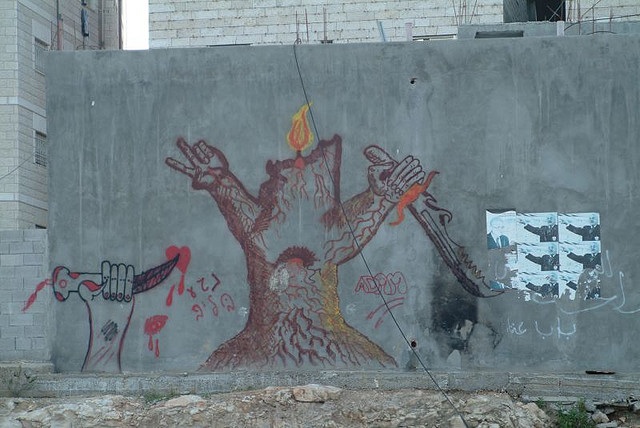
Drawings on the separation wall between Israel and Palestine. Image credit: David Lisbona
The film, which was co-directed by Palestinian Emad Burnat and Israeli Guy Davidi, was indeed widely acclaimed when it was launched in 2012. After winning numerous awards across the world, it received positive reviews from critics and was praised by Israeli authorities and media themselves, to the extent that they even falsely claimed it was an Israeli production. It follows that, by preventing Mr. Chehade to teach his class, not only has the institution failed to understand the meaning of the film, but it has also shamefully revealed its bigotry.
But the school, which has a large American-Jewish and Pro-Israeli population, is not new to such manifestations of prejudice and intolerance. In 2008, Professor Suriya Smiley was fired from her job after being accused of being “anti-Jewish” from one of her students. In this case too, the school procedures didn’t require the administration to contact other witnesses to shed a light on her alleged discriminatory conduct. Seemingly, in 2011, eight students accused Professor Chehade himself of bias when he referred to the West Bank and Gaza as the “Occupied Territories”—instead of “Disputed Territories”, which they preferred—and to the Israeli occupation as “ethnic cleansing”.
These episodes clearly strengthen the idea that Palestine has increasingly become a taboo at Columbia College—and perhaps not only there. The bigotry of a few can in fact define an alarming trend that is widespread among American society, as theorist and intellectual Edward Said argued in one of his last publications. More broadly, it is then possible that discriminations of this kind in local institutions are the reflection of the political intimacy between Washington and Jerusalem. After all, just like Columbia’s administration, the central government has repeatedly adopted controversial measures to defend the ideological supremacy of Israel on the south-eastern shore of the Mediterranean Sea—notably, the recent decision to stop UNESCO funds following the organization’s official recognition of Palestine as a member state.
As he prepares to abandon his class, Professor Chehade remarks:
This belief is precisely why it is so important to carry on the fight to defend academic freedom at Columbia College. After decades of humanitarian crisis and diplomatic failures in the Israeli-occupied territories, education and information might indeed be the only tools left to advance peace in the region. Knowledge, they say, is power.
About the Author





