
Scores of non-governmental organizations sprout every year in Geneva. Many of them dedicated to Human Rights in one way or another. So when a new NGO is established on the same theme, it draws little or no attention because it is assumed that the approach to Human Rights has long been well defined, the path well trodden, and the objectives continuously clarified.
However, a couple of months back, an NGO was established in Geneva with the broad undertaking of advancing Human Rights in the Middle East and North Africa through the instruments of global dialogue. The mission of the Geneva Centre of the Advancement of Human Rights and Global Dialogue is in itself praiseworthy as there are practically no institutions that have set out to achieve such a lofty goal, particularly in a region where the clash of values, traditions and religions invariably leads to violations of the most basic of human rights. Not to mention a variety of systems of governance which cover all the shades from democracy to dictatorship and occupation by military force.
The ambitions of the new Centre draw attention to its determination not only to compile, monitor, document, denounce and remedy human rights violations in this region of the world in accordance with universal principles, but to tackle an elevated and commendable goal which is the contribution to the evolution of human rights concepts. Apparently from the literature already available on the new NGO, its founders, an international team, have embarked on the difficult task of expanding and innovating existing concepts on human rights by invigorating dialogue between communities, civilizations, religions and societies at large. Their objective is to develop awareness of societies and cultures in view of achieving more balanced policies and procedures to improve the status of human rights and global tolerance.
On a more local level, the Centre is resolute on another objective: propagate human rights awareness among the general Arab and Muslim populations and, for this purpose, it intends to propose training and education courses with lectures, workshops, seminars and an exposure to the international human rights organisations for professionals and students alike. As for advocacy, the objectives are, to say the least, daring: the Centre intends to submit reports to regional and international agencies in respect of recurrent violations of human rights in the MENA region. It will prepare documented reports and complaints in respect of violations of human rights falling within the Centre’s areas of interest in order to seek and propose remedies for such violations. It will also provide advice on policies and procedures to governments when solicited.
The region certainly lacks major actors bent on the safeguarding and respect for human rights and dignity according to established international standards. And if recent history is a measuring paradigm, global dialogue on the values of justice, tolerance, and an overall humanistic dialogue have been practically inexistent.
This new NGO’s approach is certainly refreshing. The Human Rights arena has been constantly inundated with reports on Israeli violations of Palestinian rights. This is justified in view of the persistent occupation of Palestinian territories by the Israelis. It is also warranted because of the flagrant abuses of Palestinian human rights perpetrated by Israel over the last 46 years of its occupation of those territories. But this does not obliterate the fact that brazen violations have been committed in more than one Arab country where human lives are dispensable by the thousands.
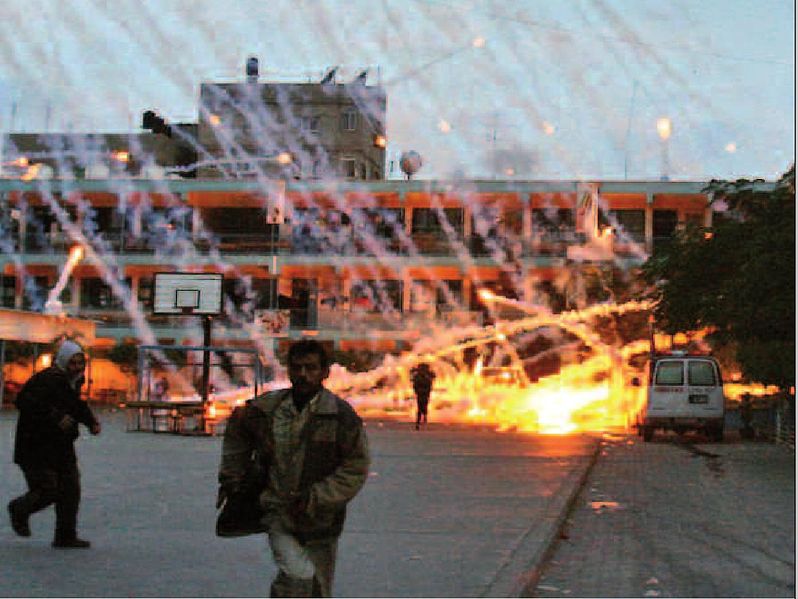
An Israeli white phosphorus attack on the UN school in Beit Lahiya on 17 January 2009, during Operation Cast Lead. Image credit: HRW
The Centre’s approach is also inspirational. Middle Eastern societies have experienced upheavals and turbulences for practically a century, since the fall of the Ottoman Empire which encompassed all those regions after World War I. From dictatorships to feudalities, the peoples of the region have been systematically crushed, their civil rights raped, their aspirations stifled, their cultures and religion mocked and demonized. They had no voice. International human rights concepts bypassed their specificities. Their traditions and values had no place in the international arena preoccupied by first distancing itself from Nazi atrocities and then by nursing the scars of a decolonization process which proved to be murderous. Arabs were specifically ignored. Human rights, as far as they were concerned, were in the hands of brutal dictatorships catering for Western powers obsessed by access to resources or of outmoded governance structures and rulers possessed by fanatical, archaic or obsolete ideas and practices of religion.
By addressing the exigent need for innovative solutions in the approach to human rights, the Centre seeks to promote the much needed coordination between individual organizations and governments who are willing, albeit with inconsistent attitudes, to engage in this process. By engaging authorities in this path, the Centre hopes to strengthen the observance and upholding of human rights particularly in situations where humanitarian assistance is required. By conducting surveys, publishing reports concerning issues of regional importance and convening symposia and conferences, the Centre hopes to become the venue for meetings of leading personalities from the region who share the Centre’s vision.
Quite an ambitious and provocative program. A ray of hope in a region tormented by erratic upheavals and an encouragement for the rare governments who are already engaged in this path.
About the Author





[…] Scores of non-governmental organizations sprout every year in Geneva. Many of them dedicated to Human Rights in one way or another. So when a new NGO is established on the same theme, it draws little or no attention because it is assumed that the approach to Human Rights has long been well defined, the path… […]