
With only a few days remaining to the Iranian elections, many speculations are made concerning the possible outcomes. Although most Iranians experience suppression by the regime on a daily basis, and the elections are far from democratic, it would be wrong to suggest that the Iranian voter is apathetic, that the outcome of the elections is already decided upon or even irrelevant.
After Iran’s last national elections in 2009, the biggest protests since the revolution of 1979 broke out. Many supporters of the defeated candidate Mir Hossein Mousavi marched the streets of Tehran, claiming that the elections were unfair and that Ahmadinejad was a dictator. The protests were harshly suppressed by the regime, resulting in hundreds of arrests, the use of live ammunition and other forms of intimidation. After the uprising was successfully put to an end, a great disillusionment with democratic change and reform set in.
However, running up to the 2013 elections, almost 700 candidates registered themselves to run for the elections. Some of them merely tried to make a statement. The few dozen women that registered were of course well aware of the fact that the Islamic Republic has never allowed women to run for president. Others were genuinely hopeful, like Akbar Hashemi Rasfanjani, a former Iranian president, and Esfandiar Rahim Mashaei, the protégé of current president Mahmoud Ahmadinejad. However, the Guardian Council (highly influenced by Khamenei) allowed only eight candidates to participate in the elections, excluding both Rasfanjani and Mashaei. Rasfanjani openly supported the green movement in 2009, and it was a tactical decision not to let him participate out of fear he would attract voters that hold anti-regime sentiments. Mashaei’s victory would have ensured Ahmadinejad’s influence in a new government, something the supreme leader was keen to avoid by excluding him from the elections.
Over the past few months, Khamenei’s rhetoric hasn’t left much to imagination; he will no longer tolerate any direct challenges to his supreme authority. A propaganda campaign is launched by the Revolutionary Guards and security forces, which has led to the arrests of activists and bloggers, and the shutdown of websites and newspapers.
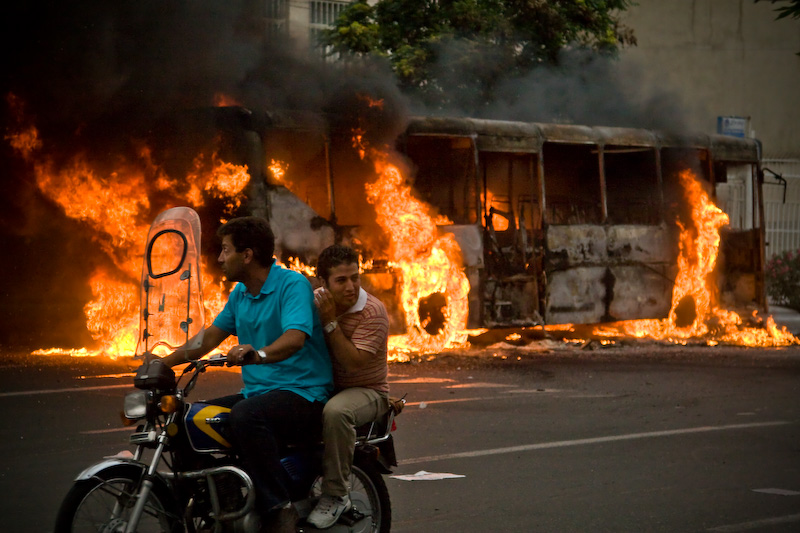
Protests after the 2009 Iranian election. Image Credit: Lapost/Wikimedia Commons
Although the eight remaining candidates are often referred to as Khamenei’s puppets, not all of them necessarily endorse his political views, and they differ from one another in their views of the relationship between Iran and the west. Arshin Abid- Moghaddam, Chair of the Centre for Iranian Studies at SOAS, University of London, argues that within certain limits, a spectrum of variety is allowed in the elections.
The only candidate that openly calls himself a reformer, Mohammad-Reza Aref, is not a prominent figure and is very unlikely to win the elections. However, Hassan Rouhani, who calls himself a moderate cleric, is perceived as a reformist too. Rouhani is a former nuclear negotiator, and was partly responsible for halting the enrichment of uranium and an increase in cooperation with the inspectors of the International Atomic Energy Organization in the last few years. It is his ambition to improve Iran’s damaged relations with the West.
In the centre of the spectrum are current major of Tehran Mohammad-Bagher Ghalibaf; a pragmatic conservative, Mohsen Rezaee; a conservative that has recently shown some tolerance towards the freedom of expression, and Mohammad Gharazi; who holds relatively moderate political views, but is not a prominent figure.
On the conservative side of the spectrum are Ali Akbar Velayati; a conservative figure that is close to Khamenei, Glolam-Ali Haddad-Adel; known for his anti-Western ideas, and Saeed Jalili; currently the head of Iran’s nuclear negotiating team. Jalili is perceived as Khamenei’s favourite candidate. He has close ties to the supreme leader, and is seen as the most conservative and anti-western candidate.
It is clear that the regime is wary of a repetition of the events of 2009, and is ready to suppress any opposition. However, there is still some space for critique and protest. Satire is found in the fictional character of Zahra, a middle class Iranian woman who runs her own election campaign online. Zahra is calling for democracy, dignity and justice, and attacks the corrupt political system to ‘win back our Iran’. More subtle critique is expressed in a popular puppet show on TV. A puppet called ‘red hat’ touches upon sanctions, inflation and the lack of free speech. One of his puppet friends, a donkey called ‘Darling’, is a controversial figure. His appearance suggests he is homosexual, and after rumours spread the government banned the donkey from the show, he returned wearing duct tape over his mouth. The other puppets explained he said things he shouldn’t have had, and was now punished for it. Apart from this satire, last week the BBC reported the ‘biggest anti-government protest for years’, at the funeral of a senior pro-reformist cleric in Isfahan. The protesters called Khamenei a dictator, and called for the release of political prisoners. The protest was not suppressed by the regime, probably out of fear of provoking more anger just a few days before the elections.
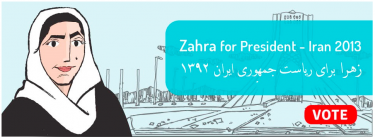
Zahra is calling for democracy, dignity and justice.
Despite the fact that the elections in no way resemble free and fair elections in accordance with international standards, it would be a mistake to think the Iranians are therefore apathetic. There seems to be an interesting paradox here. On the one hand, many Iranians see the elections as a sham. On the other hand however, they do believe their votes are still meaningful. Many Iranians have not lost their hopes for a democratic process. Abid-Moghaddam told Al Arabiya English: ‘There is too much at stake, and Iranians have become accustomed to exercising the democratic right to vote.’ Therefore, it is likely that the voter turnout will be relatively high on June 14th.
About the Author





