
Through a combination of renewable energy, power conservation and using 12-volt systems, households could significantly reduce their power usage and reduce greenhouse gas emissions.
Abovyan Street, which leads into Yerevan’s central square, is lined with shops, cafés, restaurants and clubs. At night it is brightly lit and full of people. The street is alive; it even has its own Facebook page.
But it wasn’t always like this. One night in November 1995, I had to inch my way along Abovyan in total darkness. The electricity was out. There were no shops, no bars, no people, and hardly any traffic. I couldn’t see my feet. This was not a minor problem: holes, ditches, and open manholes lay across my path. To move, I had to wait for a car to pass so that the path ahead would be illuminated. I would move a few hundred meters, then stop to wait for the next car. It took a long time to get home.
Armenia’s power sector was in crisis. The country’s Metsamor Nuclear Power Plant was closed after the devastating Spitak earthquake in 1988. In 1991, the Soviet Union collapsed, triggering an economic crisis. Tensions with neighboring Azerbaijan over the Armenian enclave in Nagorno-Karabakh broke out into war. An Azeri blockade cut Armenia off of the Joint Transcaucasian Power Grid, resulting in severe power shortages.
As a result, most Armenian households had power for only a few hours a day. It wasn’t only a question of lights and televisions. Refrigerators could not keep food fresh. Water pumps didn’t work. Lifts stood idle. People organised their lives around the scheduled hours when power was available. It was not uncommon for people to store water in their bathtubs, refilling them when the water pumps could run.
![Metsamor Nuclear Plant [Image Credit: Urban Times]](http://archive.the-ipf.com/wp-content/uploads/2013/11/ut1.jpg)
Metsamor Nuclear Plant [Image Credit: Urban Times]
Innovative Household Solutions to the Power Shortage
The sound of diesel generators soon became part of the city’s soundscape. But most people couldn’t afford to buy or run generators. Some turned to the illegal electricity market, paying bribes to tap into the power supply. Wires stretched between buildings like spider webs. My flat was one of them; my landlady had disconnected the official power supply and shared a line with my neighbors. I had constant but dim light until I accidently reconnected official city power. The illegal line heated up, burst into flames, and exploded. Accidental death by electrocution was not uncommon.
The solution that most households came up with was based on car batteries and transformers. When the power was on, the batteries charged. These would power a secondary 12-volt power system. Besides providing light, the system could run radios and 12-volt televisions. They weren’t powerful enough to run washing machines or irons, and of course could not run lifts, but they significantly improved the quality of life.
A Partial 12 Volt Solution?
Although I never set up this kind of solution myself, I saw car batteries in action in the homes of every Armenian family I visited. I was struck by how much can be done with 12 volts. Years later, I saw similar systems in remote locations in Mongolia, which recharged their batteries with solar power.
I’ve always liked the idea of off-grid power. But is it necessary to have a power shortage to use it? Why not install parallel, off-grid 12-volt systems in households today? With the right kind of bulb, you can get excellent indoor lighting. Computers, cell phones, televisions, DVD players and other electronics can easily operate on 12 volts. Many kitchen appliances could run, as well as power tools and fans. Household water pumps can operate at 12 volts, as can refrigerators designed for boats or campers.
A 12-volt system could also integrate with home-based solar or wind energy generation. Households could still tap into the regular power grid for heavy electricity needs, such as electric heating. Through a combination of renewable energy, power conservation and using 12-volt systems, households could significantly reduce their power usage and reduce greenhouse gas emissions.
A downside of a 12-volt system, at least in the short run, would be cost. An article in homepower.com points out that 12 volt systems are expensive, and that direct current (DC) is not as efficient as alternating current (AC). But the author points out that household energy use could drop from 25-30 kWh per day to about 10. High costs could be a temporary issue: if more people adopted 12-volt systems, equipment producers would have the incentive to design and build more 12-volt devices for household use, and more households might be tempted into trying renewable energy.
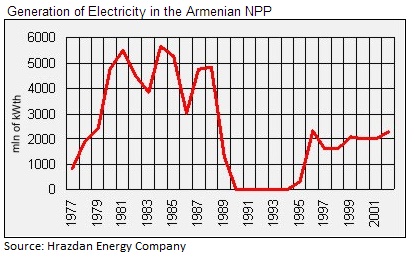
Nuclear power generation in Armenia.
A Final Lesson
Armenians today no longer use their 12-volt systems. The war with Azerbaijan ended in 1994, and in 1995, the nuclear power plant was reopened in spite of international objections. There is enough power to light up homes, schools, factories, and even the street lights on Abovyan Street. Does this mean that 12-volt solutions have no use?
Perhaps. In the short term, the average household may not have the incentive to make use of a 12-volt system. But seeing how Armenians adapted to the power shortage has made one thing clear: when fossil fuels are no longer viable for producing power, people can and will adapt. Perhaps by then there will be better solutions than 12-volt systems. But clearly, human capacity for innovative and creative solutions is tremendous.
This article was originally published on the Urban Times.
About the Author






[…] Through a combination of renewable energy, power conservation and using 12-volt systems, households could significantly reduce their power usage and reduce greenhouse gas emissions. Abovyan Street, which leads into … Article by electricity shortage – Google Blog Search. Read entire story here. […]