
Since the assassination of Hamas’s military commander, Ahmed Al-Jabari, who aided in the negotiations to release captured Israeli soldier Gilad Shalit, on November 14th as part of Operation Pillar of Defence, Israel has continued to strike the heavily residential Gaza strip whilst military factions in the strip continue to pound Israel in arbitrary rocket fire.
The escalating conflicting resonates particularly with me as I lived in Israel for a year, during which time I visited the heavily bombarded Israeli city of Sderot. Throughout the past few days, people have been tweeting under the polarised #IsraelUnderFire and #GazaUnderFire, and the media has been discussing the disheartening deaths of children in Gaza who have been injured or worse during the attacks by the Israeli Defence Forces (IDF). However, having firsthand knowledge of the everyday trauma of running from a ‘tzeva adom’, the code red sirens which warn of oncoming rocket fire, followed by the rush for the nearest bomb shelter, I can testify that this isn’t the whole picture, and that the recent violence isn’t a new phenomenon. Hamas and other factions have particularly targeted Israel for the past decade during the times school is starting or leaving; a bid to heighten the causalities and in reality have led to a vast proportion of Israeli children suffering from Post Traumatic Stress Disorder.
The concept of ‘proportional force’ has been bandied about, both in regards to the 2008 Operation Cast Lead and the recent hostility. I believe this is a legitimate argument to use, until one digs a little deeper. How exactly can one measure what is proportional in warfare? If we look at intent, the amount of rockets sent in by militants in the Gaza strip to Israel amount to over 880, at the time of writing, hinting that with each attack deaths were intended. If we look at the death toll in Gaza with over 130 killed and over 940 injured, we can see a more proportional sum. Nonetheless I would argue in terms of intent, the factions in Gaza including Hamas, the ruling group, are indiscriminate whereas the IDF claim they drop letters, warn residents of impending air strikes and use highly precise targeted missiles to ensure the least amount of civilian casualties in their bid to weed out the terrorists who live amongst them. Furthermore Israel lays out many reasons as to why their death toll appears to be so small, currently standing at 5, in comparison to civilian deaths in Gaza. The ‘Iron Dome’ system has been employed specifically targets missiles and destroys them before they reach residential areas in Israel, ignoring the ones which will fall in open areas away from the Israeli population. With the high cost of the Iron Dome system running into the tens of thousands for each missile eliminated, the high priority that Israel places human life is evident. This is in comparison to Hamas ruled Gaza; there are no bomb shelters and no procedures for escaping Israeli air strikes when they go wrong, as it did when Israel hit a Hamas police headquarters on November 20th which killed fewer than 10 civilians in the same building. Israel’s Operation Pillar of Defence, I would argue, comes from the same mantra of protecting Israeli civilians as Iron Dome does; Brigadier General Yoav Mordechai has stated that there has been a significant reduction of rocket attacks at approximately 40% fewer than before the Operation began.
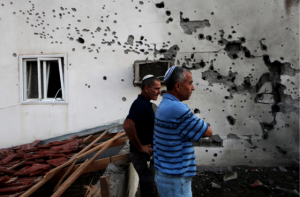
After a missile sent from Gaza hits a house in Ofakim, Southern Israel ABIR SULTAN / EPA
Troublingly Hamas has acquired higher grade weapons which could prove fatal if Israel does not continue to attempt to eliminate Hamas military leaders and weapons. Gone are the days when only qassams, often deadly homemade rockets without precision targeting systems with a short range, are the weapons of choice for Palestinian militants. US cables suggest that Iran has been smuggling weapons into the Strip through the tunnels, which has given Hamas the capability to attack targets more than 60km away, including the highly populated cities of Tel Aviv, and for the first time since 1971, Jerusalem. This suggests a movement towards a more conventional form of warfare with the likelihood of more devastation for Israel.
One worrying development has been the bus bomb in Tel Aviv on November 21st; the war is no longer based on missiles firing from either side or air strikes, militants are resorting back to guerrilla warfare, this time injuring over 20 civilians indiscriminately. Hamas has responded by promising more “black body bags” which puts to question their acceptance of the ceasefire on November 21st 2012. As does the Israeli strike on a football field in Gaza only hours after the bomb blast in Tel Aviv.
During this conflict how can both sides move forward towards an accepted two state solution and end the bloodshed that has plagued both Israel and Palestine? William Hague, the British Foreign Secretary, in his Middle East statement on November 20th in the House of Commons said that the time for the two state solution is ending, but he supports Palestinian aspirations and Israel’s right to exist and defend itself. I would argue that Palestinian factions, such as Hamas, the Islamic Jihad Movement in Palestine and the Popular Front for the Liberation of Palestine, need to join forces to ensure all groups adhere to any potential ceasefire. Israel’s right-wing government, that includes the far-right and racist Yisrael Beteinu party, needs to get to the negotiation table to ensure the ceasefire that was declared remains so that they can eventually lift the blockade on Gaza which is causing Palestinian civilian misery due to their leader’s inability to control violence against Israel. Any hinting of a ground invasion is something Israel needs to avoid at all costs, but how many more rockets can Israel take before Operation Pillar of Defence turns into Operation Cast Lead II?
About the Author






On the whole a good post, in my opinion. There is an elephant in the room that keeps on being overlooked. This latest round of rocket firing should and could have been controlled or prevented.
How?
In January 2009, the EU, US and Egypt brokered a ceasefire agreement between Hamas and Israel. Part of the agreement was the guarantees provided by these parties to police the borders with Gaza and to prevent weapons into Gaza. Britain agreed to patrol the high seas to prevent shipments of missiles and arms from Iran via Syria, Egypt and Sudan, into Gaza. They failed for sure, but they also breached the the agreement. The purpose of truce, apart from stopping hostilities, was to prevent rockets and more attacks and to move on the 2 sides to encourage dialogue and talks that might have created a momentum to lead to a more permanent settlement. The truce therefore had the characteristics of a 3- legged chair. If the third leg is removed the chair will collapse. Unsurprisingly therefore, the current crisis was at high risk of re-occurring because the guaranteeing parties failed to adhere to the deal.
Today we read that there is now a ceasefire. Is this a “hudna” or do we expect a longer term commitment to cease hostilities. Where is the third leg?
Great article, Joshua: after the cease fire a top Hamas official in a presstv article thanked Iran for the rockets, but not import of rockets, but the mere knowledge of how to make Fadjr5’s. If it is to be believed that the Gaza strip is home to weapons factories, it makes for a scary future. If you then consider Hamas has announced they are working underground, it gets even worse. Hamas, with arms factories, underground, producing however many rockets that have the potential of hitting Jerusalem and Tel-Aviv.
[…] Avoiding Operation Cast Lead II […]