
As the IPF prepares to launch a new initiative on politics and sport, it seemed worthwhile to reflect on what sport can do for society.
The politics of identity has been of interest to me since university, when as part of a module on British political thought since 1850 I studied multiculturalism and Enoch Powell’s infamous “Rivers of Blood” speech. I remember a tutorial discussion in which I suggested a person’s identity could be constituted of various “badges” across racial, religious, cultural and countless other categories of identity.
Personally, I self-identify as British, straight, atheist, rationalist and libertarian – all of which are expressions of a position in these “high” categories of race, religion, politics and so on. But it’s also important to my sense of self that I am a Guinness drinker, a video gamer (shooters, RPGs and strategy games, preferably), an admirer of the cultures of North America and Latin America, and big on going to pubs and clubs with friends. I happily attach to myself badges of identity that describe not only what I believe and where I’m from, but what interests me, and what I value doing with my free time. My sense of self emerges as a more-or-less coherent patchwork of these badges.
Multiculturalism can be thought of as a society’s struggle to knit a much bigger and more complex patchwork, making room for many more badges. For all its benefits and its enlightened attitude to other cultures and creeds, it’s hard to argue that multiculturalism hasn’t challenged traditional ideas of identity. I should say that I don’t speak exclusively about Western cultures seeking to accommodate the many different badges of non-Western immigrants, but also about conflicts sparked by different badges, many ethnic or religious in nature, coexisting in countries all around the world. In this sense, the current problems in Gaza, or with the Tutsi M23 rebels in DR Congo, or persecution of Muslims in Burma – all these and many other conflicts could be said to be at least partially problems of multiculturalism.
In 2006, when I was 18, I toured South Africa with my school rugby team. We stayed with the unfailingly generous and humble local families whose children went to the schools we played, and my hosts varied widely across religion, race, affluence and other categories of identity. Some had limited command of English, and many came from backgrounds very different than my own.
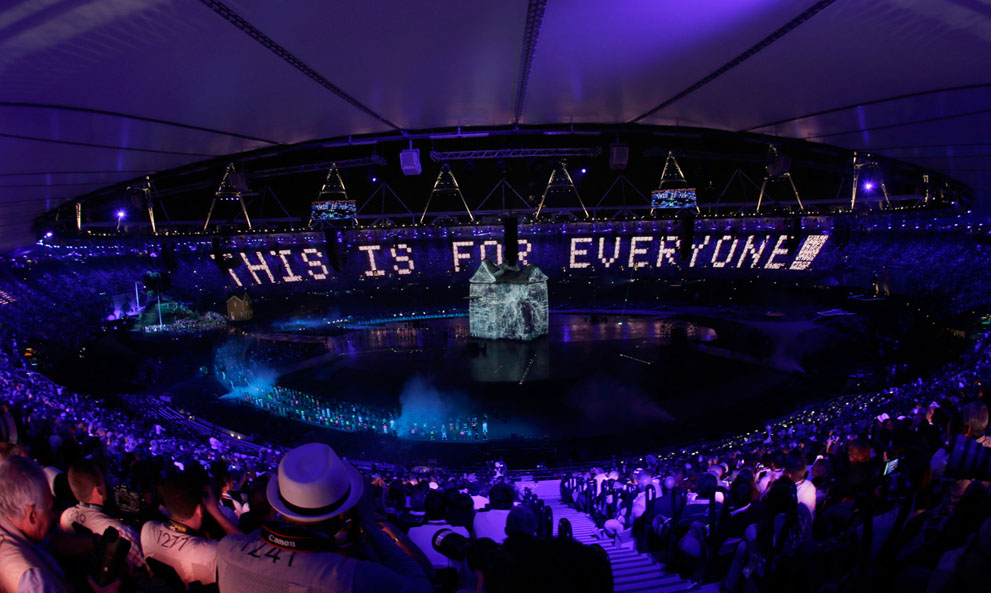
I found that it was sport – specifically, rugby and football – that enabled conversation, laughter and a sense of commonality. When I travelled around South America, locals would, upon learning we were British, strike up conversations about Manchester United (the only times I’ve regretted my preference for rugby over football). And the politicians are right when they say there was a certain national camaraderie during the Olympics this summer that united Britons of various backgrounds.
To the badges that I discuss above, I can add ones that relate to sport: I am a skier, a rugby player, a gym user, and a too-occasional SCUBA diver and surfer. I am also a supporter of London Wasps, Arsenal, England and Team GB wherever they compete as such.
Some badges are mutually exclusive – fascist and anarchist, say – but given it’s possible for both a fascist and an anarchist to support the same football team (unless you’re talking about an anarchist so extreme he or she rejects the existence of any institution), it is possible for them to find common ground.
Sport, to me, is a very important plank in my internationalist worldview. I believe humans share more badges in common, than are divided by the mutually exclusive badges which cause antagonism. The problems come when we attach more value to an especially polarising badge – such as one relating to ethnicity or religion – than perhaps we should. If just a few mutually exclusive badges were put into perspective, dropped entirely, or their importance somehow reduced relative to all the badges we share – such as in sport – then a very great deal of suffering could be averted and generations of division could be repaired.
Of course, sport doesn’t always succeed in creating peace and commonality across cultures. Indeed, the phenomenon of football hooliganism, from its dark days in English football to its equivalents in football-mad nations in Europe and South America, proves that sport can sometimes create conflict between groups that ought to have more in common than in difference.
Yet I’m sure there’s a wealth of anecdotal evidence we could source from readers regarding heated arguments about politics, religion or nationalism that have been diffused with a throwaway comment about sport (please do leave such stories in the comments, if you’d like to share). We can return to the Olympics to see such stories on a nationwide scale: for all our enthusiasm about Team GB’s success, it’s generally agreed that the British weren’t jingoistic, and received international fans with warmth and humour. The post-Olympics glow isn’t just coloured with national pride, but with the life-affirming realisation that the whole of the human race can get along, which is infinitely more important in my estimation.
I’m not about to suggest that all the world’s social problems will be solved through sport, but I do wonder what would happen if you could get the most fervently Zionist and anti-Zionist champions in a room and temporarily make them forget their badges in the current conflict so they could discuss other things. I wonder whether they would both discover themselves to be Manchester United fans.
AP Photo/Charlie Riedel
About the Author






[…] course, as a previous article on the IPF argued, it would be naïve to suggest that some of Europe’s most deep-rooted political problems […]
[…] Olympics, ushered in hopes for increased women’s rights in many repressive states, and the spirit of the games embodied much that was positive about the role of sports in society. Everyone came together to […]