
A year ago, in January 2013, the UK government announced its intention to ban khat, a herbal stimulant which is mainly produced in the Horn of Africa and is very popular amongst African communities across the world. The plant, whose leaves are chewed repeatedly for hours as a social and culture-based activity, is known for causing immediate relaxation and a mild euphoria, although it is also believed to have several side effects, including insomnia, depression and oral cancer. Moreover, speculations suggest that khat, which is already illegal in several European countries, as well as in the US and Canada, is used as a means to fund Islamic terrorism and Somali piracy.
Throughout the year, the debate over whether khat should be illegal has grown exponentially and the UK is now on the verge of facing one of the most controversial measures of its drug policy. On the one hand, the ban has been supported by Home Secretary Theresa May and by part of the Somali community in London, who lamented the drug is tearing their people apart. On the other hand, doubts have been raised by several MPs and by the Advisory Council on the Misuse of Drugs (ACMD). The UK drug advisers, following a detailed analysis, assured that khat has no direct causal link to adverse medical effects, and that adverse outcomes are rather associated with the interaction of the substance with other factors, such as alcohol. More importantly, they denied the link between organised crime and the khat trade, which in the UK is regulated by the government in line with legal principles, according to which producers and distributors are regular taxpayers.
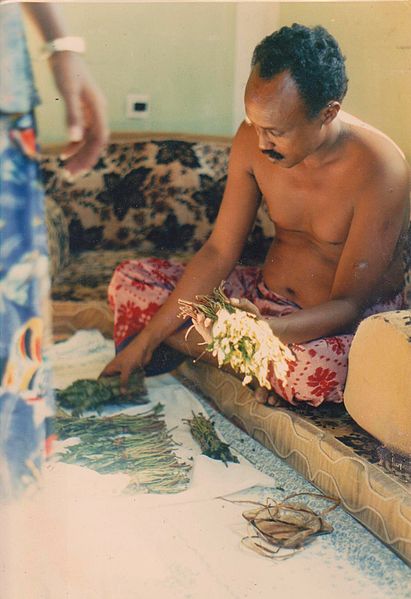
Man dividing khat into bunches in preparation for a long evening of tea, conversation and chewing. Image credit: Anna Frodesiak
Despite the experts’ advice that there is not sufficient evidence to support the ban, conservative MP Theresa May urged to take into account broader policy considerations. In particular, she expressed strong concern that the UK could become a hub for the plant’s illegal onward trafficking. “Failure to take decisive action and change the UK’s legislative position on khat”, she stated, “would place the UK at serious risk of becoming a single, regional hub for the illegal onward trafficking to northern Europe [where it is illegal]”.
However, according to critics, the socio-economic consequences of the ban amongst African communities, both in Africa and in Britain, have not been properly assessed. Currently, in Kenya, the khat trade is a multi-million dollar export business, which has contributed to the economic development of some areas that are now amongst the richest in the region. As Vice UK recently reported, thousands of farmers, traders and stakeholders who are involved in the business will soon lose their jobs, crippling the economy of the entire country. With up to 60 tonnes exported to London each week, khat trade is their only means to survive within an economic context that would otherwise offer very little alternatives.
To this regard, the Home Affairs Committee recently warned that precarious economic and social conditions amongst these communities might consequently increase the threat of drug-related crime. As the ban will inevitably make the illicit trade more enticing for criminal organisation, people once employed in the business are expected to become the primary target of organised crime recruitment. The prospect of a life of potential hardship is in fact likely to push them towards criminality, with the risk that, in the absence of regulation, even khat-funded terrorism might become a possible scenario.
Committee chairman Keith Vaz denounced the initiative of Home Secretary Theresa May to ban khat, stating that, considering the well-established links between poverty and radicalisation, the lack of consultation on this issue is particularly concerning. “The best solution [to help prevent Britain becoming a hub for traffickers of the drug],” he suggested, “is the introduction of a licensing system for importers as a middle way between unregulated trade and an outright ban.”
In recent years, the criminalisation of drugs has been regarded to be largely counterproductive for Western governments that, despite the increasing efforts in the War on Drugs, have failed to curb the distribution of illicit drugs. Anti-drug policies have in fact indirectly created a criminal market of macro-economic size, which allegedly contributes to the spread of corruption, crime and terrorism that thrive in the illicit economy. As UN officials admitted, the focus on law enforcement, rather than prevention and treatment, is the main reason for the failure of current policy responses. This, they argued, is particularly true in the case of relatively lawless and developing regions, where the links between narcotics production, poverty and criminality are more definite. Nonetheless, national governments across the world continue to prioritise the ban of mind-altering substances, whilst new names such as khat make their way onto the list of profitable drugs on the black market.
About the Author






What is missed from this piece is that the stated reasons for Theresa May’s decision have nothing to do with the true reasons.
Right-wing Tories have long called for a ban on khat because that is what they do. They think you can control people’s actions using the law and they want people to be forced to do what they consider to be right.
The problem for these right-wingers is that the UK has a coalition government and the Tories can not implement the mainstream right-wing measures these MPs would like.
Changes to the Misuse of Drugs Act do not have to go before the full House of Commons so Ms May thought she could throw a bone to her right-wing by showing that she would be tough if only she didn’t have to get support from the Lib-Dems.
This is Theresa May bolstering her hopes of succeeding Cameron as party leader.
Though it has no power, changes to the MDA do have to be considered by a Commons committee and it seems clear that this committee would, like the Home Affairs Select Committee, say this is a bad move. May cannot afford this appearance of weakness so she hasn’t pushed for the committee to meet.
Meanwhile, the social problems of the Somali and Yemeni communities, which may or may not be made worse by khat, go unattended because the ACMD’s recommendation that more attention be paid to them isn’t being actioned.
[…] A year ago, in January 2013, the UK government announced its intention to ban khat, a herbal stimulant which is mainly produced in the Horn of Africa and is very popular amongst African communities across the world. The plant, whose leaves are chewed repeatedly for hours as a social and culture-based activity, is known for… […]