
A highway construction project put on the back-burner for more than thirty years is to be implemented if Beirut’s municipality gets its way. The decision to use a proposal to alleviate traffic in the congested Beirut neighborhood of Achrafieh has been met with much chagrin by Lebanon’s civil society, decrying the move as an obsolete and expensive “solution” that cannot fit in with today’s traffic realities. Instead of adding yet another highway to the ever-expanding concrete jungle, activists are arguing for greener alternatives and more open spaces.
The project, named the Fouad Boutros highway, comes with a whopping $70 million price tag and is meant to cut through historic neighborhoods, connecting a main thoroughfare of Achrafieh to the national highway . This means that demolition of up to 30 old houses and the eviction of residents is to be expected if the plan goes through. Indeed, residents whose homes are in the pathway of the upcoming highway have not yet been officially informed of an eviction although they are aware of the plans, and the government has continued with preparations. While opposition to the project has gained publicity over the past year, the municipality has yet to abandon the project.
Beirut’s mayor, Dr. Bilal Hamad, publicly stated that the project was long overdue, and the sooner that it is implemented, the sooner a solution to the debilitating traffic of Achrafieh can be resolved. “Long overdue” is certainly an understatement – the highway plan has been shelved multiple times, beginning in 1964, and the municipality is using outdated 1995 projections as a basis for its current construction. The irony of the situation is that the lead consultants of the 1995 concept of the highway, TEAM International , have also called the current project outmoded, as the realities of Beirut’s automobile numbers and resulting traffic congestion have not been taken into account. However, Dr. Hamad himself claimed that the highway was a “temporary but imperative solution”, as no other alternatives have been officially proposed.
But there are alternatives to this highway that can be studied instead; rather than building a road that will most probably invite more unwanted traffic and destroy some of the last few green spaces of the neighbourhood, the municipality should study public transportation solutions that would either alleviate the amount of cars on the road or provide a greener space.
As the land has already been appropriated by the government, activists are demanding that it be used for a green public space, rather than a highway. One proposal put forward is the Fouad Boutros Park, which would increase the amount of green space from 0.8 sqm per inhabitant – a far cry from what the World Health Organization deems “healthy”, as it is recommended that cities have at least 10 sqm of green spaces per inhabitant.
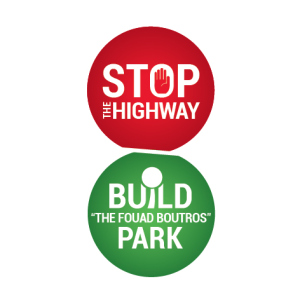
Image Source: ‘Stop the Highway, Build the Fouad Boutros Park’ https://stopthehighway.wordpress.com/page/2/
Lebanon itself does not have any forms of public transportation besides notoriously unreliable buses and the ubiquitous shared taxis. What the Lebanese government can and should do is look at successful initiatives that have been implemented in cities across the world aimed at getting people out of their private cars and onto forms of public transportation. Take bike sharing for instance; this green form of transportation has gained popularity in recent years, with major cities like New York and London embracing the system. Granted, Beirut would have to allocate space for bike lanes, but that would be a much smaller price to pay – and a far more sustainable solution if implemented correctly – than the Fouad Boutros highway’s hefty price tag. There has been some demand for improved safety standards for bicycle use so as to promote awareness of a greener mode of transportation around the city.
Improvements to the bus system that is currently in place in and around Beirut can also decrease traffic congestion by getting people off roads and onto shared transport. Bogotá’s TransMilenio bus rapid transit (BRT) system is a success story where, much like Beirut, the mass transit system was a scattered array of minivans and privately operated buses; in order to improve the situation, a plan to construct highways across Bogotá was in the works – and it would cost billions of dollars. That plan was eventually scrapped in favor of the cheaper, more sustainable solution that the BRT system was able to provide.
There is some comfort in the fact that the project has been delayed due to the public outcry against it, leading to the municipality to state that an impact assessment of the highway is underway, and the project will only move forward if results are deemed favorable. But Beirut’s municipality should take note of the various proposals that have been put forward by civic society, and look for inspiration for sustainable solutions from successful initiatives that have been implemented across the world in various cities; these solutions should be able to protect Beirut’s few remaining green spaces and its heritage. Rather than latch on to plans that have been buried away for decades, it is time for Beirut to invest in planning out long-term goals that will do away with its crippling congestion.
About the Author






Lousy public transportation is one main reason for maddening traffic, yes. Chaos is another. No implementation of regulations. Cars park and double park anywhere, go against traffic, block roads. Traffic lights are not synchronized. A mall (ABC) is built with no entry lane! The SMART solution was chopping off a lane from the main road and annexing it to the entrance. And now they want to do an impact assessment of the planned road? Not done yet? Bakkir ba3d.