
Political elites and media around Europe must have lost their sense of humor: they call Beppe Grillo a “comedian” or a “clown”, but no one laughs at his words.
The past week After the sweeping electoral result of Beppe Grillo’s Five Star Movement (M5s), the entire world is looking at Italy with concern. There is no doubt these are times of great uncertainty for Italy, both from a socio-economic and a political point of view, but, seriously now, was anybody naïve enough to really expect a concrete solution to come out of the polls? That the outcome of the election in Italy was doomed to produce no governing majority was quite predictable. So what is this fuss all about?
The Reasons behind Grillo-Phobia
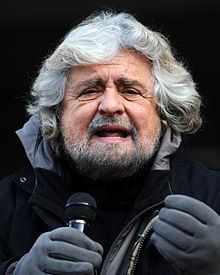
Beppe Grillo. Image: Wikimedia Commons
The outcome of elections in Italy seems to cause a great deal of anxiety not so much because of its potential to worsen the already stagnating economic situation, rather on grounds that a big share of the Italian electorate voted for a man who is often regarded as a “clown”. Mind you, I am not talking about Berlusconi, he’s better described as a shameful disgrace! I am referring to Beppe Grillo.
Yet, apart from his bushy and curly hair, Grillo’s appearance does not resemble at all that of a clown. Neither do his arguments. Furthermore, he does not have sharp teeth like the blood-thirsty kid-eating clown IT in the famous American horror movie. So where does the Grillo-phobia stem from?
The demonization of Grillo by the Italian press – with the exception of the daily “il Fatto Quotidiano” (the only newspaper that does not get public funds) – is hardly a surprise, since the M5s’ political program pledges to eliminate the huge public financial support that biased newspapers cash in every year. Also the grudge that Italian “professional” politicians bear against Grillo finds a simple explanation: they can’t get over the fact that people preferred a “comedian” over them! But why does that surprise them? Grillo makes jokes about Italy, they made a joke out of Italy!
The View From Abroad
Foreign press in the English speaking world usually describes Grillo as a “Comedian turned politician”. The fact that his comedy has always contained insightful political analysis does not seem to matter. That he has drawn up a detailed and clear political program does not matter either. That almost every party in Italy at some point recycled some of the ideas he proposed on his blog (that by the way is one of the ten most visited blogs in the world) is not relevant. The fact he created a huge grass root movement that in a few years attracted millions and became to most voted single party in Italy is simply seen as a “collateral effect of the crisis.”
German Social Democrat leader Peer Steinbrück commented on the Italian elections saying: “I am appalled that two clowns won. A professional one […] Grillo, and another one, who surely is a clown with exceptional levels of testosterone.” Words that, apart from undermining Steinbrück’s credentials as comedian and unveiling his ignorance about the existence of viagra, do reveal that Grillo’s popularity sends the shivers down the spine of the European political elites.
Spanish newspaper El País accused Grillo that his anti-political populist rhetoric condemned Italy to ingovernability. One might reply to that: what is the difference between an ingovernable country and an ungoverned one?
Bottom line is: for the press Grillo was and remains “a simple comedian who cannot be taken seriously when he talks about politics, no matter how valid his political proposals or arguments are.”
Grillo and the return of people-politics
If we exclude the 30% of ignorant, suicidal, masochist, gullible and mentally-corrupted countrymen who voted Berlusconi yet again, the rest of Italians, including those who didn’t turn up at the polls, really tried to bring about change.
Before the elections European leaders fretted at the idea of a possible return of Berlusconi to power, yet they did not seem to appreciate enough the fact that a majority of Italians did not vote for him. Instead, voters were held responsible for the billions of euro that were lost in European stock exchanges as a consequence of the election result. One could almost hear those greedy speculators: “bloody Italians! they guzzle EU funds and they even dare voting for the wrong guys!”
All the negative and disapproving comments about the electoral choice of Italians reveal an arrogant and worrying subliminal message: “what people want to choose freely does not matter, what matters is that they choose what they are expected to, especially if they are broke southern Europeans who don’t know what’s best for them.”
One might suspect that what really scares the European financial and political establishment is not so much Grillo’s allegedly “populist” tirades, rather his capacity to fill up squares with millions of people and create a movement made up of young, new, motivated people who believe in real and uncompromised political change.
Grillo’s achievement seems a first step towards a “government of the people, by the people and for the people”: the essence of that direct-democracy that is too often preached and too rarely put in practice.
The ascent of the M5s calls to mind the words of legendary Judge Paolo Borsellino, assassinated by mafia in 1992. As he once put it: “Revolution is made on the squares with the people, while change takes place inside the voting booth with a pencil in the hand. That pencil is stronger than any other weapon, more powerful than any shotgun and sharper than a knife.” For those who want to maintain the corrupted and stagnating political status quo, that lesson is certainly a frightening one.





