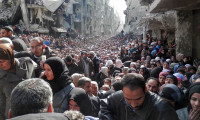
Migration is not a phenomenon of the 21st century. Throughout history people have moved from one nation or region to another for economic, social, political or environmental reasons. In the month of July alone, 50,000 migrants arrived in Europe, 70% of whom are from Syria. Since the beginning of 2015, it is thought that 225,000 refugees and migrants have travelled to Europe with some 3000 more who have died or are unaccounted for.
There is no simple solution to this problem as Europe is not equipped with the resources to respond to the crisis efficiently. Pressure has been seen to overwhelm Greek authorities where police are reported to have used fire extinguishers and batons against migrants. Also, it seems that there is a significant lack of political will amongst some European nations to support a coordinated regional response. Britain, Hungary and Austria, for example, opted out of the EU scheme to relocate some of the migrants who had arrived in Greece and Italy more evenly amongst Members.
Here are a few thoughts to consider when thinking about the migrant crisis:
The Western political elite should not be blind to the hand that they played in contributing to the migrant crisis we see today. The majority of migrants travelling to Europe start the perilous maritime journey from the shores of Libya, which is commonly described as a lawless or a near-failed state.
Today Libya exists with a government that struggles to exercise any sizeable control whilst hundreds of armed militias run rampant across the country. To look back only four years however, in 2011 the United Nations authorised humanitarian intervention following a harsh and disproportionate crackdown by the Libyian dictator, Mohamad Qaddafi, on his populaces after protests against his leadership broke out.
NATO (Compromising of the US and 27 European States) led the intervention and was tasked with the primary aim of protecting Libyan civilians and preventing further human rights atrocities. In practice, however, the intervention was seen to prioritise regime change over this aim. Furthermore, the campaign also received significant criticism for failing to commit enough resources to a post-conflict stablisation effort. Since the removal of Qadaffi, the country has been rife with instability and criminal activity and thus opened an unmanned door unto European shores.
Although in the liberal West we have a strong sentiment to ideals such as the principle of ‘equal and inalienable rights’, there seems to be a significant gap between thought and practice. The world we live in is inherently unequal both by nature and intent. Natural resources are not spread evenly amongst nations and economic prosperity is not even guaranteed where they do exist. Scarcity fuels competition and capitalism. Although globalisation has allowed some nations to significantly reduce poverty and improved the quality of life of millions, it should also be acknowledged that not all those who participate in the global market economy are winners.
Essentially, as much as the West is keen on its ideals, we are not too fond of the idea of equality in reality. What’s ours is ours, what’s theirs is ours for the taking and we don’t like to share anything we have.
One could argue that the concept of ‘equal rights’ is nothing more than an ideal, as it appears that only citizens of a state are entitled to be rights holders. As soon as an individual becomes ‘stateless’, they are no longer subject to the same rules and rights as people who belong to a state. If you are an illegal migrant, you have no ‘right’ to earn a living in your country of choice. You have no ‘right’ to buy your own property, no right to be treated as an equal in the judiciary systems as ‘citizens’ who actually belong to a state.
Of course, one must consider that in practice, it would be problematic if all people of the world had equal status in any country. For example in Britain, the National Health Service (NHS), which is free at the point of use, would unlikely cope with the pressures of serving every migrant on the same terms as British citizens. The simple fact is, no country can have a completely open door policy without seriously risking the stability of both social and economic elements of society. It is nonetheless worth considering this disparity within the conception of universal rights, however.
All in all, a compromise needs to be made between the humanitarian obligations of the Europeans towards the migrants on our shores and between the harsh realities of resource scarcity and instinct for self-preservation. This will undoubtedly be a difficult and delicate task to resolve and there will be losers. Nevertheless, it should be our task to reach a solution that is least injurious for both parties so that at least there are some winners.