
If there is a powerful opponent it is certainly nature. So far this year, Chile has been living tough times. The South American country has struggled with damages provoked by unpredictable and devastating weather. Flash floods and forest fires have occurred since February in the country affecting people’s security and health, as well as the country’s infrastructure, industry, natural protected areas and over all economy, leaving the Government to combat different fronts all at once.
Floods
Heavy rains have flooded the valleys and towns in the regions of Antofagasta, Atacama and Coquimbo and is said to be the “worst rain disaster” to face the region in 80 years.
Such regions are usually considered among the driest of the world, however, the Government has now declared a “state of emergency” in the Atacama desert itself. The declaration of emergency gives control of the region to the armed forces to “safeguard public order”, a senior government official said according to local media reports.
Roads are blocked and power outages have been reported while authorities are scrambling to evacuate people. The floods have displaced more than 20,000 people, with about 4,00 people currently living in temporary shelters and 69 people still missing. Authorities have confirmed that 23 people have died.
The Government’s emergency office reported that nearly 40,000 people were without power and almost 50,000 lacked drinking water in northern Coquimbo, Atacama and Antofagasta.
This area seems to be predestined to struggle. This is the same region that attracted international attention in 2010 when a group of 33 miners were trapped in a mine and dramatically rescued only one month later.
Reports indicate that among the people affected are four of the 33 miners, who have declared: “We have lost everything”.
Local experts have said that there were a series of natural conditions that caused the flood, including the dry terrain. Despite this being good for filtering, the amount of rainfall proved too much for soil that was not used to these quantities.
These floods have come at a bad time for Chile, given the fact that the country is still struggling to control their intense forest fires.
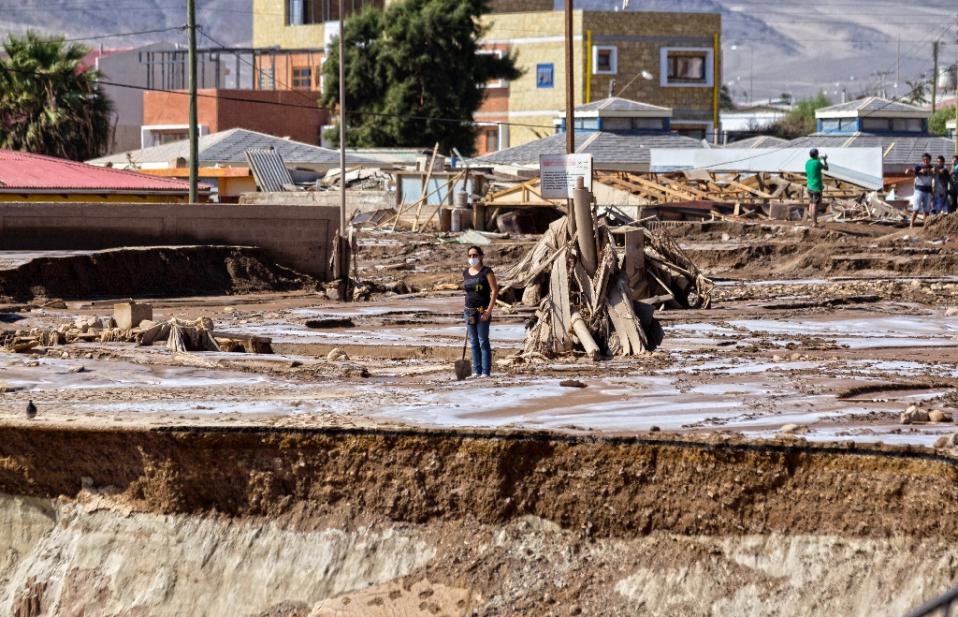
A woman stands amid the mud in Chanaral, which was flooded after heavy rainfall caused the overflowing of the Copiapo river, on April 1, 2015 [Source: AFP Photo/Patricio Miranda]
Fires
Affected by years of drought, the southern region of Araucania has been devastated by an intense forest fire, with firefighters attempting to fight the flames for over a week and a half. The fires have affected a park famous for its century-old pines known as ‘monkey puzzle trees’.
The Government has declared these regions as ‘disaster zones’. The fires are burning in three protected areas: China Muerta National Reserve, Nalca Lolco National Reserve and Conguillio National Park. The fire has affected about 11,000 acres so far.
Fifteen firefighting brigades are in the area, 440 miles south of the capital, Santiago. However, the forest fire in the Araucania is only one of many currently active fires according to the ONEMI, which registers that nearly 40 separate blazes are burning some 14,000 hectares.
The forest fires pose a problem for Chile’s drought problem and have been doing so for some time now. President Michelle Bachelet said the country’s drought situation has reached a critical condition, and announced that millions of dollars would be invested to improve access to underground water and the construction of desalination plants to provide more drinking water.
President Bachelet said: “Faced with this critical situation, there is no choice but to assume that the lack of water resources is a reality that is here to stay and that puts at risk the development of important regions of our country.”
To add flame to the fuel, Valparaiso was hit by another fire this year, forcing the evacuation of 4,500 people. The fire, which started as a forest fire, reached houses in the port and destroyed at least 60 homes and devastating around 148 acres of land. The blaze comes less than a year after 15 people were killed and more than 3,000 homes were destroyed in Valparaiso by another fire.
![Environmentalists have warned the fires are threatening hundreds of plant species and wildlife [Source: BBC News]](http://archive.the-ipf.com/wp-content/uploads/2015/04/81883407_026445873-1.jpg)
Environmentalists have warned the fires are threatening hundreds of plant species and wildlife [Source: BBC News]
Aftermath
The forest fires, floods and droughts not only represent a risk to people’s lives in terms of security and health, but these natural disasters have had a negative impact on the overall situation in Chile.
The droughts not only exacerbated the fire in the north, but also hit the agricultural sector. The Government has had to distribute resources among 57,000 peasants to help them to face the lack of water affecting the crops as well as the animals. About $5 billion (Chilean pesos) have been invested in aid.
Mining is one of the most important industries in the country, especially in the south that has been affected by the floods. Many mines have to shut down in order to avoid a disaster. Every day mines that are out of business represent millions (pesos) lost. There are also concerns about the toxic waste of the mines given that containers, abundant in the north, can be damaged by the floods and cause a serious leak that could be harmful to people and the environment. These containers are full of mineral waste such as mercury, copper, and arsenic. The Government has said that there is no reason to be concerned so far.
Floods, forest fires, and droughts in Chile are still to be contained by Government. However, the aftermath is to be seen. This is going to be a rough year for Chile.
About the Author






great article.. we should think about the consequences of buried “gold” as is the case of mines.
Wow, disappointing. Scapegoating the voiceless? “Nature is the enemy”?!? I don’t see a discussion here of how climate change, mining, urban development, or fire surpression might be causing mud slides, excessive rains, or out-of-control fires. As an experienced forest fire fighter here in the U.S., I recommend that this ‘storyteller’ dig a little deeper before making shallow pronouncements as to the ’causes’ of these natural disasters. Too bad he is only concerned about the ‘pesos lost.’ A lot more than this risks being lost if this is the only focus…