
The trends of climate change present a worldwide security challenge and require the adequate response of the international community. The negative impacts of these changes are demonstrated regionally in a different extent; largely, we can observe them in the Arctic region. Numerous security questions in environmental, political, social, and economic areas are been raised, we must deal with them properly and promptly.
Economic potential and relative richness
According to the assessment based on the US geological survey the Arctic area may present about 13% of the world’s undiscovered but recoverable oil reserves and as much as 30% of the world’s undiscovered natural gas reserves. The non-stable surface, low temperatures, semi-annual day and night cycles, inadequate infrastructure or incidental pollution, act as difficult and dangerous obstacles in construction of research, exploration and extraction facilities. The attractiveness and expedience depend also on tax and fiscal regimes, competition, environmental costs, accessibility to infrastructure and markets, carryback/payback period, potential of new discoveries and value creation. Therefore, the remunerations differs among five countries which have the highest interests in territorial claims over the region (Russia, Greenland, Norway, Canada, USA). Considering the mentioned obstacles and dependencies, the extraction is not explicitly favourable for any country, especially in terms of high environmental costs and lack of infrastructure. Despite this, the most favourable perspectives appertain to Russia, then to Norway and Greenland. Moreover, the commercial collaboration and competition of the most interested parties, such as ExxonMobil, Shell, BP, Statoil, Eni,Total SA, Chevron, ConocoPhillips, Gazprom and Rosneft, are highly determined and motivated to overcome any trammel.
Besides large reserves of gas and oil, there are respectable amounts of mineral resources like gold, diamonds, iron, zinc, nickel, copper and coal. Furthermore, economic potential can be found in the boreal forest, marine life, renewable energy, and fresh water. Greenland contains 10% of the world’s reserves of fresh water, but this now at risk due to the rise in temperature.
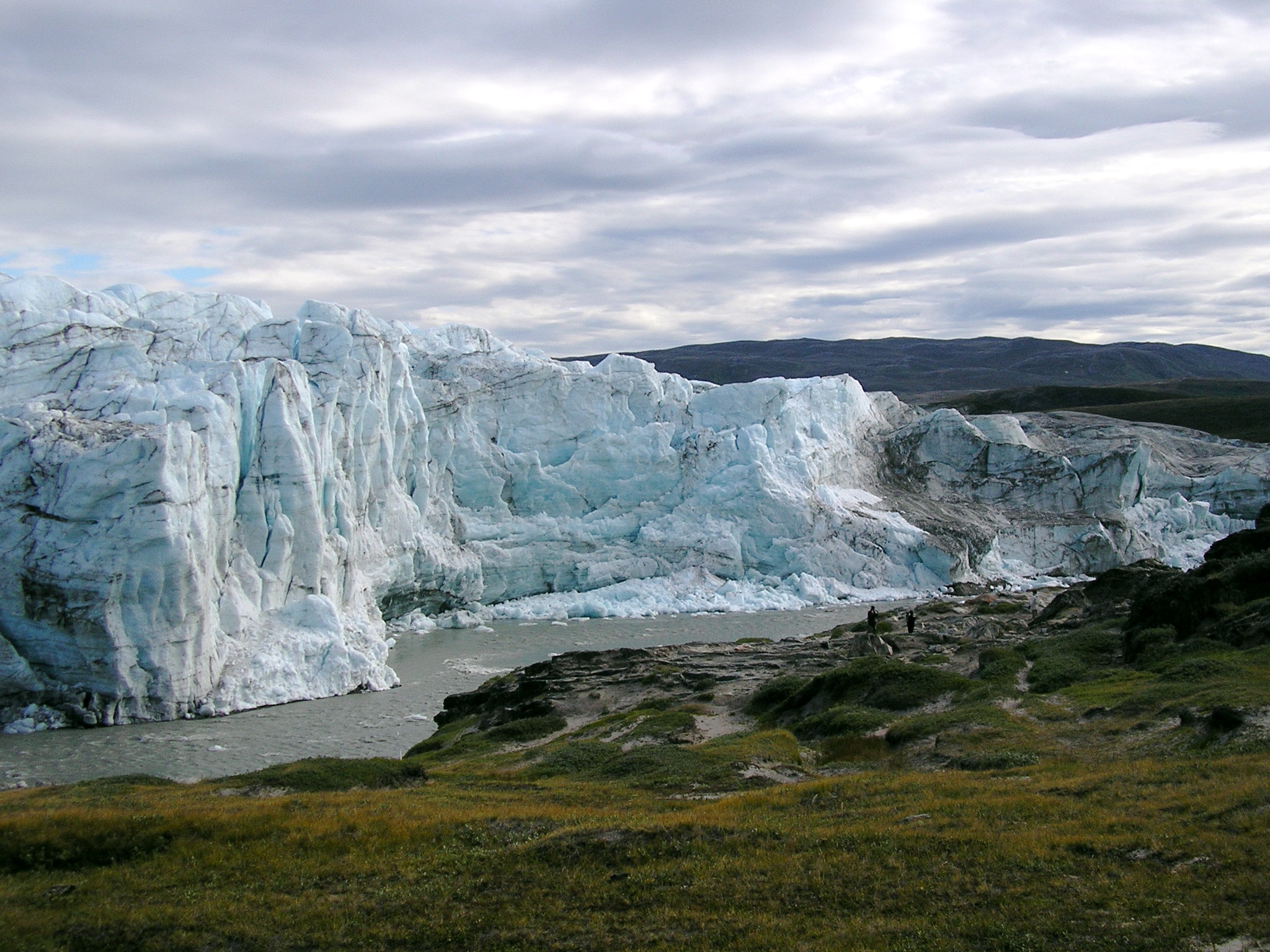
The edge of the Greenland ice-sheet, Taken near Kangerlussuaq, Greenland. Image credit L. Chang
According to studies, the cost of ice-melting and methane release from this pivotal ecosystem region is estimated at $60 trillion USD. Ig you include other impacts like ocean acidification, black carbon and altered ocean and atmospheric circulation the costs are raised significantly. The negative consequences will affect all nations but primarily will be distributed in the less developed parts of the world represented by floods, heat stress, droughts, storms, low agricultural production and poorer health.
Politics: power & militarization
Power, control, militarization and territorial conquest in order to appropriate strategic natural resources, have always been attributes of high politics. The Arctic region, full of natural resources and perspective new sea routes, stimulates the mentioned political interests and brings the Arctic into important political focus.
The largest territories in the region appertain to Russia, Canada, Greenland and Denmark. Hence, the US strategy is to extend cooperation with potential partners, like Canada and Denmark, so as to extend its control over the region. Chossudovsky explains in his article that the ongoing militarization process is a part of the North American integration under the Security and Prosperity Partnership Agreement (SPP).The formal ratification in 2006 of the North American Aerospace Defense Agreement (NORAD) gives permission to deploy US troops in the Canadian territorial waters. Denmark is the US’s NATO ally and there is the Thule US Air Force base in Greenland, hosting the detection system of ballistic missiles directed towards North America. Russia established several scientific-military stations in its northern parts where nuclear testing was undertaken during the Soviet era.
The United Nations Convention on the Law of the Sea (UNCLOS) was concluded in 1982 and since then 162 countries have joined the convention. It defines a 12 mile zone for territorial waters and 200 mile exclusive economic zone that gives the countries drilling rights. However, the US has not signed the convention for fear that it would limit its activities in the area. On the base of the Convention, Russia tries to claim the vast territory reaching the North Pole so as to obtain more drilling rights. The correspondent UN Committee has not yet recognized this claim. Likewise, other countries (Canada, Denmark/Greenland, the US, Norway, Sweden, Finland, Iceland) are also trying to expand their rights. These countries are members of the Arctic Council, the leading multilateral forum in the region, currently presided by Canada.

English: U.S. Secretary of State John Kerry answers a question on May 14, 2013 during a ministerial news conference at the conclusion of an Arctic Council meeting in Kiruna, Sweden. Image credit: U.S. Department of State.
Conclusions
The nature of big players in international politics remains in the morally-low interests of power games and greed. The release of the Arctic methane will bring globally harmful impacts and therefore the resolutions require considerable investments into the mitigation and adaptation programmes together with the change of the current capitalistic economic philosophy.
The fight of the national claims over the region and its natural resources could lead the world to the possible armed conflicts and environmental disasters. It is important to realise that the price of such conflict and the environmentally harmful extraction of the last oil and gas reserves, are really not worth as much as the investments to protect the habitable ecosystems and creation of more sustainable models of society. The profit perspectives do not take into the cost of life.
Moreover, the rights of the Arctic inhabitants are being limited and their voice is not being heard sufficiently in discussions about their living area. Their society is already challenged by tough conditions and further changes would mean more negative socio-economic impacts like forced migration, food insufficiency, worsened health conditions that could consequently lead to the fall of their unique culture.
Even if the financial resources were found for building-up the infrastructure that would limit the negative impacts of the climate change, it is doubtful if the practical capacity and determination of the crucial players would be found.
The world and life itself are gifts so we should approach them with respect and responsibly. However, when searching for ‘godhood’ in individuals, we often find links to egocentrism, narcissism and proudness, and then the world is at stake.
About the Author





