
Salma Banu is 23 years old, a worker of shrimp cultivation in Tafalbari village , Southkhali Union in Bagherhat Bangladesh, she expressed “ while my husband‘s monthly income from his cultivated land was not enough to continue fundamental demand of 8 family members, I was bound to [become] involved for extra income “. Due to her husband’ s incapability to run the extended family, Salma became involved in shrimp fry collection regularly and started to spend three to four hours a day working to help her family.
She says, ‘my husband’ s monthly income was Tk 5,000 (approximately) per month’, the amount was not enough to keep up a joint family while her husband was the only earning member . “Even, it became hard to earn Tk 5,000 due to erratic rainfall and salinity affecting agriculture” .
“When I became pregnant for the first time, I could not endure this extra pressure of income generation and as a result I delivered a dead child.”
She recollects “Even on the very next day of my delivery I went to shrimp collection”. She considered, if they had any other options, they could have migrated to another place. Momtaj Begum , 29 years old and mother of 2 children from Razapur Village, Modhupur thana Barisal says, “just after AILA in 2009, contraceptive methods remained unavailable due to damages of local shops and pharmacies”.
Shops remained closed for 15 days, communication and transportation system were interrupted, field health providers remained absent, and FWA were unreachable due to bad communication. Due to the unavailability of contraceptive method, she became pregnant at the age of 17. As the communication system was disrupted, she could not go to ANC.
Finally, she had to deliver her child with the assistance of a traditional birth attendant at home. Her baby is malnourished and has been suffering from different diseases. The World Health Organization (WHO) refers to maternal health as the health of woman during pregnancy, childbirth and the postpartum period. Each year approximately 5, 36,000 women die as result of complications during pregnancy, child birth, and in the 6 weeks following delivery.[1]
One of the goals of the MDGs was to improve maternal health by reducing the maternal mortality ratio by 75% and achieve universal access to reproductive health. In countries like Bangladesh, some might find it strange though, Climate Change is considered one of the biggest threats to achieving the MDG for maternal death, clearly emphasizing the need for better and geographically more specific knowledge of Climate Change and maternal health.
Statistically, almost 3 million neonatal deaths globally are attribute to maternal health condition, such as poor nutritional status, deprived living environment and infectious diseases. There is growing evidence of the impacts of global environment changes on people, health and a renewed consciousness among people and nations of the need to act quickly to protect the health. Environmental and health exposure is threatening the lives of millions in Bangladesh which is one of the most affected countries by climate change.
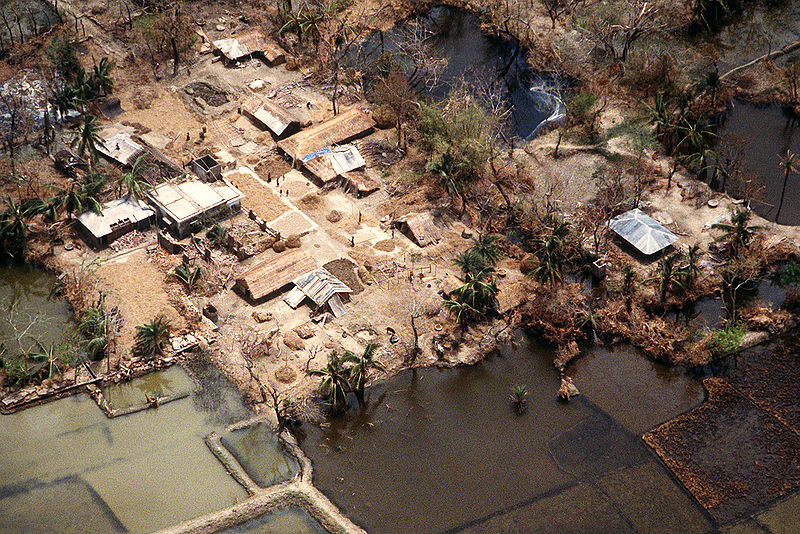
A damaged village surrounded by flooded fields, nearly three weeks after the 1991 Bangladesh cyclone hit the country. Image credit: Airman 1st Class Cheryl Sanzi (USAF)
It is estimated that BDT 500 crore is annually spent on physician fees, medicine and travel costs, which means illness and ill health are also huge financial burdens. The cyclones in Bangladesh in 1970 and 1991 were estimated to have caused 300,000 and 139,000 deaths respectively. In Global Climate Risk Ranking 2007 it is reported that Bangladesh had the highest number of deaths (4729) due to extreme weather events (mostly) by storms, followed by floods and heat waves in 2007.
According to the Internal Displacement Monitoring Centre, 11 .6 million people were displaced last year in South Asia due to storms and floods. This comprises more than 9 million displaced in India, 1 .9 million in Pakistan, and 600,000 in Bangladesh. Current cyclone Mahasen has destroyed crops worth millions of dollars, and severely hurt farmers of coastal areas. Saroj Das , Technical Coordinator & Program Coordinator for Climate Change & Concern world Wide says:
“After [a] disaster [the] danger of women becoming victims of sexual violence increases”. Even, relief efforts don’t take into consideration health needs of women like obstetrical care. Prolonged exposure to filthy water during post disaster period cause severe skin diseases and gynecological problems for women.
Dr.Salamat Khandaker, Senior Consultant for Environment Health at WHO comments:
He further says, “During the dry season in saline prone areas, women and adolescent girls, even pregnant mothers are forced to fetch water which causes various health [and] gynecological problems like premature death of fetus, abortion and still birth”, he argues – “The link between gender and climate change straightforwardly has an influence over negative aspects on RH.”
Dr.Zainul Abedin, former country representative for International Rice Research Institute (IRRI ) observes, “Shrimp cultivation has rapidly increased on coastal areas, that is going to be a threat especially for women[s] health”. He also claims, “increasing salinity level also increased incidents of hypertensions in the coastal areas and is a major problem for expecting women that causes abortion.” Saroj says, “The government has already set up 1 ,38,000 community clinics in villages, costal belts and remote areas which are playing an important role for community health as well as reproductive health.”
“Lack of policies and implementation of existing policies are major drawback” , argues Dr. Atiq Rahman, Executive Director for Bangladesh Center for Advanced Studies. To state the “relationship between climate change and reproductive health”, he argues that there is a close association between climate change and abortion which should be studied further. Meanwhile, reproductive health facilities are missing in the shelter centers: when a natural disaster occurs everyone focuses only on primary health care rather than the availability of family planning, contraceptive commodities or pregnancy.
Income generation can be a major issue, women empowerment is very important too. Capacity building of women famers is very important for perspective land rights, programmes for rural women, technology transfers, and gender sensitive issues will need to be prioritized. Dr. Abedin considered:
Dr. Md. Sirajul Islam, Associate Professor and Chairman for the Department of Environmental Science and Management (DESM) and Faculty Advisor for Earth Club, North South University Bangladesh considers, “Population contributes to green house gas emission that impact on climate change. In this regard, minimizing high consuming population is a challenge.” Every feature is internally linked, economically population control and poverty alleviation are major issues which have vitally influenced over RH issues. Especially, debates over climate change already raised questions for sustainable development for developing and under developing countries .We should consider the population management which manages birth control , death control and mother-child mortality rates.
Dr. Atiq Rahman indicated in his study Climate Change and it’s impact on Health in Bangladesh, that “impacts associated with heat weaves are heat stroke, dehydration and aggravation of cardiovascular diseases in elderly people”. Vector born disease infections are transmitted by the bite of infected arthropod species, such as mosquitoes, ticks, bugs, sand files and black files.
The Bangladesh Climate Change Strategy and ActionPlan (2009) recognizes the importance of adaptation in the health sector by including it in the first pillar of the plan. The health chapter of the ten years perspective plan for 2010-2021 of the government with respect to climate change.
However, The Sixth Five Year (FY201 1-2015) of the government recognizes possible health impacts of degraded environment due to climate change, and wants to “build capacity in the area of environmental health through both public and private sectors.”
Similarly, the Health Population and Nutrition Sector Development Program (HPNSDP) categorizes the key interventions required to accelerate the pace of the Health, Population and Nutrition sector in Bangladesh. Dr. Md. Sirajul Islam considers “through proper understanding of climate change issue and its impending effects on health, timely initiation of preparedness activities with thorough participation of community, Bangladesh has the potential to be successful once again in combating health effects of climate change … For that policy makers and program designers must act with proper implementation of the planned activities with full cooperation of community and health work-forces at all levels.”
[1] Dr. Atiq Rahman , Executive Director , Bangladesh Center for Advanced Studies
About the Author






[…] death. Public health officials in Bangladesh say the rate of hypertension among pregnant women is on the rise in a coastal areas, a trend they link to climate […]