
For the British press, mocking politicians is a serious business. Journalistic satire – mercilessly rubbishing the airs and graces of the House of Commons’ finest – is as English as morning toast, afternoon tea and the Queen. This is why the jokes and quips thrown at our Prime Ministers are so important. Much more than mere cheap gags, the focus of political ridicule is as much a social commentary as are the soaps that fill the pages of the TV guide. David Cameron has lived behind the black door of 10 Downing Street for 4 years, now. Ministers have come and gone, policies have U-turned and protests have been kettled, but one thing has been constant. Every criticism thrown at Dave and his chums has been marked by the same jibe: ‘Dave is a toff’.
The gulf of Dave’s disconnect
A few years at Eton and Oxbridge under his belt, a taste for holidays in Tuscany and a working knowledge of white tie, David Cameron is part of the upper class. But while ‘DC’ may look little out of place alongside the long history of upper class Tory PMs, the politics of Pitt the younger has no place in the 21st century.
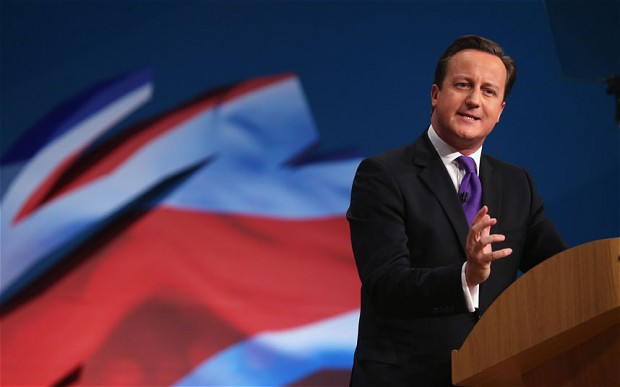
British Prime Minister David Cameron at Conservative Party Conference 2014. Image Credit: The Daily Telegraph
The ethos of Tory party politics should not lie in maintaining the interests of the landowning classes, or in its modern-day equivalent – the suburban white-collar professional. Post-war British conservatism has helped to define a British politics of opportunity, not of inheritance. It is this heritage that today’s generation of Bullingdon Club Tories threatens, a threat made most visible in the back-slapping and fist-pumping of this week’s Conservative party conference.
Another Tory Conference, the same old speeches
The issue of education reform was notably absent from the main stage agenda of the Tory conference. This year saw the effect of then-education secretary Michael Gove’s radical reform of the national curriculum, the most sweeping upheaval of British schooling and exams in a generation. Coursework-based examining was scrapped, as were current marking guidelines that have been wracked by allegations of grade inflation for years. Gone was the syllabus of grade-chasing and educational box-ticking – in was a new era of academic rigour and a very English education. But seemingly these changes mark ‘mission accomplished’ for the Tories. Michael Gove spoke to rapturous applause from the Tory party’s activists, while the speech of current Education Secretary, Nicky Morgan, was limited to a wooing of the teaching unions that have proved so resistant to Tory reforms. Any movement for continued reform of British education seems to have stalled. Then David Cameron stepped up on stage. With grandiosity predictable from a politician eyeing re-election David Cameron promised much. He pledged “a land of opportunity for all… So it makes no difference whether you’re black or you’re white, a man or a woman, the school you went to, the background you have, who your parents were. What matters is the effort you put in, and if you put the effort in you’ll have the chance to make it.” But if the Prime Minister thinks that he can enact this vision without proper reform of the country’s schooling, he his gravely mistaken.
‘Education, education, education’
Cries of ‘Old Boys’ Club’ in the Commons and headlines of elitism splashed across the tabloids are not mere riling of the incumbent government. The disconnect between ruling politicians and the issues facing the vast majority of the population is total. It is a trait endemic across the kind of institutions from which we rightly source our political leaders. For the Tory party, the noughties marked more than just a painful decade in opposition. They saw a total relapse from the self-made champions of the social ladder that the party had in Thatcher and Major, to the current Old Boys of public school politics. While public schools and Oxbridge Colleges are easy and soft targets for vitriolic attacks on elitism, they are part of the solution, not the problem. Three years at Oxbridge is arguably the best higher education in the world. We should embrace this most valuable of British assets and we should not shy away from looking to them to provide our country’s captains of industry and politics. However, we should never be satisfied with such institutions acting as a revolving door for social class. ‘Education, education, education’ was the calling card of New Labour’s drive for social equality but Cameron has failed to reopen the avenues of social mobility that grammar schools and compulsory private school scholarship programmes could offer. If we wish to see real change across the lives of British people, we must do all we can to ensure that even if the next century’s Cabinet Ministers can all be found in Eton or Oxbridge yearbooks that they represent a true portrait of our nation. Public schools must not claim diversity through the proportion of oligarchs’ children in each year, but in the number of disadvantaged children to whom they have offered the best education available. A British private education is the ultimate foundation to success in today’s world. It cannot be restricted to those with the golden shovels of a privileged upbringing.
Education: an electoral holy grail?
Conservative Ex-minister, Baroness Warsi, spoke out in August on the need for the Tory party to reach out to minority ethnic communities before the next election. It is in reforming the educational infrastructure that Mr Cameron may have his golden ticket for re-election. While entrepreneurship provides huge potential for prosperity (and the Tories have done much to bolster small and medium business in the UK), education is the holy grail of an assured future. The top universities go to great lengths to ensure that a student’s background is no barrier to their potential. Admission tutors are now incredibly sensitive to considering an applicant’s schooling and prior opportunity when interviewing prospective Oxbridge students. Under the current system there is a healthy ratio of private to state school students at all top universities. However, these statistics still hide the brutal truth that Oxbridge is still a bastion of the white middle classes. Typically, black and minority ethnic (BME) applicants to Cambridge are concentrated in a handful of subjects – Maths, Economics, Law – that are seen as the surest paths into stable, well-paid careers. These are the most oversubscribed subjects, and it is here that the University loses the greatest number of BME applicants. Universities in Britain have always been proud of a system based on personal interest rather than career path. To most international students the freedom to become a banker having studied classics, or a lawyer having read German literature is a novelty. Oxbridge admission tutors always talk of looking for a real ‘passion’ for a subject from interviewees – torturous words for any applicant. However, it was in the academic incubator of a private school education that I was able to foster my own interests and that I was encouraged to nurture them. At Cambridge, the subjects with the lowest applicant to place ratio, those seen as the easiest to get accepted for, are hugely dominated by white, public school applicants. While it would be crude to propose that a love for the arts can only be developed in the confines of a boys public school, I have little doubt that if British private schools were a true representation of British society, there would be far more BME candidates across all subjects at top universities. We kid ourselves in thinking that a social barrier like an expensive education can be circumvented. Instead it should be exploited by government to encourage the kind of social mobility that the state sector has never been able to provide the most capable of its students.
Sign of our times: the signet ring
True Tory politics should be about opportunity for social advancement. Dominant rhetorics of market equilibrium are resolute that today’s inadequate competitive scholarship system across the country will achieve this. In short, it has not and will not until private school students being on bursaries and scholarships are the norm, not the exception. It is a sad sign of the modern day that an ex-Conservative Prime Minister spoke out in protest at what he saw as the “truly shocking” fact that the “upper echelons of every single sphere of British influence” is still dominated by a private-school educated affluent elite. In a country that prides itself on its tolerance it is criminal that we cannot yet pride ourselves on the real opportunity we afford to all. Some may criticise such ideas as little more than window-dressing, masking real social inequality with ethnically diverse privilege. However it is not silver spoons, signet rings or trust funds that hold the key to a better future for this country. It is empathy, experience and understanding of the plight of those most disadvantaged and deprived in Britain that points towards a brighter future for all. You can be sure that when the first Prime Minister to have been born on a council estate steps into number 10, it will be a good day for Britain.
About the Author






Was listening to R4 the other morning and listened to Grayson Perry talk about ‘Great White Males’ and positive discrimination.
http://www.newstatesman.com/culture/2014/10/grayson-perry-rise-and-fall-default-man
I think Education is definitely the first and most important step, but after that I think diversity will be an important issue in terms of making sure our Government is representative of the nation as a whole.