Cuba is a country with personality to spare. With its legacy in music, dance, rum and revolutionaries, it has a culture and people unlike much else. With all of its unique character, however, it has an array of unique problems. The confidence trick is possibly one that stands out most to a visitor and, when examined, sets us up with a series of questions about the country and its politics.
The confidence trick varies in form as much as its artists. Arriving by bus in a new town, one can hardly step off the bus because of the crowds trying to advertise lodgings and taxis. They are forceful, following you and asking you where you are staying. If you tell them that you’ve already organised something and that you are not interested, Ah but Señora So-and-so-with-whom-you’re-staying is out of town, very ill, or even dead. Sitting on a bench, it is not very long before someone comes over and introduces themself and, after patiently getting to know you for twenty minutes, will tell you their money-oriented sob story. Cubans are very friendly they tell you, and you get to know some, they take you to lunch, then others join, and you get landed with the bill larger than you would get at home. Fake money, unsmokable cigars and women charging you for dances are all such regular occurrences that you stop noticing them. I once had a man spend forty-five minutes at a club convincing me that what I had been learning for the last year was not Cuban Salsa dancing but in fact Puerto Rican Salsa. But if I wanted to learn, his brother was giving classes. In a country where tourism is such a large part of the local income you cannot help but walk around with a money sign over your head.
Since actual crime is often not an option, the people who would have mugged you instead learn deception, patience, how to act, and, most importantly, to speak English. The problem is how truly convincing they are. I was scammed into paying an expensive lunch bill and only later I realised it was not that they had got carried away with their hospitality, or that they made an overestimation of a foreigner’s budget. When one of them offered to pay his share when I made a fuss, it had been only to bring the price down so I’d be more likely to pay up rather than go to the police. A whole show had been put on, an argument with the establishment’s owner, my dinner-mates getting upset and displaying shame because they had let me down.
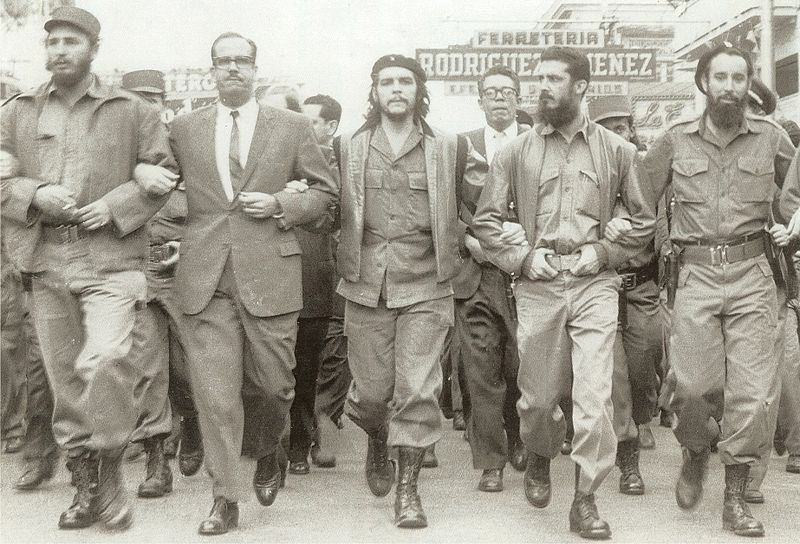
This photo was taken on March 5, 1960, in Havana, Cuba, at a memorial service march for victims of the La Coubre explosion. On the far left of the photo is Fidel Castro, while in the center is Che Guevara. Author unknown.
One is quite often told by guidebooks and previous visitors that Cuba is not to be looked at in the same way as other countries. It does seem that people tend to focus on the negatives, perhaps because the Communist system is so alien and often such a sensitive topic. But before one goes too heavily into a tirade about over-qualified waitresses, and doctors working as part-time taxi-drivers because it pays better, one must consider the positives. We are talking about a third-world country where no one starves, employment is a priority, everyone has a certain level of healthcare, and in which the worst kind of crime to cross your path as a tourist is likely to be someone convincing you to voluntarily hand over your cash rather than force it. Plenty of countries can only dream of being so safe. As a third-world country it has a lot going for it.
This is forgetting the people themselves, of course. Real Cubans are some of the kindest and funniest people one can hope to encounter in Central America. It is easy for visitors, especially if they don’t speak the language, to feel that Cubans are liars, cheats, or just untrustworthy. This statement is likely to be equivalent to saying all British people want to mug you. Some do, most don’t. The difference is that as a visitor to Cuba the majority of people you are interacting with are from that minority. If you took all the criminals in the UK and put them in one place and visited that one place you might get the impression that Britain was entirely populated by law-breakers. The impression one is likely to get from Cubans is an unrepresentative one and is there because you’re a tourist, but if you avoid the English speakers and the ones that come to you and manage to break past that first layer, you find a different Cuban.
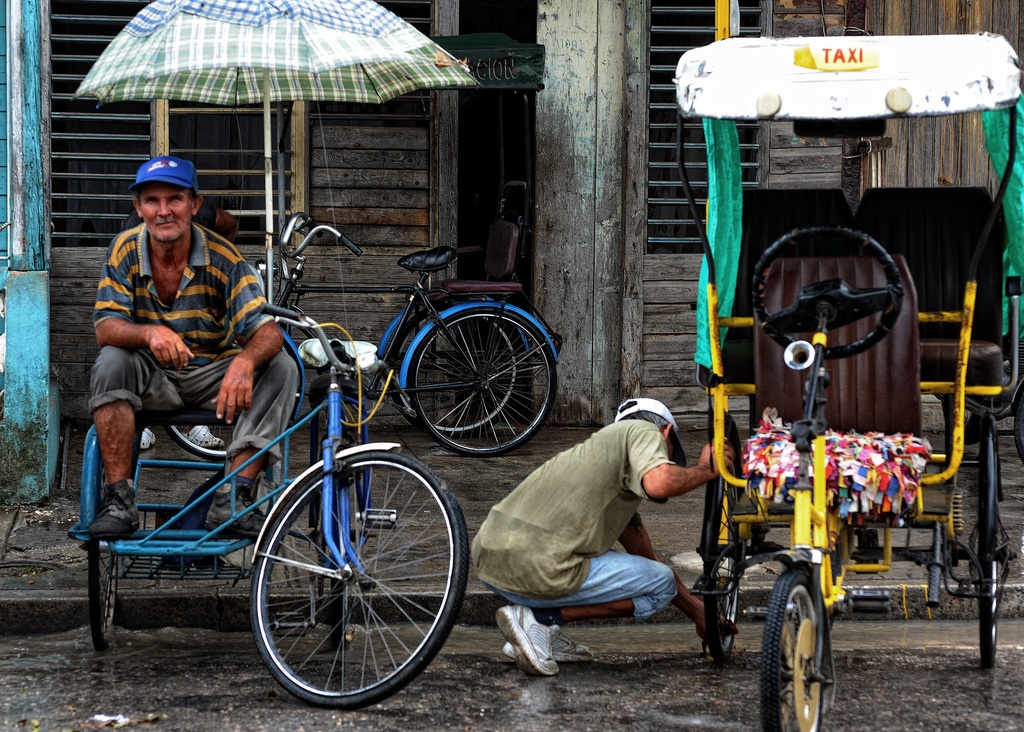
Pedicabs in Banes- Cuba. Image credit: My Huy Street photography
Even if we agree that this negative side is an unrepresentative minority, however, it still does not avoid the fact that it makes up the majority of a tourist’s interaction and experience of Cuba. For a country that relies so heavily on tourism it makes it very hard for a foreigner to visit. There is always expected to be a little price to pay, especially if you are integrating with locals, but the thing that makes it different from the scamming crowds in Thailand, India, or many other countries, for example, is that the prices for tourists are so expensive. When ripped off in other countries it can often be for not very much and can be considered in isolation (i.e. that one person now has more money, which doesn’t matter). But since Cuba works on a dual currency system, the CUC (convertible peso) for tourists and the National Peso or CUP (a 24th of a CUC), a minor scam can cost you a substantial loss while creating an even greater divide in wealth between those with legitimate jobs and those that just scammed the equivalent of a month’s pay (if not more) in half an hour. It is no surprise it is such a common occupation. For a country whose economy leans so heavily on tourism, is making it so difficult to visit and be a tourist a failure in the Cuban system? Especially since so many people take to this lifestyle and do so openly. Now with the news that Cuba will do away with its dual currency system the future for these con artists looks uncertain, as does the future of tourists and with them, the economy of Cuba.
About the Author