
Hilary Clinton, as Secretary of State, recently claimed the Chinese government was ‘trying to stop history by opposing the advance of democracy’. Indeed, since the West first adopted democracy as their uniform political system, it has tried to export it to other nations, citing national self-determination as both a human right and an effective means of improving living standards. Democracy has been sold as both an end in itself and a means to an end.
However, the proclaimed superiority of this method of governance is facing a strong challenge. Due to overtake the United States as the world’s largest economy by 2020, by the latest BNP Paribas estimates, China is shaking the foundations of Western thinking. In 2013, 85% of Chinese citizens were happy with their government compared to only 28% of Americans . How could it be that a country with only one political party is beating the West at its own game?
For Eric X. Li, a venture capitalist who grew up in Shanghai at the time of the Cultural Revolution, the explanation for China’s rise is to be found in its ability to overcome the issue of ideology in governance . Since Deng turned his back on absolute communism, the Chinese have refused to adopt another foreign-born one-size-fit all model. Instead, creating a system unique to their own country, they prioritised economic growth over all else and initiated the 20 years of fastest growth ever seen.
According to Li, three assumptions tend to be made about undemocratic nations such as China: that they are morally illegitimate, politically closed and operationally rigid. Proponents of liberal democracies point to the lack of accountability of a single-party system as inevitably entailing human rights abuses, removal of personal freedoms, and inefficiency and corruption in government.
In theory, of course, the probability of these events occurring under authoritarian rule is clearly higher than in a democratic state. However, theory and practice are often worlds apart. The claim that a liberal democracy would be better for China than its current system requires two factors to hold true. Firstly, it must be clear that the liberal democracy would empirically give better results in those domains than the authoritarian regime. Secondly, it must be the case that the Chinese population values those aspects that are compromised by an authoritarian regime more than those that are offered. In other words, the pros must outweigh the cons.
In Li’s view, the three presumptions made of the Chinese Communist Party (CCP) are incorrect. If legitimacy doesn’t come from election in the Chinese system, then it is made up for in competency. In each of the three sections of the government sector – social organisations, state-owned enterprises and the civil service – the process of promotion is done on a highly meritocratic basis that is both highly efficient and bereft of nepotism. Xi Jing Ping, before becoming China’s premier, had already managed areas with the equivalent GDP of US$1.5 trillion and over 150 million people. Barack Obama, with the credentials he had prior to election, would not even have made a small county leader in China.
The claim that China is politically closed due to its single-party structure is also becoming less and less justifiable. Political pluralism is, in fact, present in Chinese politics, it is simply internalised. Whilst the CCP is not constrained by the ballot, a loss of legitimacy in the eyes of its people does pose a huge risk. China has a long history of violent uprisings and recent events in the Middle-East reinforce the presence of this threat.
The removal of party politics in the domestic sphere has allowed China to undertake long-term projects through the state sector that would be unimaginable for a democracy. China’s one-child policy, despite being deeply criticised, has helped curb population growth in a way that has benefited everyone who depends on the finite resources of the earth..Thanks largely to massive internal undertakings of the party, China now ranks 70th in Transparency International’s CPI ranking, ahead of both the world’s largest democracy, India, and traditional European democracy Italy.
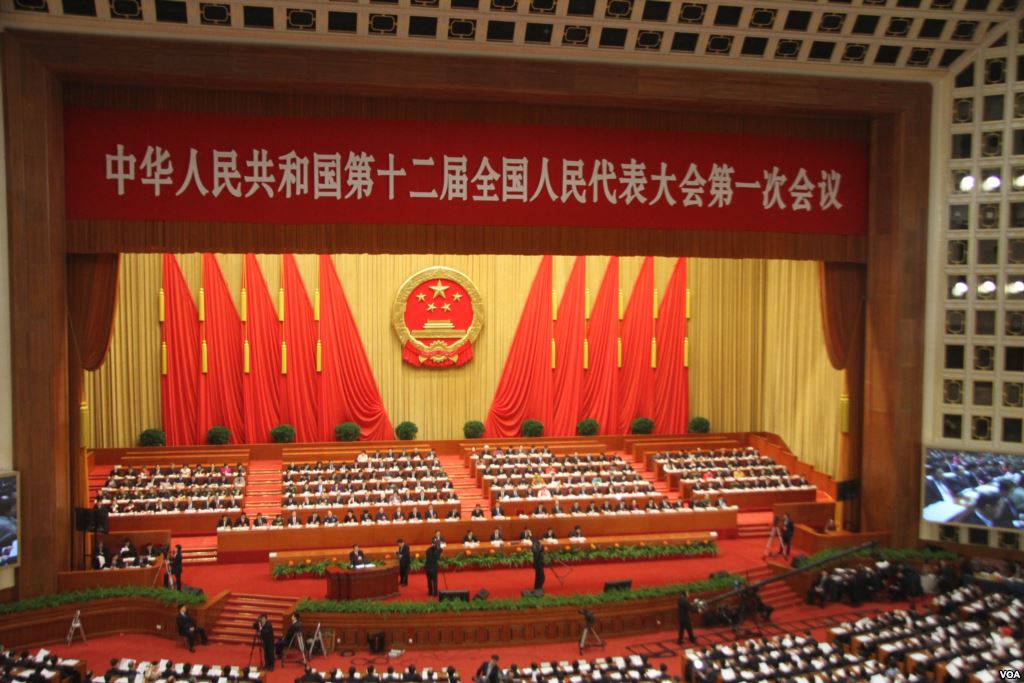
The 12th National People’s Congress held in 2013. Image credit: VOA
Whilst the EU and the US continue to struggle to come to terms with the burden of their debt, China has purchased their bonds to the tune of US$1.2 trillion. In contrast, the latest report from the World Economic Forum has pointed to the interdependence of extreme income inequality and political capture as a leading threat to liberal societies. Indeed, in a country such as the United States, where the concentration of wealth has been steadily increasing for decades, and the financing of election campaigns becoming increasingly important, it would be naïve to overlook the connection. According to Oxfam’s 2014 report , in the US, the wealthiest one percent captured 95 percent of post-financial crisis growth since 2009, while the bottom 90 percent became poorer . The average net worth of a US Senator now stands at over US$14 million . As US Supreme Court Justice Louis Brandeis once said:
The claim of illegitimacy directed at the CCP then, has more than a hint of hypocrisy. More endemic still though, in liberal democracies, is government inefficiency. By virtue of their Montesquieuan separation of powers, decision-making processes are highly bureaucratised. A major stumbling block to all new regulations is the deep partisan nature of house legislation. Illustrated most recently by the US government shutdown, which cost the US economy US$2billion, rivalry of interests are often detrimental to social interests.
Admittedly, this goes no way in morally justifying the dreadful treatment of dissidents and total ban on government criticism from outside the government that persists in China. It is impossible to condone such actions, they are universally reprehensible; but blaming these negative aspects on the structure of the political system would be an oversimplification. Presenting the situation as one of democracy and emancipation or authoritarianism and repression is a false dichotomy. America was already a democracy when it wiped out many of its Native tribes. Russia, today, is at once a federal democracy and a brutally repressive regime.
Developed nations continue to have, by and large, a ‘little Westerner’ attitude towards China. They assume she is temporarily stuck under an authoritarian regime but will soon complete her transition to becoming a full capitalist democracy. This assumption that Westernisation is a product of development is arrogant and incorrect. It should be recognised that our system is a product of our own personal history and culture. Each nation, in its own circumstance, will be more suited to different forms of governance and different priorities. Many developing countries, with large parts of their population under the poverty line, would undoubtedly prefer to prioritise economic growth over the right to vote. Growth comes from pragmatism, not from adherence to meta-narratives.
In stark contrast to the claims made of it, China’s one party system has proven itself to be adaptable, meritocratic, and legitimate. In 1949 when the CCP came to power, the country was mired in civil war and dismembered by foreign aggression with a life expectancy of merely 36.5 years. Today, not only has that figure risen to 75, but literacy rates have also risen from under 20% to 95%. For democracy to now become an end in itself for China, it would have to be the case that the two conditions are fulfilled – the pros outweigh the cons – and as it stands there is little evidence that this would be the case.
Of course, imposing a blanket copy of China’s political and economic system onto the other countries is not the lesson to draw. This would be committing the same basic error as the ideological USA and USSR. What China has shown the world is not the benefits of authoritarianism, but the importance of case specificity: the need to combine the right aspects of each system, dependent on the specific characteristics of each country, to harness its productive potential. Martin Jacques points to the importance placed on unity and the historically influential role played by the state in Chinese society as reasons for the suitability for the Chinese system to its country. Otherwise, with a population of over a billion they would be at severe risk of balkanisation.
As the waning hegemonic power, the West faces a dilemma under the new world order. One option is to continue to confront China over its one-party system and heighten tensions over trade disputes, as Hilary Clinton insists on doing. Pushing agendas on the world is the natural reaction, but it will recreate a global schism. The smarter approach involves understanding that other nations are equally capable of creating systems of governance suited to their needs as we are. Many leaders would have done well to consider this before intervening overseas for supposedly ethical reasons, such as the spread of democracy.
About the Author






Fascinating article. Well thought through and argued. So true for those of us who have lived and worked in China
[…] Hilary Clinton, as Secretary of State, recently claimed the Chinese government was ‘trying to stop history by opposing the advance of democracy’. […]