
Last month the editor of the Guardian, the UK newspaper responsible for the publishing of Edward Snowden’s classified NSA files, wrote about how British security services compelled him to physically destroy the electronic equipment used to store this information, to prevent the publication of further leaks.
This is an action called “prior restraint”, and Alan Rusbridger, the Guardian’s editor, claimed this would have been an impossible action for government or law enforcement services to take in the United States, because of the press freedom enshrined in the First Amendment. It is for this reason, he stated, that the Guardian would now conduct all NSA research from the US, where copies of the destroyed material had been kept for safekeeping.
The contention is that because freedom of the press is written down in black and white in American law, unlike the “unwritten constitution” of the UK, the guarantee is stronger, and thus the freedom more real.
Rusbridger argues that to achieve the same level of press freedom in the UK, it would have required the Guardian to go to court, at which point the information would have been in the hands and under the power of a judge, jeopardising permanently the paper’s ability to publish what it likes, regardless of where the information was kept.
I disagree.
Whilst in this specific case it may be true that Rusbridger’s actions were the only options available to safeguard the right to publish further leaks, it is not true that the UK does not have a written down, watertight guarantee for freedom of the press.
That guarantee is Article 11 of the Charter of Fundamental Rights of the European Union, which says:
Freedom of Expression and Information
- Everyone has the right to freedom of expression. This right shall include freedom to hold opinions and to receive and impart information and ideas without reference to public authority and regardless of frontiers.
- The freedom and pluralism of the media shall be respected.
The UK is a signatory to the EU Charter, which outlines the rights of EU citizens which have been created and preserved in previous treaties and case law. The charter has no legal force in solely national matters, but this is clearly a cross border issue. The Guardian is reporting on surveillance of fellow EU governments by the UK’s listening service Government Communications Headquarters (GCHQ). It is a story that transcends national borders.
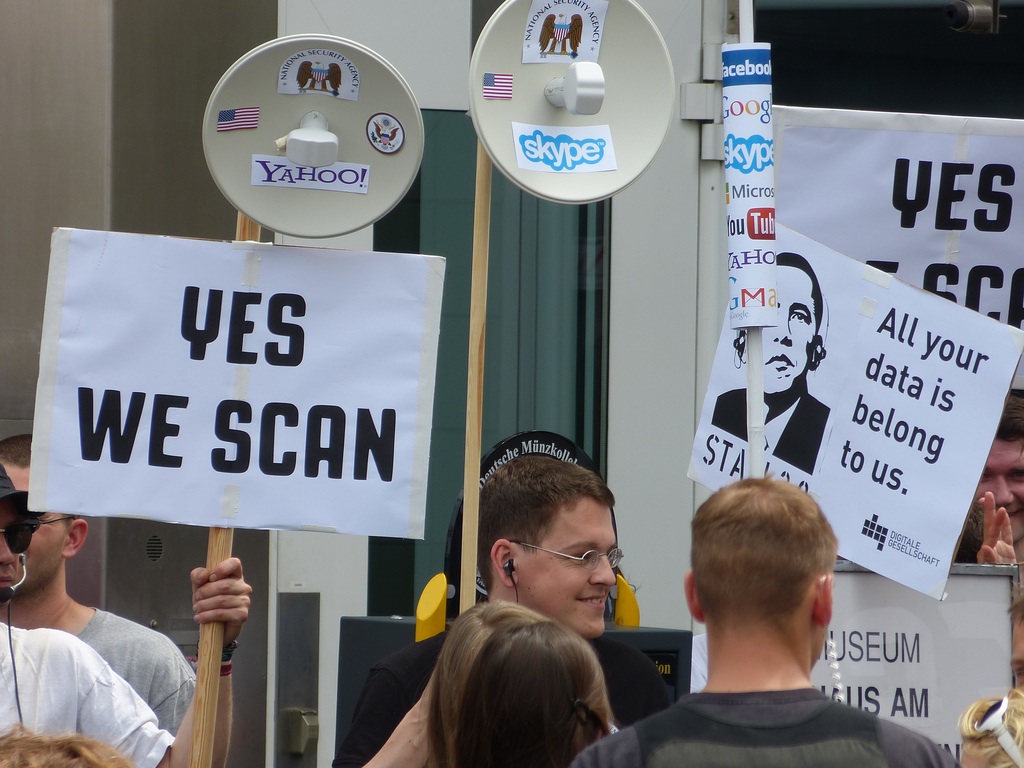
Yes We Scan! Privacy Activists Protest Against PRISM and NSA Surveillance As President Obama Arrives in Berlin. Image credit: Mike Herbst
So the Guardian’s rights are guaranteed, despite what Alan Rusbridger said at a recent hearing in the European Parliament. Whilst it had no other option in this case, faced with threats of legal action from the government and the physical presence of intelligence service officers. If the Guardian wishes to preserve the press freedom which is under grave threat in the UK right now, the best thing it can do is take the UK government to court arguing infringement of its rights under article 11 of the Charter.
This article may not have the same absolute and paramount preventative qualities, but only because it hasn’t been challenged yet in the courts. America’s constitutional rights have had far longer to set in. But I have faith that any legal action would quickly settle the matter, and enshrine the rights of the press.
A court case will challenge what appears to be the unfettered power of the UK government over press freedom on matters of national security, and hopefully create case law which will make it impossible for security services to again attempt this sort of prior restraint.
About the Author





