
Since the fall of Mubarak, Egypt’s political instability and internal strife have severely weakened its once hegemonic status among the East African states. This has seen its neighbours, most notably Ethiopia, begin to outrightly defy Egyptian dominance and push harder for reform of water rights. Egypt’s fragile leadership in the region was further derailed by the split of its long-standing ally Sudan. The significance of this was demonstrated in April when South Sudan’s Minister of Water Resources announced that he planned to sign the Entebbe Nile Framework Agreement; a pivotal move that received condemnation from his Egyptian counterpart and seemed certain to threaten peace in the region.
The Entebbe Nile Framework Agreement proposes more equitable division of Nile water. Six countries, Ethiopia and Kenya among them, are currently parties to it. The Nile’s flow is 85.5 billion cubic metres of which Egypt claims 55.5 bcm and Sudan the remainder; their legal right based upon the strictly bilateral 1959 Nile Waters Agreement. Egypt is the most reliant on the resource that provides 95% of its water for drinking and irrigation. There exists much debate in African politics as to whether this agreement is now void; not least because of the split of Sudan but also since it was signed by Great Britain on behalf of Sudan, their colony at the time.

The Nile and 6th October Bridge, as seen from en:Qasr al-Nil Bridge, Downtown Cairo, Egypt. October 2004. A view towards north.Image credit: Przemyslaw “Blueshade” Idzkiewicz
As any amendments to the agreement would severely reduce Egypt’s allocation, successive Egyptian regimes have steadfastly refused to negotiate, claiming historical rights to the lion’s share. Indeed, during his reign former president Anwar Sadat declared that threats to Egypt’s water security would constitute an act of war. The recently deposed President Morsi too adopted similarly confrontational rhetoric in defence of the resource, declaring, “If our share of Nile water decreases, our blood will be the alternative”.
This hardline stance on Nile water has functioned for Egypt in the past, proven by the fact that we have never seen any African state mount a significant challenge to their dominance. Consequently a disgruntled peace between the region’s powers has been maintained. Ethiopia, however, is now pushing forward with its own plans for development of hydropower damn and by commencing construction on its Renaissance Dam has indicated that it is prepared to do so without Egypt’s blessing.
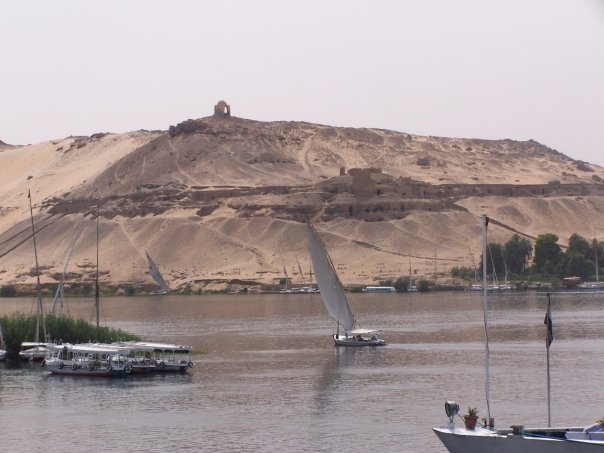
Feluccas on the Nile at Aswan. Image credit: Marc Scarisbrick.
During the Mubarak regime Ethiopia never made such bold assertions over water rights but Egyptian instability has resulted in curtailment of trade and tourism, thus weakening its economy and increasing reliance on financial assistance from external powers. Egypt is one of the biggest recipients of U.S. aid, receiving $1.55 billion per year.This assistance would most likely come to a halt were Egypt to engage in a war, thus resigning Prime Minister Qandil and, inevitably, his successor to reluctant negotiation with rival African states. Ethiopia has timed its hydroelectric projects expertly, building dams while Egypt and Sudan were distracted by domestic challenges. With the balance of power shifting upstream, Egypt no longer commands the same authority and is again mired in internal strife thus making peaceful agreement the probable outcome after decades of fruitless Nile negotiations.
In stark contrast to Egyptian stagnation, Ethiopia has made huge advancements and is poised to become the next Nile basin power. Besides the apparent acquisition of a new ally in South Sudan, the Chinese government too agreed to grant Ethiopia a $1 billion loan to help finance the Grand Renaissance Dam, which will become the largest hydroelectric power plant in Africa. Ethiopia views electricity exports as a reliable source of income in the coming years and the dam will enable the export of large amounts of clean power across North and East Africa, starting with neighboring countries Djibouti and South Sudan.
Conversely then, it appears that internal violence in Egypt will result in stable peace in the Nile basin as a whole. Egypt’s current turmoil means it can no longer interfere with Addis Ababa’s expansion. As Ethiopia becomes a net provider of green power, the downstream states (Egypt and Sudan) will risk widespread criticism when opposing Ethiopian projects on other platforms. This will bolster Ethiopia’s already significant regional influence and provide it further clout at the African Union. These developments along with increasing external investment signify that Ethiopia is on its way to meeting most of the Millennium Development Goals by 2015. While Egypt flounders in political instability, the World Bank predicts Ethiopia to be a middle income country by 2020.
About the Author






According to article 39 of the current constitution of Ethiopia, its ethnic based regions can secede and become independent nations if supported by more than 50 % of the inhabitants. This dam is being built in one of these regions (carved by force from the lands of the Godjam Amharas) where they deported recently other Ethiopians from other regions. Therefore ownership of the dam can only be limited to the ruling ethnic group i.e. The Tigrayans or perhaps the ruling class of the region where the dam is built.
This dam can perhaps escape Egyptian negative reactions but i rarely believe it can do the same with internal ethnic based politics of Ethiopia.
Abba u r ridiculously pointless, i mean if u comment as Ethiopian. i dont support the current regime but r u saying we need to build 85 dams to satisfy all the groups? OBVIOUSLY u start with one and it has to be somewhere, though I dont say it is the best place.
this dam has a big impression with everything about the country… JUST DONT HOLD THE COUNTRY BACK, if u can JUST SHUT UP
please reply to what you have read not to what you have in your mind long before you show up here.
I Like Abba Tobia. He is a cool guy. Way to go Abba Tobia
Keep dreaming Aba Tobia [a wolf in sheep’s skin)
Bad mouthing on some other country won’t help your cause!
Eritrea needs you to pay in blood to liberate her of the dictator, got it ?
Hi Abba Tobia, history suggests that lack of co-operation over Nile water leads to inefficient use of water and loss of valuable freshwater in the region [Jonglei Canal, Aswan Dam]. With this in mind would you suggest that the ruling ethnic group in question would be better suited to running the dam than the Ethiopian government?
whether we like it or not, the dam can only be run not by Ethiopians as a whole but by the Tigrayans because of the nature of their constitution imposed by force twenty years ago on Ethiopia. Therefore the Tigrayans will be in a better position against all their oppositions by controlling and running the dam and it is with this in mind they proceed with the project.
Abba Tobia,
You are talking totally nonsense and garbage!
Abba tobia , you don’t know any about the area , the Amaras and others are more than the locals by ## In the area and the locals are peace loving people .
It does not matter whether the amharas are numerous or not. Benishangul is run by the Benishangulis.
why? tell me why.
This is a great article that sheds light on a part of the world that isn’t noticed much. It is also very well written.
Terrific article, loved reading this. I have no prior knowledge of the water rights, or indeed the intricacies of the territorial struggles of the mentioned States in this article, so am significantly more informed and look forward to future editions.
The author conveyed an intricate issue in such a way that a passing reader like myself now feels fully confident to join this discussion. I look forward to many more entries.
To your success,
Gabriel
Abba Tobia is right! But that is Ethiopia politics problem and another topic.
no my friend my point is relevant to the dam, very relevant.
Very interesting and well written article in a very specialist area.
Marc 1 – Wikipedia 0
Cheers
I think this article is reasonable.It reflects the current and past. There is no question that Ethiopia is catching up its long due position in the Nile. While this is the fact, however, I hope Ethiopia will carefully consider Egypt’s basic water needs.
Hi Abdu. Thanks for commenting, can you expand on your last statement, would you agree that the balance of power has shifted to Ethiopia?
Very well written, intriguing subject and surprisingly easy to read. You brought the subject to life, like Shakespeare and his iambic pentameter. No doubt this will be a popular article and will be interesting to see the subject develop as as time goes by.
Interesting that Mubarak’s dictatorship brought political stability which Egypt forfeited in favour of a democracy that has seen their economy plummet.
Great article, looking forward to more.
Superb. It adds an interesting dimension to the effects of Quantitative Easing – Arab Spring is becoming “African Dam”. I guess it is also another sphere that juxtaposes increasing Chinese influence in Africa (sorry for the rhino).
Your article is too simplistic and inaccurate! It’s not Egypt’s strength that silenced East African countries including Ethiopia from using the Nile waters or ask for replacement of the outdated agreement instead, their internal weaknesses. Ethiopia didn’t forecast Egypt’s political crisis and start the dam as soon as situations are ripe for that; the Arab spring was a surprise to the world as much as it was to the Arabs themselves.
For your information the CPA (Entebbe agreement) has been under negotiation for at least 10 years before those East African signatories tabled it for approval. In addition the Eastern Nile countries (Ethiopia, Sudan and Egypt) has been working on the optimal utilization of the blue Nile water by forming an agency called ENTRO (Easter Nile Technical Regional Organization) and they have in principle agreed that Ethiopia is suitable for hydropower generation while Sudan and Egypt are for agriculture. With this in mind the Renaissance dam (GERD) was under study for long and all the three countries were aware of the potential benefits the dam will bring.
Based on the above facts, the dam can’t signify a power shift nor is related with the internal politics of any country!
Hi Belay, although I don’t appreciate the unnecessarily rude tone of some of your comments I am glad that you engaged with the article and left comments. Maybe ask yourself why the Co-operative Framework Agreement has been under negotiation for so long with relatively little result? Especially given that the 1966 Helsinki Rules dictated that all the Nile’s riparian states were well within their rights to start developing their own projects.Sudan has been represented in these negotiations for years but never agreed to sign before its partition. The acceptance of South Sudan thus indicates a significant shift in power given Sudan has traditionally been Egypt’s strongest ally in the region.
Ethiopia has been working on optimal utilisation of Nile Water for decades. The American Bureau of Land Reclamation undertook detailed research, ‘The Blue Nile Project’ that lasted for four years and was completed in 1964. It released proposals for numerous viable dams in Ethiopian territory but to carry out the plans, 8.5% of Nile water would need to be diverted. Egypt, backed by the Soviets, vehemently opposed these proposals and even threatened military action so despite the plethora of proposed projects, there was no way Ethiopia could act upon them without external aid. As Cascao said in 2009, the World Bank consistently made it clear that any loans would require Egyptian permission.
It is obvious to anyone with a basic understanding of geography that Ethiopia should have had large dams in place decades ago. The Aswan dam, though a symbol of Egyptian pride, is located in an extremely arid zone. As such, it loses a vast amount of water to evaporation; Aswan is one of the hottest regions in Egypt and consequently an unsuitable site in which to construct a reservoir. As Collins wrote in 1990, Ethiopia’s more suitable climate means that its proposed dams would only stand to relinquish a quarter of the water lost to evaporation in Lake Nasser.
The fact that Egypt consistently blocked Ethiopia’s hydropower development plans and is now unable to do so does indeed signify Egyptian weakening brought on by internal politics.
Thanks again for commenting.
i think you are absolutely wrong in your assessment. Ethiopia was allowed by the western nation to build the dam and i suspect the source of this green light to be reactions to islamic fundamentalism.
A very interesting and informative article One which brings to light a lot of information which would have probably been brushed over by most mainstream media outlets.
Furthermore, doesn’t the bulk of that ‘aid’ manifest itself as military aid? Dam construction versus damned construction… .
Indeed it does – irony abounds
[…] May, when Ethiopia began diverting the course of the Blue Nile as part of a project aimed at building the biggest hydroelectric dam in […]
It’s a candid analysis of the geopolitics of the Nile for regular reader…thanks!
The Bible predicts in three places that the river Nile will dry up. Here are two of them.
Ezekiel 30:12 And I will dry up the Nile and will sell the land into the hand of evildoers; I will bring desolation upon the land and everything in it, by the hand of foreigners; I am the Lord; I have spoken.
Zachariah 10:11 He shall pass through the sea of troubles and strike down the waves of the sea, and all the depths of the Nile shall be dried up. The pride of Assyria shall be laid low, and the scepter of Egypt shall depart.