
A big step has been made in the fight against the illegal animal trade. The sixteenth conference of the Convention on International Trade in Endangered Species (CITES), held in the Southeast Asian hub of Bangkok this March, announced a “watershed moment” in its battle against the trafficking of endangered animals. In what has been hailed a landmark decision by many animal rights activists, an agreement has been reached which will now see more of the world’s most-at-risk species come under legal protection.
CITES, a multilateral treaty established in 1975 to regulate the international trade in animals, has been at the heart of the decision. Recent campaigning has resulted in many species now being moved into Appendix II of the convention, which contains animals that may be under threat of extinction unless trade is closely surveyed. This will be especially pleasing for those who campaign for the protection of sharks, an animal which is being caught and killed at an alarming rate in Asian waters. The oceanic whitetip and porbeagle, as well as three types of hammerhead, will now join the likes of the Great White as species guarded under Appendix II. This will give them added protection against exploitation and overfishing. But is this enough?

Image Credit: Wikimedia Commons
According to some reports the global shark population is declining by up to 6-8% each year, whilst several species remain critically endangered. This is in large part due to the insatiable demand for shark fin soup, which is seen as a delicacy and a status symbol in the Far East. Somewhere between 100 to 300 million sharks are killed each year for their fins alone, in an act which is as brutal as it is immensely wasteful. The trade looks set to remain, however, as a burgeoning middle class in China, and in particular Hong Kong – where up to 50% of shark fins change hands – means more people can now afford what was once only a preserve of the ultra-rich.
Sharks are not the only species currently under threat in Asia, though. Rhino horn, long seen by Chinese pharmacists as an object with mystical properties, continues to blight the black market. Widely (but falsely) believed to be a cure for anything from fever to cancer, powdered rhino horn has long been a staple of Chinese medicine. But it has been a long time since Dicerorhinus sumatrensis, a wild species of rhino native to Myanmar, was spotted. Moreover, there are currently thought to be only 200 such rhinos left in the world, as poaching looks to have driven this species to the verge of extinction.
Yet there is more. The pangolin, a pinkish mammal that is prized for its meat and scales in China, is similarly under threat. Trade in all four species of the Asian pangolin has been illegal since 2002, yet the demand for the anteater-like animal, in particular its scales (which are believed to benefit breast-feeding mothers) has all but destroyed the population of the animal in Southeast Asia. Only recently a Chinese boat was caught off the Philippines with a cargo containing over 400 boxes of frozen pangolin meat. This is not the first time this has happened, however. Three years ago another vessel was seized in Guangdong province, China, with an estimated 7.8 tonnes of the stuff onboard. Much of the meat makes its way onto black markets in Vietnam, where pangolin is highly sought after. Indeed, Vietnam has made a name for itself in the illegal animal trade with an estimated 4,000 tonnes or so of wildlife products passing through the country each year, according to the World Wide Fund for Nature (WWF).
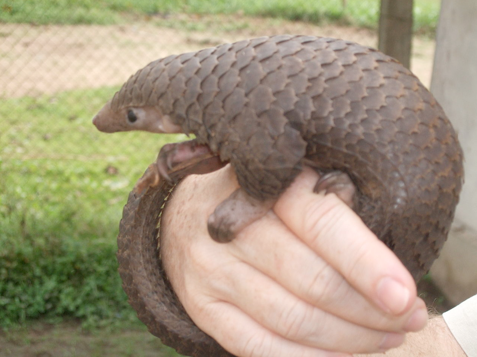
On the way out? Pangolin meat is not hard to find in Vietnamese markets. Image Credit: Wikimedia Commons
The Asian trade in endangered animals is still a big problem. But what can be done? The work of conventions and organisations such as CITES and WWF needs to continue: they have proven that lobbying and persistent campaigning can pressure governments into taking action. Yet more needs to be done. What must change are people’s attitudes towards the sale of endangered animals, particularly of consumers in the Far East. For example, despite a slight drop in sales of shark fin soup in China, the product continues to prove popular as it is seen as a part of the national identity: young people are afraid to upset the older generation by defaming what is a centuries-old tradition.
So long as there are poachers willing to risk hefty prison sentences for big money, the trade in endangered animals looks set to continue. Consumers in the Far East must realise that this is morally wrong, as well as damaging to the environment, and need to take responsibility for their complicity. Cross-border controls and checks can only do so much. People need to be educated fist. Only when attitudes change will the demand for exotic animal meat be made redundant.
About the Author






[…] article was originally posted on International Political Forum by Neil […]
[…] http://archive.the-ipf.com/eaten-to-extinction-asias-appetite-for-the-endangered/ […]