
Awareness of ebola in the Western consciousness has increased dramatically in the past few weeks after the first person in Europe (a nurse based in Madrid) was reported to have contracted the virus. This was closely followed by news this week of the first person to contract ebola from within the United States, a Dallas-based nurse treating Thomas Eric Duncan, a Liberian, for the disease in Texas.
Originating in West Africa in December 2013, the disease has spread rapidly, now affecting Europe and the USA for the first time since last year’s outbreak.
Despite the fact that the Dallas-based nurse represents only the second case of the virus in the United States so far, a media storm has followed inciting fear and panic in the general public and respective governments of Europe and the USA.
The potential scale of ebola is estimated to affect the world’s population on an international scale according to projections by the World Health Organisation (WHO), but since 2000 alone the international community has witnessed comparable scares over SARS and bird flu. Is ebola a real threat to the West, or is panic the real epidemic?
The Public Panic Response: What Is The Likelihood Of A Western Epidemic?
Health journalist James Ball recently drew attention to the unreliability of press coverage surrounding the issue of ebola. He cites the Daily Mirror’s recent headline ‘Ebola terror as passenger dies at Gatwick’ as an example (particularly since the patient in question had not actually contracted ebola). In the USA similarly sensationalist headlines continue to make the front pages. MyFox Detroit asks “Can all US hospitals safely treat ebola?” while ABC leads with ‘Ebola Emergency’ to announce the contamination of the Dallas health worker.
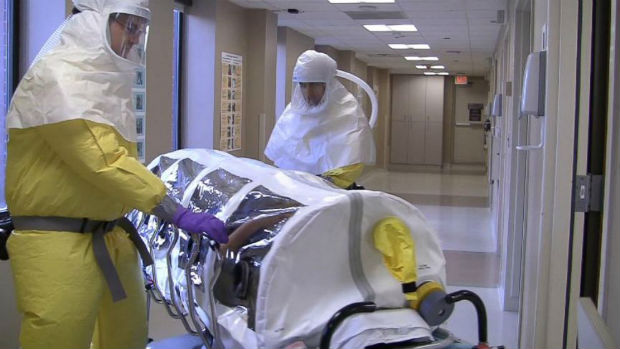
Health academics and specialist journalists seem polarised over the severity of the potential ‘Ebola epidemic’ in Western countries. The Economist argues that ‘the assumption that the Ebola outbreak could always be managed […] is under strain’, but comparative diseases in both Africa and Western countries have already statistically proven themselves much bigger killers.
As of October 7th, the WHO confirms that ebola is responsible for 13 deaths per day in West African countries (Guinea, Liberia, Nigeria, and Sierra Leone), while diarrhoea is responsible for 404, malaria for 552, and HIV / AIDS for 685.
James Ball further references seasonal influenza (common flu) as a more pressing and fatal concern for the UK and for the Western world as the Winter approaches. He describes hospitals as being ‘swamped’ on an annual basis with suffering patients, while the WHO estimates an annual international epidemic of 3 to 5 million, with a death rate of between 250,000 and 500,000.
According to health officials, the highly contagious ebola is certainly a threat to the West, but while little can be done to estimate the potential scale of the virus in the Western world, cynics warn the general public not to ignore the impact of more common killers that have plagued the international population for decades.
The West’s Contribution: Frenzied Governmental Responses To Treatment And Prevention
The public and press response to the ebola epidemic has inevitably implicated international governments and their respective policies for the treatment and prevention of the virus. The international political response to ebola has divided governments so far, as they continue to disagree over border control policies, sending aid to the source of the contagion, and following the advice of governing bodies such as the United Nations.
In the UK and the USA, political and governmental response to ebola has shifted dramatically since the spread of the virus to Western countries.
When ebola was confined to West Africa alone, the UK and the USA concentrated their efforts upon sending aid and specialist health workers to Liberia, Guinea, Nigeria, and Sierra Leone. Now that the virus has spread, however, their policies concerning ebola have shifted towards their own national interest. Both countries have introduced border patrol in recent days, despite Public Health England stating that there were no plans to introduce border screening only last week. Enhanced ebola screenings have now been introduced across the USA to track all people travelling from ebola-affected countries. Both countries hope that this will prevent the spread of the disease, although it is unclear whether or not the procedure has been effective in its short-lived history so far.
Despite their potential for heightening national security, these increasingly isolationist political tactics also have the potential to heighten the fear, panic, and stigma surrounding our understanding of the virus.
Australia’s Prime Minister Tony Abbott has refused to enter into any aid-related relationship with West Africa whatsoever, saying that he will not ‘send health workers into harm’s way’ and further suggesting that he is not ‘absolutely confident that all the risks are being properly managed’.
While some of the world’s richest countries, then, are turning their backs on what could potentially be an international health crisis, some of the world’s poorest are stepping up their efforts to help combat the disease.
The Guardian’s Monica Mark seeks to draw the nation’s attention to Cuba’s contribution, as they send hundreds of health workers out to West Africa, heeding the United Nation’s warnings that an increased number of resources in ebola-stricken countries are sorely required.
Panic: The Real Epidemic And How To Treat It
More so than ebola, panic seems to be the real epidemic of the international community. While individual nations were contemplating the implications of their own involvement in the health crisis, the WHO’s Dr Peter Clements was working in Liberia, West Africa at the epicentre of the virus.
‘People living in the community were afraid, civil unrest was simmering, […] and health workers were being targeted’, the WHO reports. ‘Dr Clements said the key to working with a hostile community is listening first. So he patiently listened to the community to understand their fears, then he started to explain about the virus and how people become sick.’
‘Once they knew what Ebola was and how to stop it, they declared together “No more Ebola in our community from TODAY!”’
While only a handful of cases have been reported in Europe and the USA so far, the threat of ebola in West Africa is still very real and the threat of international contagion is growing in the consciousness of the Western community like a disease of its own. Through working with afflicted communities in Liberia Dr Clements was able to affirm that panic and fear of the virus is just as toxic as the virus itself.
If ebola will prove itself as serious an epidemic in the West as it has been in West Africa, it may be necessary for governments and press agencies to shift their focus from isolationist security policies and sensationalism to basic education about what the virus is and how to recognise it. It seems that only by teaching individual communities, whether third- or first-world, will the international community be able to tackle ebola effectively.
About the Author





