
The latest military coup to oust the democratically elected President Morsi has throw Egypt back into turmoil. But why has this happened and why are the west reacting, on the face of it, quite pacifist to such events? These questions can be summed up in five key questions that perhaps explain why we should have seen the coup coming:
1. Firstly, is it a coup? Clearing up ideological misconceptions:
The military, the christian clergy, the muslim official clergy, the Mubarak era court system and rich families, represented by privately owned media, all backed the coup making it a textbook operation, originating from a reactionary movement that had already attempted a multitude of coup scenarios. The breaking into Alitihadia presidential place, the popular upheaval because of acute oil shortages that were mysteriously resolved instantaneously after the coup, and unreformed Mubarak-era court-rulings, banning democratically elected institutions, is all evidence that suggests a coup was already in the making.
This is reinforced by the repression of the media and freedom of expression. Five anti-coup channels were closed down and other stations, including Aljazeera, suffered interferences. The coup officials also showed a complete disrespect for the law and human rights by illegally kidnapping the president himself and other political activists.
Regarding the pretext of protesters on the 30th being behind a second revolution: protesting is constitutionally protected but not a constitutional power transition method according to the Egyptian constitution. The numbers of pro-coup protesters remains unclear, although opponents of Morsy claimed that google had cited 30million demonstrators, however google denies issuing such a statement. Middle east monitor expressed how the pro-coup protesters’ advertised numbers just don’t add up. The figure was more than likely used to validate the coup.
But if the facts are this clear, why is there even a question?
The US armament industry,for example, would suffer losing a pivotal market if the Obama-administration was to openly denote what happened as a coup. That would deprive them of 1.5 billion dollars of US taxpayers money set aside for military aid to Egypt.
Moreover some left wing and progressive western thinkers cannot be trenchant when it comes to the ideological affiliation of Mohamed Morsi to “Political Islam”. This is quite naive and dogmatic: the muslim brotherhood is the unofficial and anti status quo, (even proletarian) expression of political islam in egypt. Directly opposed to Al Qaeda and alike groups, the muslim brotherhood embraced Democracy. While most secular parties in the Arab world remain a one-man show, the Muslim brotherhood enjoys internal democratic mechanisms and institutions. However, the muslim Azhar clergy, backing the coup, is the official pro-mubarak institution representing a lingering line of the clergy class that had no problems coexisting with the mubarak regime and was rather a part of it!
In principle, it should be left to the egyptian voters to decide who will enjoy their vote and have their backing. For five consecutive elections after the revolution the muslim brotherhood was always majority. A coup, just has to be called a coup! That is principle not opinion.
Lastly, an interesting observation can be made about the “kind” of crowd that gathered on the 30th June. Human Rights Watch spoke of horrific levels of sexual abuse in Tahrir square. Over 91 women (and some report even infants) were sexually abused and mob raped. In huge crowds, of supposed political activists, one would expect minor incidents but not these sorts of violations. However entire mobs practiced rape and they were apparently so numerous that the rest of the protesters couldn’t intervene. In Egyptian revolutionary vocabulary, the June 30th crowds were mainly fouloul (Pro-Mubarak) and Baltajia (mercenaries or bandits or rapists).
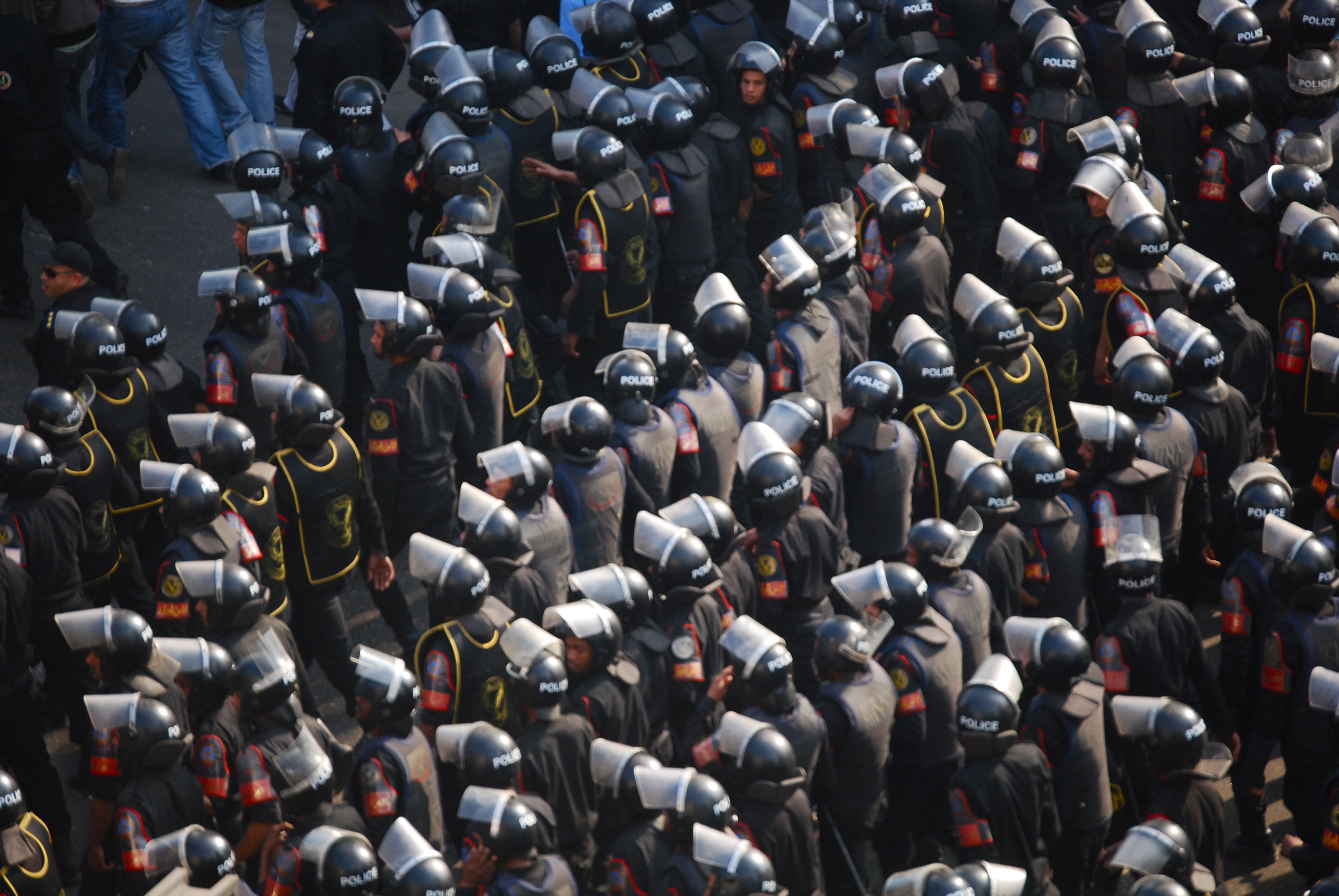
Rows of Egyptian Central Security Forces quelling 2011 Egyptian Protests in the Day of Anger 25th of January, 2011. Image credit: CC-BY-SA
2. Why did the revolution underestimate the threat?
The Egyptian revolution, or more appropriately, the egyptian society and in it’s core its most organised and numerous faction, the muslim brotherhood, weakened the revolution through key decisions.
The same group that orchestrated Mubarak’s removal, General Tantawi’s ouster (it is now clear Morsi’s constitutional decree was only a facade for a new generation of generals willing to oust older generals) ousted President-elect Morsi. General CC, official leader of the coup is the same general that came out before the presidential elections to defend the military’s practice of performing virginity checks on female protesters.
International (USA) acceptance or welcoming of the revolution provided a fake sense of security. This acceptance evaporated instantaneously as power balances shifted.

Secretary of Defense Chuck Hagel visits Cairo, Egypt, April 24, 2013. Egypt is Hagel’s fourth stop on a six day trip to the middle east to meet with defense counterparts.(Photo by Erin A. Kirk-Cuomo)
The muslim brotherhood is reluctant to admit that it was actually very distant from decision making or applying policies by the largely corrupt Egyptian state. There was a fake sense of normality that Mohamed morsi partook in by appearing like a president who was actually ruling and able to “achieve goals”. This threw the weight of the inevitable failures of the state onto the president rather than the deep-state that prevented any serious improvements to prepare for the coup. “Telling the truth” openly and ousting as many corrupt officials in revolutionary popular manners would have been more beneficial for Egypt.
Ultimately, these factors meant that Morsi was seized easily (he could have been surrounded by millions of his supports for lack of better judgment). The Egyptian revolution, represented by all of its democratic institutional achievements through the parliament and the president is suffering the strongest wave of the anti-revolution headed by reactionary forces.
3. The Egyptian opposition front after the coup:
The Egyptian political powers that backed the military coup, on the first Egyptian civilian president elected, had obtained a few government ministries and presidential posts. The unreformed Mubarak-era and the private media portrays them as leaders that capitalized on the threat to oust Morsi. However, the left and liberal front has completely renounced betraying any sense of democracy, respect for the law or the principle of peaceful transition of power. Ultimately betraying the Egyptian revolution and their own ideological core values will destroy their already extinguished popularity. Coup histories also tells us that after a Military-coup stabilizes, it’s civilian political front is always next to be terminated and marginalized (unpopular and unarmed, they have no bargaining chip in a militaristic regime!)
It is useful to point out that the extremist salafists islamist party, Nour Party, backs the coup. This means that the struggle cannot be simplified to Islamists Vs secular even when one oversimplifies.
4. Ambiguity in most official international reaction:
Some regimes have been blunt in their support of the coup: The Saudi Kingdom and The United Arab Emirates. They both pledged and provided enormous amounts of financial support (8 Billions USD), this alone should be troublesome for any progressive western thinker who backs the coup or chooses to stand idle. The USA’s and EU’s general avoidance of condemning the coup is particularly astonishing. Especially given the rhetoric that both advance about “spreading democracy”. An explanation could be that Morsi’s plans (the Egyptian revolution at large) threatened the core of western interests in the middle east: Egypt is the world’s largest grains importer and under the one year old democracy it already managed to slash its share of imported grains. Egypt also controls the Suez canal and president-elect Morsi’s chief economic plan was to build a mega–service and industrial area on its shores. This would endanger the economies of US allies such as the United Arab emirates, where port services are a major trade and Egyptian activities in the area enjoy a geographical and obvious economic advantage. Ships won’t have to enter the Persian gulf but would rather purchase the same services on their route through the Suez canal. Another factor is Morsi’s Ideology and relations with Israel. It is a fact that most Israelis see Islamists as an existential threat. President Morsi proved very strict in adhering to international laws and to the terms of the peace treaty with Tel-Aviv. He even brokered a solid peace treaty between Gaza and Israel that continues to hold.
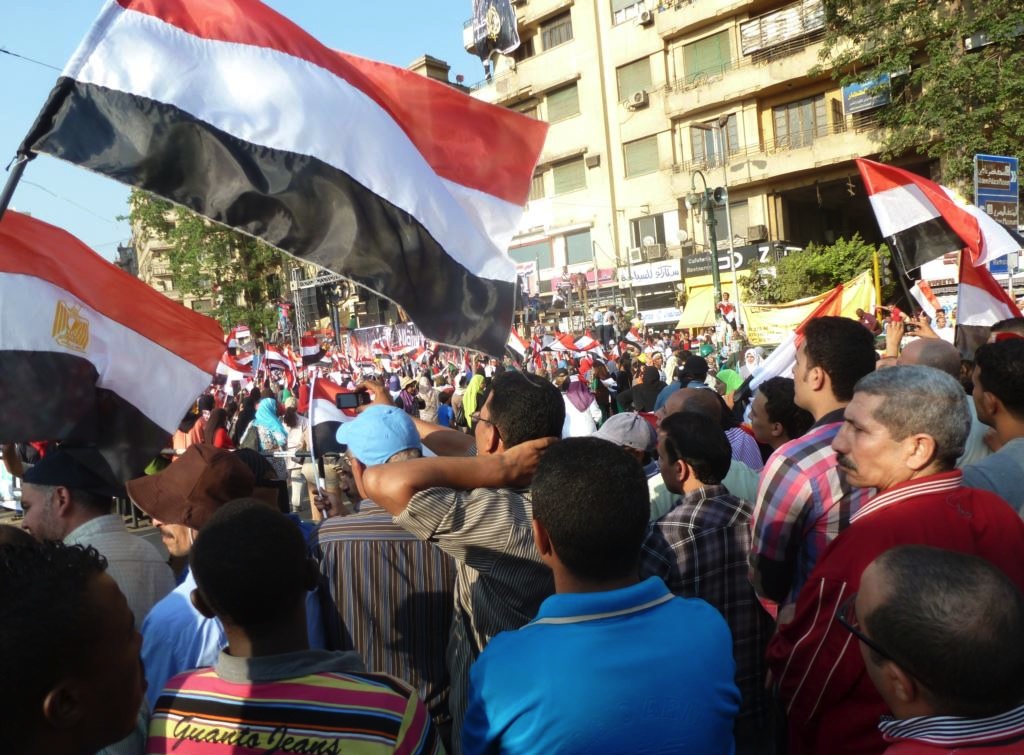
Thousands poured into Tahrir Square to celebrate what they are calling Egypt’s “Second Revolution”, the military’s ouster of president Mohamed Morsi, July 7, 2013. Image credit: S. Behn
As I already pointed out, political parties that chose to back the coup will become politically obsolete. The secular salvation, the extremist Salafist Islamist party and the Nour party will have no political future in modern Egypt. However I hope that when time comes and the coup Generals decide to slaughter them, there would be democratic forces to defend them.
The Egyptian coup authorities seem determined to end the Rabaa Adawia and other sit ins calling for a return to democracy. They have shown willingness to shed civilian blood and use live rounds to disperse crowds. The protesters are at a physical disadvantage facing the strongest military in Africa and the Arab world. Even though the sit ins assemble huge crowds, the unreformed Mubarak-era security apparatus could use a multitude of crowd-dispersing methods: gradual brutal force, water and supplies blockade and nerve gas.
The sit inners and anti-coup protesters are well aware of the price to be payed to resume the democratic process. They have destabilised the military coup by their 30 days strong sit in and continual protests. So far, the revolutionary anti-coup momentum shows no signs of slowing momentum. The atrocities that the Coup authorities are committing are drawing in more sectors of Egyptian society, especially the culturally sensitive slaughter of the women’s marches.
In conclusion, and realistically, it is a question of whether coup leader, general CC, will have a chance to flee or will be tried. For the coup political supporters who will be left behind when Morsi returns I profess Morsi will quote Hugo Chavez after he overcame a similar military coup in 2002: “I forgive you, evil people”.
About the Author






[…] likely used to validate the coup. But if the facts are this clear, why is there even a question? READ FULL TEXT… Fascism should rightly be called Corporatism, as it is the merger of corporate and government […]