
The demand for social equality, a trigger in the Arabs uprisings, a thirst for justice, equality, and freedom motivated the people to finally demand their rights. It has been over two years since the beginning of the revolutionary chain and leaders are still struggling to meet the peoples’ demands. Few governments have succeeded in showing great progress towards a full democracy but there has been transitions towards a more democratic society even if it is proving to be a lengthly process. But should people only be depending on the central governments to meet their demands? In order to be resilient and progressive, people in the Arab world have adopted new approaches towards governing their affairs. In the light of this, Arab Informations and Communications Technology (ICT) users have shown resilience and adaptability. ICT has succeeded in provide the Arab peoples with more equality and freedom than ever before.
Starting with education, more Arab people now have better and equal access to high quality online education, overcoming the burdens attached to governmental education system. There are no statistical figures on the number of people who are actually pursuing online education, still, a recent World Bank report on education indicates that there is an increase use of ICT in most of the schools in the Arab countries. In the post-secondary education level, more courses are now offered online in free platforms such as Coursera, Edx.org, MIT open courses, the Open University; furthermore, promising projects such as the Syrian Virtual University (SVU) and the Arab American eUniversity System (AAeU) are taken place side by side with many online degrees offered by many higher education institutions around the world. Even though these courses are offered in English, which can constrain people to pursue it, still more people are interested in using these platforms because they offer access to unbiased, critical, and liberal content about various sciences. This has helped the people to build up their skills and knowledge and become more competitive and skillful. In addition, more scholarships are now offered online through online applications that directly ties the students and the global education community. Moreover, in societies where books are expensive and not always available, online libraries have offered an opportunity for students to save money and have equal, affordable, and sometimes free access for the latest available knowledge in the globe as many of these libraries offer memberships for a reasonable fee. Despite these advancements, online education in the Arab world is facing critical challenges that can be summarized in ICT infrastructure, culture, leadership and e-learning strategy, the local content, copyright issues, and instructors and learners.
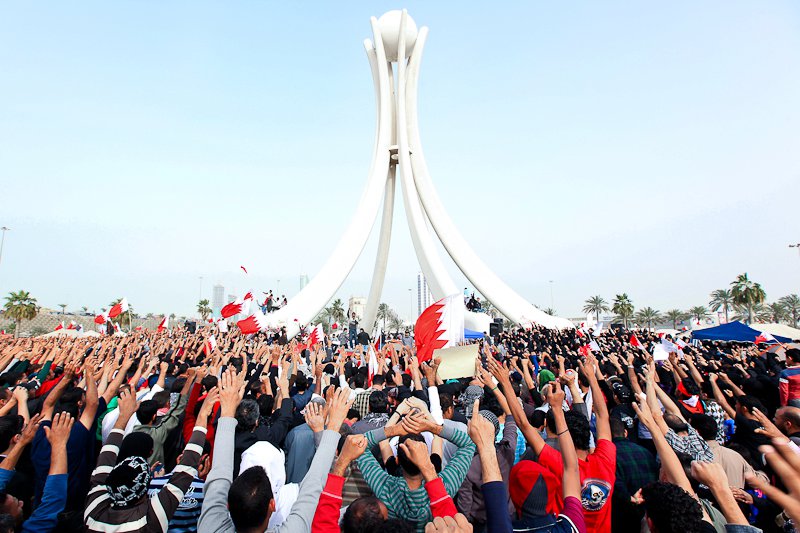
Protesters fests toward Pearl roundabout, 19 February 201. Image credit: Bahrain in pictures
ICT offers the advantage of free and equal access for information and from multiple resources. The growth of citizens’ journalism gives the space for Arab citizens to access more accurate information and news from the field about government performance, corruption, international affairs, and social affairs. Also, it allows for the utilization of social media to create change where people can work together and overcome cultural and religious differences. Additionally, the communication and cultural exchange with other Arabs and nations flows freely and without restriction as a result of utilizing the ICT, thus empowering social equality.
The use if ICT also empowers social equality and equal employment opportunities. Many Arab and international companies, universities, NGOs, and INGOs offer online recruitment for their staff either by physical employment or virtual employment. Bayt.com, one of the online recruitment services in the Arab world, founded in 2000, has offices in 10 regional cities – Abu Dhabi, Dubai, Riyadh, Jeddah, Al Khobar, Doha, Manama, Kuwait City, Amman and Karachi-, reported that more than 26,000 employers, representing companies of all sizes, now hire through Bayt.com. Bayt.com boast 12.5 million users and over 40,000 leading organisations – mostly from around the Gulf Corporation but also the wider Middle East, Africa, Asia, North America and Europe. Usually, those employers offer equal employment opportunities based on merits and qualifications in contrast with the government recruitment system that is highly affected by cronyism, nepotism, and political affiliation.
ICTs have also strengthened religious freedoms. It gave Arabs the opportunity to learn more about other religions and share their religious perspectives with other Arabs and nations. Arab citizens can now conduct religious debates with their counterparts and exchange perspective in different aspects of their own faith or other religions. Although some hatred materials are published too, but with websites content management this risk has been reduced.
ICT and gender equality empowerment are correlated. Despite the fact that gender equality is still in inadequate levels in the Arab world, the ICT sector has helped the improvement of gender equality. Most of the information available on Arab women’s’ usage of ICT does not clarify their use in comparison to men’s’ use of ICT. The proportion of female workers in the ICT business sector is very low, except in Lebanon (40%) according to the UN-ESCWA. ICT works to improve the chances of increasing women’s income and encourages the development of entrepreneurial activities as well as small and medium-sized enterprises.It contributes to raising the awareness of women in political, economic, and social issue. It also helps to empower the participation of women in social life decreasing gender sensitivity and inequality.
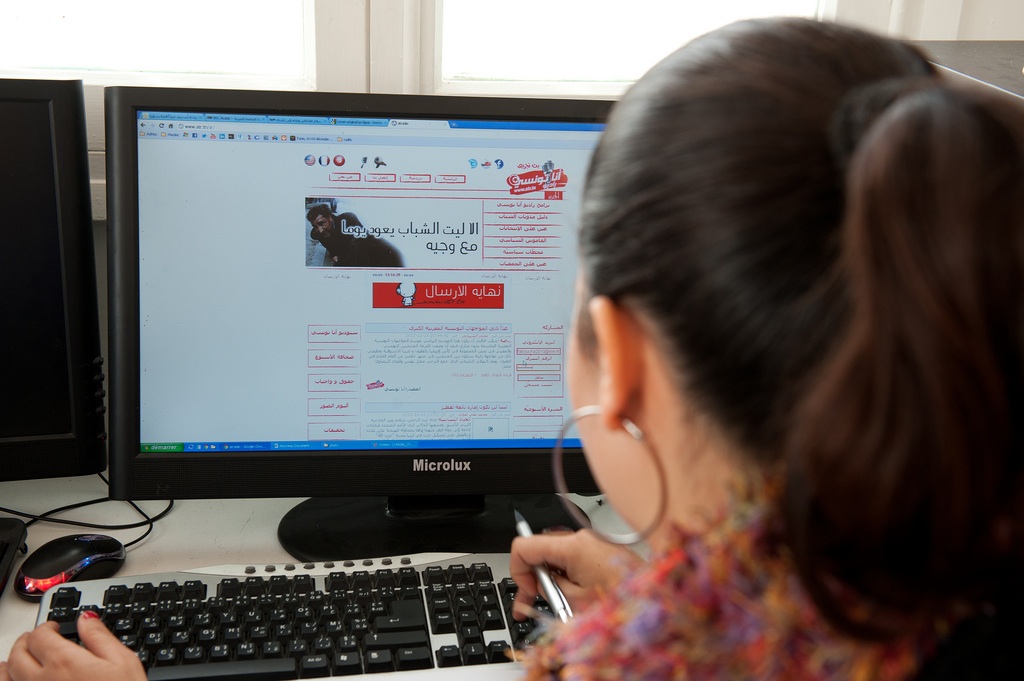
Young woman working on a computer. Tunis. Photo: Arne Hoel / World Bank
In conclusion, achieving social equality in the Arab world is both the responsibility of the governments and the peoples. The governments have to increase their investment in the ICT infrastructures, to work in developing national ICT policies that governs the ICT sector and adapts to its rapid use in public and private sectors, and to establish E-Government models to radicalize ICT governance. Using technology more in education, business, and government will increase the level of transparency and accountability and therefore helping to promote good governance and rule of law. Any upcoming Arab government should empower ICTs role in governance. On the other hand, the people are responsible in developing a culture of respect and appreciation for ICT utilisation and promoting the use of ICT in all different aspects of our society.
About the Author





