
In late April, the Turkish Prime Minister, Recep Tayyip Erdogan, offered his condolences to Armenian families over an event that occurred nearly a century ago. Erdogan’s statements held particular significance given they occurred on the eve of the 99th anniversary of the onset of the Armenian Genocide – which began on April 24th, 1915 and continued throughout World War I. In his statement, Erdogan characterized the mass killings committed by the Ottomans as inhumane, but stopped short of formally recognizing the genocide.
Prior to WWI, there were 2 million Armenians living in the collapsing Ottoman Empire, but by 1922 there were fewer than 400,000. The 1.5 million that perished were killed in what most historians, but not Turkey, consider to be a genocide – also considered by many to be the first genocide of the 20th century.
As Constanze Letsch notes for the Guardian:
The interpretation of the mass killings in 1915 remains a highly contentious issue in the country and abroad, and has fueled bitter controversy between Armenia and Turkey. Armenia has urged Turkey to recognize the killing of up to 1.5 million Armenians as genocide. Turkey, which puts the death toll at 500,000, says they died of fighting and [of] starvation, and categorically rejects the term.
Hence, Erdogan’s statements were one of the first instances of a Turkish government official publicly acknowledging these events. As noted by the Washington Post, “The Associated Press called the comments an ‘unprecedented, conciliatory message to Armenians,’ while a Turkish official told Reuters that it was the first time a Turkish leader had offered condolences so directly to Armenians.”
Yet, many were left unsatisfied by his remarks, as they were in many ways in line with the Turkish government’s tradition of rejecting the inherently genocidal nature of the events. In fact, in early April, the Turkish foreign ministry condemned a U.S. Senate committee resolution that called the killings a genocide, stating that “We reject this attempt at political exploitation that distorts history and law and we condemn those who led this prejudiced initiative.”
The history behind the Armenian Genocide is complex, but like Jews during the Holocaust, Armenians were essentially made a scapegoat, and viciously targeted as a consequence. The genocide was directly tied to the demise of the Ottoman Empire. As the Ottoman Empire declined, a group of ambitious young officers, known as the Young Turks, seized power. They sought to modernize, strengthen, and in many ways homogenize, or “Turkify,” the empire.
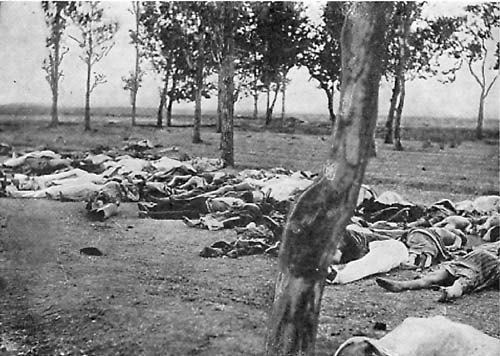
Picture showing Armenians killed during the Armenian Genocide. Image taken from Ambassador Morgenthau’s Story, written by Henry Morgenthau, Sr. and published in 1918.
Armenians were historically a class of merchants and shrewd businesspeople located throughout the Caucasus region, and were often better off than many Turks. They also had ties with many different peoples. This is precisely why the Young Turks accused Armenians of siding with the Russians during the war. While it is true that a small group of Armenians did cooperate with Russia, the Young Turks made sweeping generalizations about Armenians in order to demonize them. In Turkish propaganda, Armenians were labeled as overwhelmingly pro-Russian and saboteurs. Beginning on April 24th, 1915, the Ottoman government arrested hundreds of Armenian intellectuals and community leaders, who were later executed.
The Young Turks, calling themselves the Committee of Unity and Progress, took it upon themselves to deport anyone they felt was a “security threat.” At that time, this meant Armenians. Hundreds of thousands of men, women, and children were marched across the desert to Syria; many were killed or died of disease or starvation along the way. Armenians in the army also had their weapons confiscated, and many were transferred into labor battalions where they were essentially worked to death or killed. A law was also passed making it legal to confiscate “abandoned” Armenian property.
According to the New York Times,
Thus, the nature of language continues to be vitally important in terms of the interpretation of history in the political arena. Moreover, others are skeptical about the timing of Erdogan’s remarks, as Turkey’s government has come under increasing international pressure in the midst of government crackdowns on opposition – including widely publicized bans on Twitter and YouTube. Perhaps Erdogan wanted to exhibit that he can be progressive, but in many ways his remarks were nothing new in terms of Turkey’s official interpretation of the events of WWI.
It is extremely important that this event is recognized as a genocide, in order to prevent such heinous acts from occurring in the future. This is precisely why genocide education is so vital. As the Jerusalem Post argues, there is a moral imperative to recognize the Armenian Genocide, in the same way that the world must avoid silence surrounding the Holocaust.
The origin of the term “genocide” is intimately connected with the histories of both the Armenian Genocide and the Holocaust. Raphael Lemkin, a lawyer of Polish-Jewish origin, invented the word. He combined the Greek word “genos” (race or tribe) with the Latin word “cide” (to kill). Lemkin‘s work was originally inspired by accounts of the mass killings of Armenians. Tragically, Lemkin’s entire family was killed during the Holocaust, only he and his brother survived.
Lemkin’s work led directly to the adoption of the UN Convention on Genocide in December 1948, which entered into force in January 1951.
Article Two of the convention defines genocide “as any of the following acts committed with intent to destroy, in whole or in part, a national, ethnical, racial or religious group, as such: killing members of the group; causing serious bodily or mental harm to members of the group; deliberately inflicting on the group conditions of life calculated to bring about its physical destruction in whole or in part; imposing measures intended to prevent births within the group; [and]forcibly transferring children of the group to another group.”
If one studies the history of the Armenian Genocide, it is readily apparent that it fits the UN definition. As the BBC notes, “Argentina, Belgium, Canada, France, Italy, Russia and Uruguay are among more than 20 countries which have formally recognized genocide against the Armenians. The European Parliament and the UN Sub-Commission on Prevention of Discrimination and Protection of Minorities have also done so.”
Some historians have argued that what occurred does not qualify as a genocide because there is not enough evidence to prove that the extermination of Armenians was systematically planned. Yet, a majority of historians do not concur. Moreover, Henry Morgenthau, Sr., the former American Ambassador to the Ottoman Empire (1913-16), once wrote in his memoirs, “When the Turkish authorities gave the orders for these deportations, they were merely giving the death warrant to a whole race; they understood this well, and in their conversations with me, they made no particular attempt to conceal the fact.”
Thus, one might argue that Erdogan’s remarks were a step in the right direction in terms of Turkish-Armenian relations and the recognition of the genocide. Yet, it has been nearly a century, and still the Turkish government refuses to fully acknowledge what much of the international community and historical experts have clearly recognized as a deliberate attempt to eradicate an entire people. Genocide is the most heinous crime a people can commit, and until it is fully recognized the wounds it creates can never begin to heal. Moreover, it is imperative that future generations understand the meaning and history of genocide in order to ensure that the world never witnesses these types of horrible crimes ever again. Stopping short of a full recognition distorts that history, which is both unacceptable and dangerous.
About the Author






The Ottoman Census System and Armenian Population, I83I-I9I4
1885
Armenian Gregorian: 988,887
(Greek Catholic+Armenian Catholic) :150,166
1897
Armenian Gregorian: I,042,374
(Greek Catholic+Armenian Catholic) :120,479
1906
Armenian Gregorian : 1,050,5I3
Armenian Catholic : 90,050
1914
Armenian Gregorian: 1,161,169
Armenian Catholic : 67,838
The Ottoman Census Department was directed by the Armenian Migirdich Efendi who, following a common practice at the time, tended to staff it with young members of his own millet and sent a number of them to England and France to study modern census techniques.(Source:Muhtira-i Hiimayun. BVA, Yildiz K9 nos. 2631 and 2632. )
According to the US State Department.. Authority Letter from W.H.Anderson , there were 817,873 Armenian refugees from Turkey in 1922
Also The number of the Armenians not subject to relocation is 281,000 Armenians in Turkey in 1921: 150,000 In Constantinople (Istanbul) and 131,000 in Asia Minor(Some of them had later escaped from Turkey, 70,000 Armenians remained in Turkey, mostly in Istanbul)
Totally:817,873+281,000:1,098,873 Armenian survivors or not Ottoman responsibility in 1922
The figures were based upon information furnished by the British Embassy, Constantinople, and by the agents of the Near East Relief Society, in 1921.
As seen, the numbers that the Armenian allegation based on are nothing but imaginary propaganda instruments.
Both Armenians and Muslims suffered terrible human tragedies, but due to the absence of legal basis and international court’s decision, neither side can claim the deaths among its members to be “more genocidal” than the other’s.
This year,It is now firmly established by none other than the mighty supreme court of Europe, namely the European Court of Human Rights, ECHR, in its December 17, 2013 verdict, that the events of 1915 cannot be proven to be genocide or compared to Jewish Holocaust. European Human Rights Court(ECHR) stated it doubted that there could be a general consensus as to events such as those at issue, given that historical research was by definition open to discussion and a matter of debate.
I doubted that a «general consensus» over the events’ legal classification could be derived from political recognition and agreement among historians.
In the summer of 1914, Armenian volunteer units were established under the Russian Armed forces. By 1917, when the Russian Caucasus Army disintegrated, there were 110,000–120,000 soldiers of Armenian ethnicity. This number approached to 150,000 for the total Armenians (including other Allied forces) for Near East where opposing to Ottoman forces.
Source:
^ Kayaloff, Jacques The Battle of Sardarabad. Paris: Mouton Publishers,1973, p.73.
Jump up^ Fridtjof Nansen, Armenia and the Near East (New York, 1976), p. 310.
7 millions of turks exiled from balkans,caucaus,middle east..thousand of muslim kurd,turk,tatar,abkhazian georgian killed by Armenian hunchak,dashnack terrorist organizations backed by Russian Empire..