
The recent referendum in Crimea and the subsequent annexation of the peninsula by Russia has captured much of world’s attention of late. It has also ignited discussions about secessionism in Europe, which is quite relevant at the moment. On the 18th September 2014, Scotland will vote on whether or not to become independent from the United Kingdom. Moreover, as Graham Avery notes in a recent article for the Scottish Global Forum think-tank, “Elsewhere in Europe, the Scottish debate is followed with interest, and the result of the referendum is awaited with concern. After all, Scotland is not the only place where independence is under active discussion: in Spain the government of Catalonia has announced a referendum for 9th of November this year on the question of independence.”
Additionally, barely a week after the Crimean referendum, Plebiscito.eu, an organization representing a coalition of Venetian nationalist groups, held an unofficial referendum on breaking with Italy. There are 3.8 million eligible voters in Venice and its surrounding areas, and over 2.1 million voted to break away from Rome. According to an article written by Matt Ford for The Atlantic:
On Friday night, people waving red-and-gold flags emblazoned with the Lion of St. Mark filled the square of Treviso, a city in the Veneto region, as the referendum’s organizers announced the results: 2,102,969 votes in favor of independence—a whopping 89 percent of all ballots cast—to 257,266 votes against. Venetians also said yes to joining NATO, the EU, and the eurozone. The overwhelming victory surprised even ardent supporters of the initiative, as most polls before the referendum estimated only about 65 percent of the region’s voters supported independence.
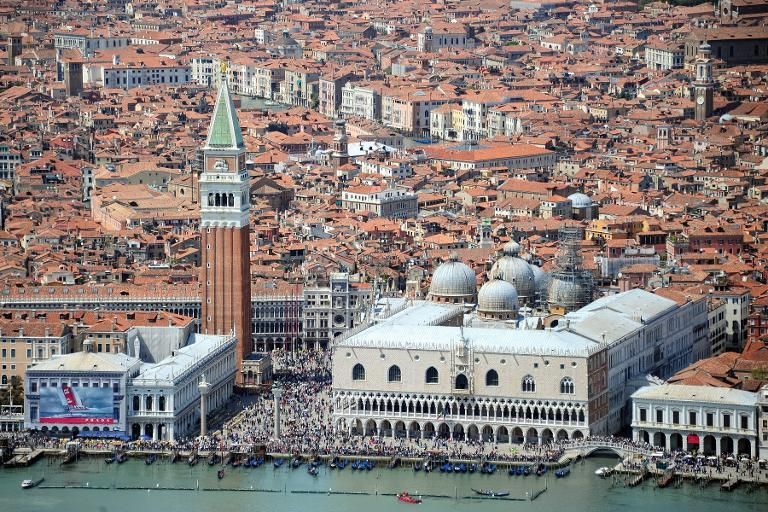
St Mark’s square in Venice is pictured on May 18, 2012 (AFP/File, Olivier Morin)
Before the vote, Lodovico Pizzati, the spokesman for the independence movement, told The Telegraph, “If there is a majority yes vote, we have scholars drawing up a declaration of independence and there are businesses in the region who say they will begin paying taxes to local authorities instead of to Rome… It won’t be like in Scotland, where London has said it will recognize a vote in favour of independence. Rome has tried to ignore us, but we are not going to wait for their recognition.”
Accordingly, it is evident that Europe may experience some major changes in the coming months and years. However, it would be tremendously incorrect to assume that these separate independence movements are the same, but they all do pose some interesting questions for Europe.
Some have argued that Venice is justified in its move for independence. As noted by PolicyMic, Venice has both economic and historic reasons to separate: “Lately Venice has been paying 71 billion euros ($98 billion) to Rome in taxes. In turn, it has only been receiving 50 billion euros ($69 billion) back in investments and services.”
Furthermore, as Thomas Carswell argues, “The idea of an independent Venetian city state is not as daft as it might at first seem.” Venice was an independent city-state for around 1,000 years, and in that capacity flourished as a center of trade, commerce, and learning. Perhaps, if it were granted more local autonomy, it would be able to regain some of its former greatness. At the moment, it appears that Venice feels overshadowed and suffocated by Rome. As noted by Matt Ford, “Unlike Scotland and Catalonia, which already possess relatively strong regional governments, Italy’s regions have limited legislative autonomy and little hope of obtaining more.”
This is not to say, however, that Venice has more reason to call for independence than Catalonia, or Scotland. Each independence movement has its own unique set of circumstances, issues, and concerns. As Graham Avery points out, “their debates on independence take place in different historical and constitutional contexts.”
Following the recent Crimean referendum, in which Crimea voted to separate from Ukraine and join the Russian Federation, Russian officials attempted to draw a parallel between that situation and the Scottish referendum. Russia was trying to characterize the West as hypocritical for condemning the Crimean referendum and labelling it as ‘illegal and illegitimate’.
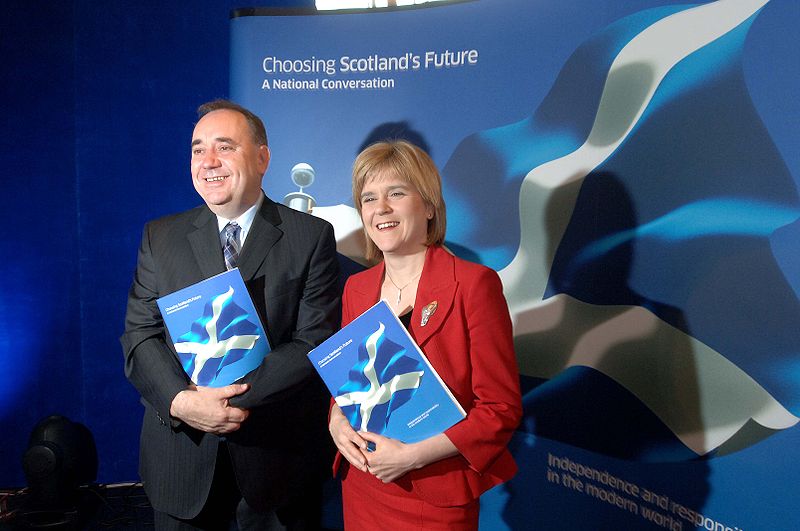
First Minister Alex Salmond and Deputy First Minister Nicola Sturgeon at the launch of A National Conversation, August 14, 2007. Image credit: Scottish Government
Valentina Matviyenko, the speaker of the Federation Council, Russia’s upper house of parliament, stated, “The decision [by Crimea’s parliament] is fully in line with international practice. It is enough to look at Scotland and you can find other examples… No one says the Scotland referendum is illegal.” The UK government did not take kindly to this characterization: “Nothing in the way the Crimea referendum has been conducted should convince anyone that it is a legitimate exercise,” the British foreign ministry tweeted.
The United Kingdom has a point. There wasn’t much of a choice for the people of Crimea in the recent referendum, as it occurred in the midst of a crisis, under rushed circumstances and the watchful eye of a foreign occupying force.
A recent article from CNN notes:
The situation in Crimea remains largely unresolved. Many in the international community do not recognize Russia’s annexation of the territory, and it is unclear what will ultimately occur there in terms of a Western response and what impact that may have.
Likewise, it is important to distinguish between the referendums in Scotland and Catalonia. As Graham Avery explains, for Catalonia:
Uncertainty seems to be the only quality that these separate independence movements, which we are now witnessing, all share. As polls fluctuate in Scotland towards a Yes vote, the country is uncertain as to whether or not it will be able keep the pound and join the EU, among other concerns. For Catalonia, it is uncertain whether or not the Spanish government will block its vote for independence.
For Venice things remain even more uncertain. On Venice, PolicyMic notes, “The majority of poll participants said they would like to remain part of the EU, NATO and the Eurozone, but these organizations have indicated in the past that breakaway regions will have difficulty regaining membership… But more importantly, Italy also considers the referendum illegitimate and unconstitutional and is sure to block any further measures Venice might throw its way.”
Regardless, this is certainly something to watch, and all of these movements have shared implications in terms of EU and NATO membership. Venice and Catalonia have particular reasons to look towards the referendum in Scotland, as it is recognized by the UK government and the international community, and arguably has more legitimacy. Thus, what ultimately occurs in Scotland will have a number of implications for future independence movements across Europe, and perhaps the world. With less than six months to go until Scotland votes, this is certainly an issue that deserves a great deal of attention.
About the Author





