
… and shows the world what to expect from the next round of global negotiations in Paris 2015.
After the EU summit in Brussels this Thursday and Friday, European leaders struck a new deal on climate change and energy policy. After the disastrous failure of global climate change negotiations in Copenhagen 2009, and shortly before the next round of global talks in Paris 2015, the EU has signalled its ambition to be a world leader in the combating climate change and highlighted the vexing difficulties in striking meaningful compromise in this area. The cornerstones of the pact formed in Brussels are a 40 % reduction of Europe’s greenhouse gas emissions below 1990 levels, a 27 % increase in the use of renewable energy, and a 27 % increase in energy efficiency compared to 1990. The deal is praised by the Union itself as Europe taking on an ambitious world leadership role in the prelude to Paris 2015.
It is also viewed more controversially however, as pitting Green business against industry. It is seen as a big challenge by many industry leaders, but bashed as teeth-less and disappointingly unambitious by Green business and environmental advocates. The 40 % reduction target of greenhouse gas emissions below 1990 levels by 2030 is a clear improvement over the old 30 % target by 2020. Furthermore, this time the reduction target would have to be based solely on domestic cuts, because member states cannot use international offsets to meet their targets anymore, said Climate Commissioner Connie Hedegaard speaking to Reuters on Friday. The 40 % goal is phrased flexibly as a minimum target which may be adjusted upwards (but not downwards) in accordance with the outcome of global climate negations in Paris next year. Yet there is also ample criticism, for example about the EU’s 27 % renewable energy market share target. This goal is binding only to the Union as a whole, but not to each member state individually. Theoretically such an approach makes sense, because it allows for potential shortcomings of member countries who have trouble in sufficiently altering their energy systems to be absorbed by larger changes in other countries who may find it easier to adapt. In practice however, as is argued by environmentalist groups, this could make enforcement of the goal rather difficult, if there is no systemic mechanism in place to ensure and co-ordinate overall compliance with the target. Additionally, a mere 27 % increase in energy efficiency, falling short of the original negotiation target of 30 %, is seen as disappointingly low by many insulation industry insiders. It is even bashed as nothing but hot air by environmentalist groups, due to the entirely non-binding nature of this indicative target. According to the Guardian, the CEO of a leading insulation firm wrote in an open letter to EU leaders, that the 27 % aim for improving energy efficiency was “no better than business as usual” and that it “sends a strong signal to the energy efficiency industry to ‘leave Europe and make your investments elsewhere’”.
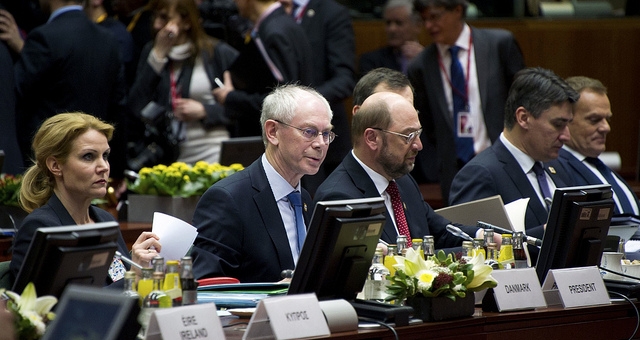
Image Source: Inline Policy http://inlinepolicy.com/2014/european-council-2030-climate-and-energy-framework/
As German chancellor Angela Merkel was quoted by the NY Times, the deal “will ensure that Europe will be an important player, will be an important party, in future binding commitments of an international climate agreement”. Yet the fact that the scale and scope of the agreement reached in Brussels is indeed enough to make Europe one of the most ambitious and proactive regions of the world in combating global climate change is not an encouraging, but rather a deeply unsettling one.
Negotiations amongst the EU-member countries were tough, and although enthusiastic Germany and France were aiming high, they eventually had to compromise with their more reluctant counterparts across Europe. Poland, aided by an alliance of Eastern European countries, enforced sizable financial commitments (€15bn-€20bn to Poland alone according to the Guardian) under the EU’s carbon trading system in order to help its highly coal-reliant energy system to adjust. Britain’s David Cameron tried and succeeded in making sure the 27 % targets in renewable energy and energy efficiency would not be nationally binding, largely for domestic political reasons.
Although the final result is encouraging because it proves that compromise in climate change negotiations is principally possible, despite differing interests and capabilities of the involved parties, environmentalist groups call it diluted, saying that it falls short of the more ambitious and meaningful commitments needed. If Europe, as one of the economically most highly integrated regions in the world and the unprecedented world champion when it comes to supranational decision-making, can’t reach more meaningful compromise within its own members, what can the world expect from global negotiations in Paris next year? The answer unfortunately is: not much.
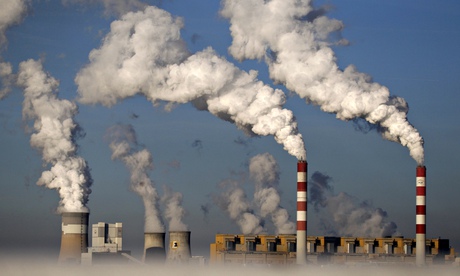
Belchatow: Polish coal-fired power plant. Image Source: The Guardian / Kacper Pempel / Reuters http://www.theguardian.com/environment/2014/jul/22/germany-uk-poland-top-dirty-30-list-eu-coal-fired-power-stations
In light of this upcoming round of international climate negotiations, the Brussels deal highlights the limited potential for global compromise when it comes to climate change. As the “climate change leader” Europe struggles within itself, the world on a larger scale is torn between an enthusiastic core of developed countries seeking to advance an ambitious climate agenda, a group of underdeveloped and/or developing countries terribly reliant on highly polluting energy sources who are thus reluctant to (unaided) change, and even those developed countries that have long obstructed vital reforms due to domestic politics but whose commitment is sorely needed to strike a meaningful deal. All the vexing difficulties that marked Europe’s negotiation process and contributed to a disappointingly diluted compromise, as many environmentalist groups call it, will be found again in Paris next year. But on a global scale, the situation is more deadlocked. Even a highly diluted compromise should therefore already be hailed as a remarkable success. In the battle against climate change it will, however, hardly suffice.
About the Author






[…] arduous negotiations amongst its own member states, before an (according to some NGOs, still) imperfect inner-European agreement on climate change action could be reached in October this […]