
Relations between the United States and Russia have consistently gone downhill over the last few years before reaching breaking point in March 2014 with the annexation of Crimea by Russia and its support for Russian separatists in eastern Ukraine.
There is some amount of unanimity among political analysts that the year 2014 saw the rapid deterioration of an already difficult relationship shared by the two countries.
Even though strained ties between Moscow and Washington could immediately be attributed to the Ukraine crisis, trouble had started brewing between them since 2011 with President Putin’s announcement of his return to the Kremlin. Matters were made worse when Russia offered asylum to NSA-leaker Edward Snowden on August 1, 2013, despite high-level officials requesting Russia to return Snowden to the United States. This only contributed to the growing distance between the two countries.
On August 7, 2013, the White House announced that it had postponed a planned early September 2013 US-Russia presidential summit because of inadequate progress in their bilateral relations during Putin’s presidency. The Obama administration referred to lack of progress on vital issues such as missile defense, arms control and global security, trade and commerce, human rights, and stated that the grant of temporary asylum to Edward Snowden was also a factor counted in the decision made.
Russia, for its part, has been disenchanted with the US for its role in NATO expansion, US recognition of Kosovo’s independence, US withdrawal from the Anti-Ballistic Missile Treaty, US plans for deploying ballistic missile defenses in Eastern Europe, the US-led intervention in Iraq, support for the “color revolutions” in Georgia (2003) and Ukraine (2004), intervention by the United States and its allies in Libya (2011), support by some US allies to the Syrian opposition.
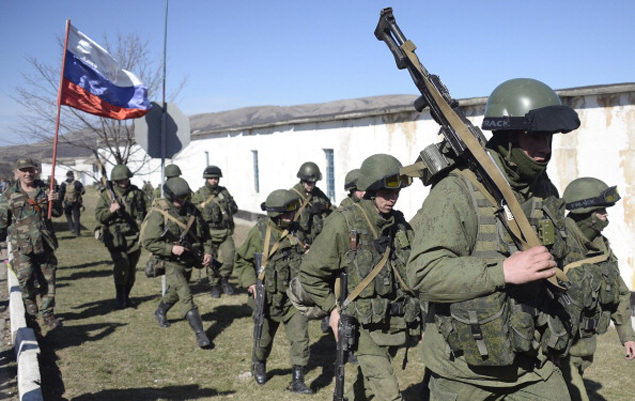
Russia Crimea Invasion. Image Source: http://gqm.ag/1DytGqu
However, before the disagreements took a more serious turn, the Obama administration had sought to “re-set” relations with Russia as a result of which both the countries were found cooperating on various occasions and on vital issues of international relevance, albeit only for a limited period. The Strategic Arms Reduction Treaty in April 2010; Moscow’s tougher stance on Iran over its alleged nuclear weapons policy in June 2010; the accession of Russia to the World Trade Organization in August 2012; and Moscow allowing American forces to transit through Russia in and out of Afghanistan—an important step as U.S. cuts down the presence of combat troops there—had set the positive tone for improved bilateral relations between the two countries. However, Obama Administration’s efforts to reset US-Russia relations were beset with difficulties during election periods in both the U.S.A and Russia. The legislative and other actions that were being taken in these countries in 2012 and 2013 could also be sited as reasons that upset the reset. In late 2012, Russia ousted the US Agency for International Development (USAID) from the country and criticized the help that USAID had provided over the years as unnecessary and intrusive. The discomfort shared between Putin and Obama has now turned into open hostility with the annexation of Crimea into the Russian Federation. However, even though the current estrangement is strongly reminiscent of the Cold War era, whether their relations are veering towards another Cold War is subject to greater debate.
The Crimean effect
There is little doubt that the US-Russia relations worsened following Russia’s deployment of military forces to Crimea at the end of February 2014 which resulted in President Obama’s cancelling plans to attend a G8 meeting which was to be hosted by Russia in Sochi in June 2014. Some bilateral trade talks were also halted, the Defense Department suspended military-to-military contacts, a visa ban and asset freeze and other sanctions against Russia were imposed by the Obama administration. President Obama issued further executive orders sanctioning individuals along with the Rossiya bank for supporting Russian oligarchs. A revised G7 meeting on March 24 2014 announced that Russia was suspended from further proceedings. President Obama also argued that Russia’s annexation of Crimea violated the international system of law and democracy by violating Ukraine’s territorial integrity and sovereignty. However, Putin emphasized the long history of Russian domination over Ukraine and viewed the relationship as beneficial to both Russians and Ukrainians. He did not distinguish between Ukrainian and Russian national identity, asserting that both nations were “one people”. He stressed that “Crimea has always been an inseparable part of Russia.” The Russian president asserted that Crimean had the same right to self-determination as Ukraine itself took in 1991 and also averred that since Kosovo Albanians were encouraged by the United States and the West to claim independence, then there’s little reason behind Russians, Ukrainians, and Crimean Tatars not doing the same. It is more than apparent today that the disputes between the two countries are serious and run the risk of being long-term. However, despite the several sanctions which have come from both countries following the Crimea annexation, it would perhaps still be an exaggeration to contend that the world is ready to witness another Cold War.
The bipolar world divided between two differing ideologies is not what today’s world scenario represents. 21st century is recognizable as a unipolar world with strong multipolar tendencies. National economies have been tied into the global economy resulting in an almost incestuous interdependence between states. A globalized world isn’t too conducive to a Cold War. However, the relations between United States and Russia have been hinting at the approaching possibility.
The containment policy is especially relevant in this regard. Numerous sanctions have been imposed on Russia following the annexation, rules have also been laid out on appropriate political behaviour expected of Putin’s presidency. United States on many vital issues has stopped co-operating with Russia. Russia does not seem to be on the path of withdrawal. However, despite the global political opinion America has tried to build against Russia, there are many countries including the likes of India, China and Brazil who have refused to condemn the Crimean annexation.
Growing world powers
The privilege that the USA once enjoyed by virtue of its being the leading capitalist in the world is waning as the world has become more globalized and several core countries from the Global North have come to dominate the international scene more assertively. These countries won’t sacrifice their national interest for the sake of a misplaced sense of solidarity with the United States. Russia is still a nuclear superpower. It is also the only country in the world to have been blessed with a greater range of natural resources than the United States, including oil and gas reserves. It is the world’s second-largest producer and exporter of oil, after Saudi Arabia, and also the world’s largest exporter of natural gas. It has a large, reasonably well-educated labor force and scientific establishment. All these make a bad case for Russian isolation in the international arena.
It is, also, for these reasons that Russia is vital to America’s own interests. If American interests are identified with nuclear non-proliferation, stabilizing the Middle East, obtaining energy supplies and also improving ties with Europe at large, Russia becomes important for it. Russia has a significant role to play in the future of arms control, the nonproliferation of weapons of mass destruction (WMD), and the fight against terrorism. When a reset of relations was sought by the Obama administration, it was certainly not done out of diplomatic benevolence. After the annexation of Crimea, when President Obama reminded Russia of its own cooperative efforts in the past and how greatly Russia was acknowledged for it. Obama spoke of occasions when the U.S. administration had attempted to strengthen U.S.-Russian ties as well as encourage Russian engagement with the world by backing Russia’s membership to the WTO and through the enlargement of the G-7 to the G-8. Obama said the world had benefited from times when Russia chose to cooperate on such issues as Syria’s chemical weapons and the reduction of nuclear weapons. Obama had also been heard admitting that the U.S. is not seeking a conflict with Russia and that it is in America’s interest for Russia to be a strong state, not a weak one. This does not resemble the Cold War scenario where U.S.A’s strength was drawn from Russia’s weaknesses and all cooperative efforts were nullified.
Also, the persistent bloc politics, absent today, helped sustaining the shifting power dynamics between the two countries during the Cold War era. But one cannot assertively dismiss the renewed possibility of a Cold War between Moscow and Washington of a different kind. America’s enduring hegemony in the post Cold War era following the collapse of Soviet Union does not today find favour with even the once staunch U.S. allies, not to mention the great power ambitions of those aspirational states who refuse to labour under the shadow of America. These states could look for a possible ally in Russia to challenge the unipole. It could bring Russia closer to forming a bloc, albeit covertly since America’s dominance cannot be openly dismissed in the international space yet. Russia has been wanting to be an equal with the United States in managing global politics since the time of Yeltsin, the need which was only intensified with Putin’s aggressive diplomacy aimed at creating a counterbalance to the West.
Ethical opposition
Putin has also added an ethical dimension in his opposition to America. He says the West has brought about its own moral decadence by rejecting “the Christian values that formed the foundations of Western civilization”. This may said to have been done with an eye to amass support among the deeply conservative Russian population, more traditional societies across the world, and even the conservative groups in the West, as scholars have argued. Even though this Cold War like tension between the two countries isn’t ideological, the advocacy of traditionalism by Putin might provide an ideological ground for the discordant ties. This makes for a wholesome opposition of America and its values, on the one hand, and an assertion of what Russia stands for, on the other.
Russia is trying to provide the world with not only a political alternative to the West but also a socio-cultural one. That Russia is not afraid of challenging the post Cold War order in Europe was perhaps certain with the Georgian War as early as 2008. But Russia should be wary of the United States as it still has the sole advantage of being the unipole. Russian economy did start growing from 1999 but have registered slow growth since 2013 and its military capability isn’t a patch on America’s. Dealing with such acute limitations, it is difficult for Russia to indulge in a Cold War with America similar to the one the world witnessed when both were superpowers of a bipolar world. Given the world scenario today, America can afford to not count the losses it would incur in aggressively constraining Russian action on a variety of functional and geopolitical matters, if matters worsen. This would compel us to consider the resemblance of such circumstances with those of the Cold War era. But the New Cold War would not have a look of the old definition or structure but create its own.
If Russia manages to engage in a New Cold War with the United States, dismissing its warnings and sanctions, the unipolar world may soon become a matter of international history. However, posing a consistent challenge to the authority of United States could become a costly enterprise for a Russia which is still recovering from the shock of disintegration it suffered in 1991. Given the slow economic growth, an increased defense spending will cost Russia dearly. Also, since Putin’s authoritarianism thrives on the fundamental differences between U.S. and Russia, the relations between Moscow and Washington are unlikely to register improvement as long as he remains in power. Putin can indulge in aggressive political behaviour in the international space and cause Russia grave misfortune and then avert the blame for his misdemeanor to the hostility of United States. He can justify any internal damage on external factors and continue feeding the Cold War like uneasiness as long as his presidency is secured. Hence, as far as political predictions go, there is little scope for improvement between the United States and Russia in the near future. However, democratization of Russia and a growing public discontent against conflictual ties it shares with the United States, can lead to some improvement of the situation. Since Russia is significant to America’s own interests, any talk of improvement if comes from a reasonable place won’t be disregarded by it.
Coming to the ongoing debate on whether America and Russia are engaged in a Cold War, there is a need to rethink our past conceptions on what constitutes a Cold War. The possibility that alternative definitions of the Cold War can emerge out of ongoing debates is in need of recognition. A world that is characterized by inconsistencies and consistent shifts in power centers and dynamics, it is naive to stick to old narratives, theories and definitions. But perhaps it would have been better if the need to debate over terminologies did not appear in the first place. 2014 did not fuel hopes in that direction. If the coming years render such discussions redundant, the world would be better off.
About the Author





