
For five years Mercy Onsando went to primary school on her mother’s back, each day the same as the first day. Some of her classmates laughed, others were too scared to look at her thinking she is contagious, while the teachers thought her father must have defaulted on paying her mother’s dowry price, thus the curse.
Although her mother put on a brave face for her, she was very depressed, blaming herself for what happened to her daughter. After all, Mercy was born a very healthy baby and her parents remembered celebrating her first steps. In one dreadful day when she was six years old Mercy developed a fever and started swelling. Only a few days later, she couldn’t walk. Living in a village with limited medical facilities in Kenya’s central province, it was long before Mercy knew what was ailing her. After a year of suffering, Mercy was diagnosed with Polio at Kenyatta Hospital after being admitted for three weeks.
Unfortunately, the struggle did not end there for Mercy. Life would never be ‘normal’ for her. There was no cure for her weak and paining limbs. However, up until high school, she went for therapy sessions which allowed her hands to function normally. After struggling with a walking stick, Mercy finally got her walking crutches in the year 1993.
“Even though the walking stick was more difficult, the walking crutches gave me sores on my hands because of my weight and legs not being of much help. The cracks on my hands took ages to heal”, said Mercy.
Mercy had a life-changing surgery subsequent to completing her high school education. After six hours of operation, her feet were surgically improved to enable her to wear normal shoes instead of the customized shoes that were designed for her deformed feet.
Medical bills are a financial burden that most people with disability have to struggle with and Mercy was fortunate to have met a missionary worker who has ever since financed her health checkups. For instance crutches are very expensive costing at least 2500 Kenyan Shillings; yet they break often and can’t be repaired once broken.
It was after her diagnosis that Mercy’s parents found out about the immunization programme. It was too late to save her but there was still time to save her younger eight siblings. Her parents blamed the busy schedule of their business and lack of information concerning the importance of immunization.
![Image Source: AP Photo/Khalid Mohammed [http://dailym.ai/1zR0fCp]](http://archive.the-ipf.com/wp-content/uploads/2015/05/Polio_Image-1-300x200.jpg)
Image Source: AP Photo/Khalid Mohammed [http://dailym.ai/1zR0fCp]
The World Health Organization prequalifies all the vaccines in the world therefore ensuring safety and quality, the organization affirms that there are those who miss out on inoculation leading to at least 3 million children’s death every year.
“Diseases kill and if you are lucky to survive, you have a lifetime disability. Disability is painful, it is dehumanizing, it robs one of their potentials.” Said Senator Harold Kipchumba, during the Immunization Week marked in Kenya on the last week of April.
The success of immunization depends on information available to the public. People’s actions are influenced by what they know, hear, read, are advised by third parties, or personal or faith-based persuasions, further asserted the senator.
The government of Kenya reports that three quarters of all children in Kenya have been fully immunized, while those that have not been reached are reported to be at least 240,000. The increase in immunization efforts has been attributed to more than half the number of women giving birth in Kenya are delivering in hospitals. Plus free treatment of children under the age of five years has led to increase in children accessing immunization. Since the vaccines are free, this is said to have averted at least 30,000 deaths.
Recent Polio campaigns by the government and the Beyond Zero Campaign by the first lady of Kenya, Mrs. Margaret Kenyatta have drawn the attention of the public to immunization in Kenya. However there was a decrease in number of children being vaccinated during the year 2008 to 2009 because of the post-election violence experienced in the country.
The immunization programme is one of the longest-standing ways of controlling diseases in the world, diseases that can cause havoc and have life-altering effects. The reason why the modern world does not know diseases that killed masses such as whooping cough and measles is because of preventable medicine.
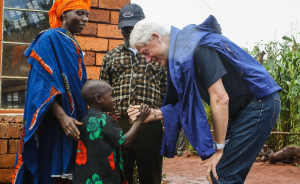
Image Source: http://bit.ly/1cFAUkX
As for Mercy the misfortune of becoming infected didn’t defeat her. The now 45 year old woman holds a Doctorate in Philosophy and Education from Pan-African University, the same place she met the love of her life, her husband Reverend Kefa Onsambo. While Dr. Mercy is grateful for her accomplishments, she lives to warn others not to make the mistake of taking immunization lightly.
Dr. Mercy Onsambo takes the time to remind everyone that immunization is something that takes barely five minutes but bridges the thin line between life and death.
About the Author





