
The world cup is almost upon us! How similar is international football and international politics?
At their roots, these are bodies in which both try to create legal level playing fields, whereby all participants know where they stand and what is and is not acceptable.
Football tried to have internationally agreed rules (and a governing body) to make sure that everyone played the same game, using the same rules. This was FIFA which, while facing a lot of opposition initially from countries such as Britain amidst fear that the national Football Association (FA) would lose much of its power, has become the overarching footballing power.
Attempts to create rules and a governing body that is obeyed in international politics is far harder to achieve. In much the same way as football, there are clear gains to be had from everyone agreeing on certain rules and the possibility of a global referee who can decide when such rules are broken and when punishment should be given. In the long term, this is necessary for the continuation of relations between countries; which relies upon trust to continue with the ‘rules of the game’.
The power distributions in both football and politics leads to global laws which are unfair to those smaller, less established states at the expense of larger, more developed ones. Comparing the IMF (as a figure head of western influences in the global economic order) and FIFA brings about some interesting similarities. For example, both decide if other nations can join based on certain principles which they hold to be necessary to engage in trade/matches respectively. The IMF do this by assessing the economy and potential for growth while FIFA inspect facilities and engages in discussions with government officials. In both football and politics, smaller, less developed countries are often penalised by severe and bureaucratic processes which prevent them from participating on a level playing field. These problems can occur for minor reasons, such as not being able to correctly fill out paperwork which “comes with expertise and knowledge”.
Despite these barriers to participation, in both these areas, the rise of non-western states has upset the balance. Now, the global order must increasingly take into account the interests of these groups and thus change their respective set-ups.
The existing power relations between footballing regional bodies is most clearly seen in the distribution of 32 World Cup places wherein Europe has 13 places and Asia, Africa and Oceania only 10 between them. Although, this is already an improvement on previous tournaments and further change toward equity is expected. This has largely been possible due to the expansion of the number of teams taking part in the World Cup. Despite this, UEFA remain a leading player in negotiations.
The increase in the number of participants is also true in international politics where there is a clear increase in the number of parties involved in debates; as seen through the creation of the G20 (rather than the G8). However, despite this positive change towards greater inclusivity, the security council at the UN has 15 members, 5 of which are western European or ‘others’ (including USA) 3 of whom are permanent members and thus have a veto power.
The importance of rules in football is such that there are certain ones (even if these are implicit) that are followed no matter what. In the past, and even today amongst most true fans of the game, a display of good skill is applauded. There also remains a sense of gentlemanly sportsmanship that the media frequently fails to acknowledge when discussing the moral reprehensible nature of a player diving- when a player is fouled and the referee stops the game then the defending team is, in the unwritten laws of the game, meant to kick the ball back to the attacking team at which point there is a general round of applause for this fair act. Not only does this returning of the ball happen on almost every occasion that the referee stops play but so does this round of applause from both teams and both sets of fans. This happens at both grassroots and professional levels at local and international matches.
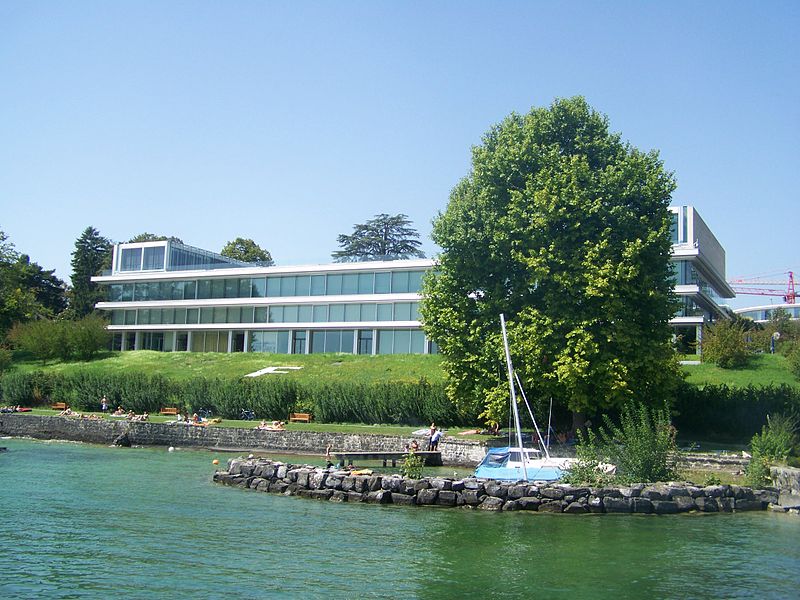
Building of UEFA (Union of European Football Associations) situated in Nyon, Switzerland. Image credit: Florian Pépellin
Money, and market forces, in both politics and football are everywhere and it brings a huge amount of influence in both. There is a clear historical trend for both whereby they went from being amateur pursuits to professions. Big business and billionaires now own and control football and are totally separated both socio-economically but also increasingly geographically from the fans. This is shown by the huge amounts required to be spent to sponsor the world cup 2010 which was $125 million US dollars. In much the same way, big businesses and billionaires increasingly own much of the infrastructure and set the agenda for the international political stage. One need only look at the money poured into lobbying (formal and informal) across the world to recognise this growing trend. Corporate power has incredible power over both footballing and political bodies.
Finally, people are passionate about football and can talk endlessly about it in pubs up and down Britain, there are newspapers across the world dedicated to it. Watching a game and shouting at a TV screen in a pub matters because you think you can change the outcome. Despite the varied identities of the club, the players and the supporters, none of it matters during the time spent playing football as they come together. Why does politics not evoke such emotion? In the build up to the World Cup, shouldn’t questions about the political situation and the riots In Brazil evoke as much emotion as whether Cleverley should make the England squad?
About the Author






Recent scandal of treatment of construction workers in in Dubai, and over-expenditure in Brasil where infrastructure for the indigenous population is so poor, brings international football smack ito the field of politics. How right you are.
Interesting piece Joe. Enjoy Brazil!
[…] Football And Politics: More Similar Than We Think? […]